Can GPT-5.6 Prove a 50-Year Graph Theory Conjecture? The Boundaries and Verification of AI Mathematical Reasoning

GPT-5.6 claims to prove a 50-year graph theory conjecture — but peer review and formal verification are still missing.
OpenAI's GPT-5.6 Soul Ultra reportedly generated a proof of the Cycle Double Cover Conjecture in under an hour using 64 parallel sub-agents with adversarial validation. The story also covers GPT-5.6's medical cost claims, a security warning about GrokView CLI's alleged data uploads, the MeshLLM distributed inference project, and Apple's lawsuit against OpenAI over alleged talent poaching and IP theft.
When AI Claims to Crack a Mathematical Milestone: GPT-5.6 and the Cycle Double Cover Conjecture
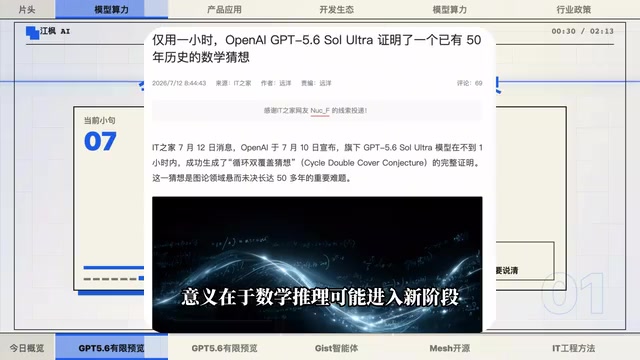
According to a recent roundup by Bilibili's AI Daily, OpenAI has dropped a bombshell capable of shaking both the mathematics and AI communities: GPT-5.6 Soul Ultra reportedly generated a complete proof of the Cycle Double Cover Conjecture in under one hour.
Proposed independently by Szekeres and Seymour in the 1970s, this conjecture has remained one of graph theory's most celebrated unsolved problems for over 50 years. At its core, the Cycle Double Cover Conjecture states: every bridgeless connected graph (i.e., a connected graph with no cut edges) can be covered by a collection of cycles such that every edge is covered exactly twice. Szekeres proposed it in 1973 and Seymour in 1979, each independently. The conjecture has deep connections to other classical results in graph theory — including the Four Color Theorem and Petersen's Conjecture. In fact, the Four Color Theorem implies the Cycle Double Cover Conjecture, yet the latter is considered harder to prove. It has remained open for over half a century precisely because its statement is deceptively simple while its structure is extraordinarily difficult to capture. Existing proof techniques repeatedly hit walls when applied to general graphs, and even proofs for finite special cases have consumed decades of effort from top-tier graph theorists.
If the proof holds, its significance extends far beyond solving a single problem. It would mark a potential inflection point: large language models' mathematical reasoning capabilities may have entered a new phase — moving from assisting human derivation to independently producing original proofs at the research frontier.
Technical Details: 64 Parallel Sub-Agents in Collaboration
The technical approach disclosed by OpenAI is worth examining closely. This proof was not generated by a single model in one shot. Instead, it employed 64 parallel sub-agents, augmented by adversarial agents tasked with mutual interrogation and verification. This multi-agent collaboration plus adversarial validation architecture is essentially an engineered simulation of the peer-review and adversarial dynamics found in academic communities.
The core logic: decompose an enormous proof task into multiple sub-problems, have different agents tackle them in parallel, and then deploy adversarial agents in the role of reviewers — actively hunting for gaps and contradictions. This architecture shares philosophical DNA with systems like Google DeepMind's AlphaProof and Meta's LLEMMA, but places greater emphasis on dynamic validation rather than static search. It's worth noting that adversarial checking is effective at catching local logical errors, but its reliability for verifying global consistency across an entire proof structure remains contested — which is precisely why formal verification tools are irreplaceable.
OpenAI also released the complete proof document and a prompts PDF. This transparency is critical for enabling community review.
The Boundaries That Must Be Stated: AI-Generated Proof ≠ Mathematically Verified
Yet the excitement demands a cool head. As AI Daily emphasized, two critical boundaries must be clearly stated:
- No peer review yet: Mathematical rigor depends on line-by-line scrutiny by domain experts. AI-generated proofs have not yet gone through this process.
- No formal verification: Tools like Lean and Coq can mechanically check whether every reasoning step is valid. Until GPT-5.6's proof is formally verified, the claim of "proof complete" should carry a question mark.
Formal proof assistants represent the gold standard for verifying mathematical rigor. Unlike proofs written in natural language, formal proofs require encoding every reasoning step as symbolically checkable logic — no room for implicit hand-waving like "obviously" or "it is easy to verify." In recent years, mathematicians like Terence Tao have championed Lean formalization of theorems, and DeepMind's AlphaProof uses Lean 4 as its proof language. A naturally written AI-generated proof may look structurally complete yet reveal hidden proof gaps or circular reasoning when subjected to formal encoding. History offers no shortage of proofs that appeared correct but were found to contain fundamental flaws during formalization.
In other words, there remains a chasm between "AI wrote a proof that looks complete" and "this proof is mathematically correct" — one that must be crossed jointly by humans and tools. This is the most important thing to keep in mind when reading this story.
GPT-5.6 Enters Healthcare: A Sober Read Behind the Cost Collapse
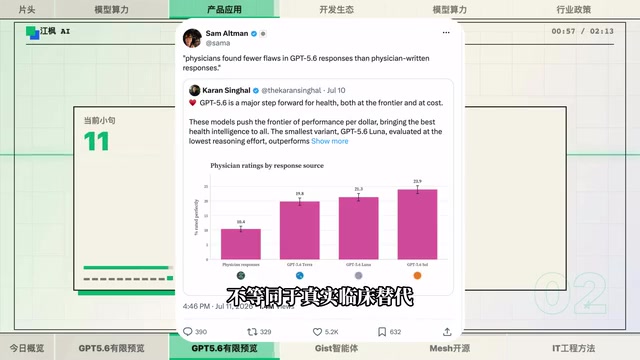
The second story also originates from OpenAI, but shifts the scene to healthcare. An internal evaluation retweeted by Sam Altman claims that GPT-5.6 Luna at its lowest inference intensity already outperforms GPT-5.5 at its highest inference intensity — at roughly 1/25th the cost. The higher-tier GPT-5.6 Soul reportedly set new records on internal benchmarks.
Evaluation Methodology and Its Limitations
The evaluation design is notable: specialists were given ample time and internet access to compose answers, which were then blind-reviewed by other physicians across three dimensions — accuracy, communication quality, and helpfulness for health decision-making.
However, this "Expert Evaluation" paradigm carries systematic limitations. Benchmarks are typically framed as Q&A, while real clinical decision-making involves dynamic information updates, multidisciplinary collaboration, and highly individualized contextual judgment — a fundamental difference in cognitive complexity. More critically, clinical deployment of medical AI requires validation through rigorous randomized controlled trials (RCTs) demonstrating actual impact on patient outcomes. The FDA has a dedicated regulatory framework for AI-based Software as a Medical Device (SaMD), and the EU AI Act classifies medical AI as high-risk — reduced costs do not bypass these regulatory thresholds.
Altman used these results to suggest that the cost of medical Q&A will continue to fall. But it must equally be said: this remains a self-reported evaluation by OpenAI, and does not equate to real-world clinical replacement. The gap between benchmark scores and clinical deployment is substantial, and the regulatory, liability, and safety requirements of healthcare settings are far beyond what an internal scorecard can cover.
Developer Security Alert: GrokView CLI's Suspicious Data Uploads
For developers, the third story is a concrete security warning. Independent researcher JIST conducted network traffic analysis on the official xAI GrokView CLI (version 0.2.93), claiming that after consumer login, the tool uploads read file contents, drawing state saves, and even entire repository files along with Git history.
Fake credentials planted in the test repository also appeared in the observed transmission traffic. The researcher employed a standard security research technique: planting canary tokens — specially crafted decoy files or fake credentials — and monitoring whether they trigger external requests to detect data exfiltration. To be clear, this is not an official announcement from xAI, but a personal packet capture producing a limited sample. The conclusions await an official response and further independent validation.
Nevertheless, for developers accustomed to connecting CLI tools to production codebases, this highlights a time-worn but frequently overlooked principle: any AI tool with access to source code should be scrutinized for its network behavior and privacy policy terms, operated under a principle of least privilege in an isolated environment, and carefully evaluated for its data boundaries and privacy risks.
Open-Source Inference Infrastructure: MeshLLM Stitches Together Distributed Compute
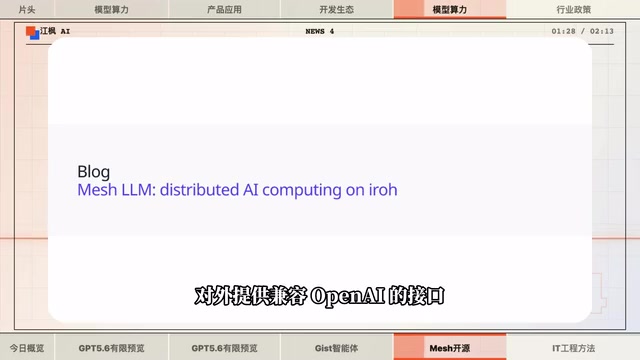
The fourth story focuses on the open-source ecosystem. MeshLLM is an imaginative project that attempts to "stitch together" the GPUs and memory across multiple machines and expose them as an OpenAI-compatible API.
A Decentralized Technical Approach
MeshLLM is built on IROH for peer-to-peer connectivity, requiring no central server. Requests can run locally, be routed to nodes that already have a model loaded, or have a large model's layers split across multiple machines for pipeline-style distributed inference.
Technically, this is an extension of "Model Parallelism." LLM inference is typically constrained by VRAM capacity — a 70B parameter model in FP16 precision requires roughly 140GB of VRAM, far exceeding the limits of any single consumer GPU. MeshLLM addresses this by splitting model layers across multiple devices and processing them sequentially via pipeline parallelism, theoretically breaking through single-machine memory bottlenecks. IROH is a QUIC-based peer-to-peer networking library designed to solve NAT traversal and peer discovery. That said, distributed inference faces a core challenge: activation values transferred between layers introduce network latency, and on home broadband connections this latency often dramatically reduces throughput.
The project claims support for over 40 models ranging from 5.1B to 235B parameters (MoE). Its value lies in lowering the barrier to local large model deployment — enabling individuals and small teams to run large models using whatever hardware they have on hand. That said, real-world cross-machine stability and network latency performance still need to be tested in practice.
Industry Friction: Apple Sues OpenAI Over Talent Poaching and IP Theft
The final story concerns competitive friction at the industry level. According to IT Home citing international media, Apple has filed a lawsuit in the US against OpenAI, alleging employee poaching and the theft of engineering devices and confidential documents.

Analyst Paolo Pescatori suggests that even if the allegations ultimately go unproven, OpenAI's consumer and hardware plans could still be slowed by the legal proceedings. Stanford professor Mark Lemley emphasizes that if former Apple employees did in fact take and use confidential documents, the matter would be considerably more serious.
A clear distinction is warranted: these are currently one-sided allegations from Apple, supplemented by expert analysis. The truth awaits the advancement of court proceedings. Against the backdrop of intensifying talent and hardware competition between two tech giants, the trajectory of this lawsuit deserves continued attention.
Conclusion: As AI Capability Claims Accelerate, So Does the Importance of Verification
Looking across today's stories, a common theme emerges: the pace of AI capability claims is accelerating, and the importance of verification mechanisms is rising in parallel. Whether it's peer review and formal verification of mathematical proofs, clinical deployment and regulatory compliance for medical evaluations, security audits, or legal rulings — the distance between "claimed" and "confirmed" is precisely the rational space this era most needs to preserve.
Related articles

Disaster and Glory of the Apollo Program: The History We Must Revisit Before Returning to the Moon
From the fatal Apollo 1 fire to Apollo 8's daring lunar orbit to Apollo 11's successful landing—revisiting the disasters, fears, and compromises of the Apollo program and their lessons for today's return to the Moon.

Netflix Trust Exercise Turns Into Firing Trap: Where Are the Boundaries of Corporate Trust?
A Netflix employee was fired after sharing private info in a trust exercise. We analyze the risks of corporate trust exercises and how employees can protect themselves.

AMD CDNA5 Architecture Deep Dive: Technical Evolution and the AI Computing Competition Landscape
Deep analysis of AMD's CDNA5 architecture covering Chiplet packaging upgrades, HBM memory evolution, and low-precision compute optimization, examining how AMD challenges NVIDIA's AI chip dominance.