Can Large Models Tell Stories in Reverse? Non-Linear Narrative Benchmark Reveals Capability Boundaries

New research shows LLMs default to linear narrative and struggle to truly master non-linear storytelling.
A new study built a benchmark of 83 published works to evaluate language models' non-linear storytelling. Each work was annotated with dual event orderings, causal dependencies, character knowledge states, and suspense structures, forming story graphs. Across 19 models, outputs skewed more linear than human works; when asked for specific structures, only about half fell in the human range. In 81% of decisive judgments, 71 human readers found requested non-linear versions harder to follow, and preferred story-graph-generated stories (72%), a difference automated evaluation missed. Core conclusion: following rearrangement instructions is not the same as true non-linear narrative ability.
Every story has two orders: the order in which events happen, and the order in which they are told. When the two diverge, the story is non-linear—flashbacks, nested narratives, parallel threads—techniques human writers wield with ease, yet for large language models these remain a threshold not yet crossed.
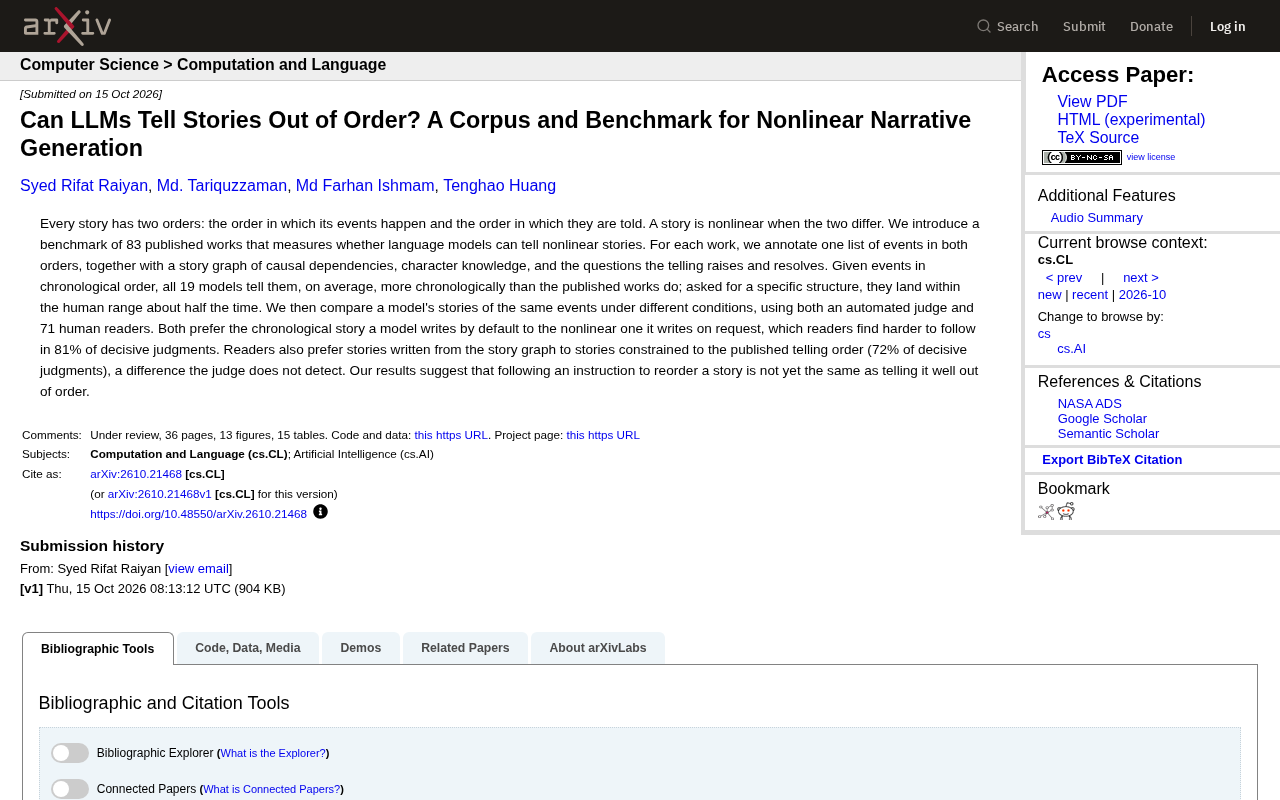
A new study has constructed a benchmark of 83 published works to systematically evaluate whether language models can tell non-linear stories. The research team annotated two orderings of the same set of events for each work, and built a story graph recording causal dependencies, character knowledge states, and the setup and payoff of suspense throughout the narrative.
Models Default to Linear Narrative
The experimental design goes straight to the core question: give the model a set of events arranged in chronological order and ask it to tell the story. The average performance across 19 models—they tend to recount events in chronological order more than published works do. In other words, models naturally choose the path of least resistance: linear narrative.
When explicitly instructed to adopt a specific narrative structure, they only land within the range of human authors about half the time. This means that even with explicit instructions, the model's control over narrative structure remains unstable.
This finding aligns with everyday user experience: ask an AI to write a flashback story, and it may place a flashback scene at the beginning before quickly reverting to linear progression. True non-linear narrative requires maintaining interwoven timelines across the entire story, placing higher demands on the model's global planning capabilities.
Story graphs are the core analytical tool in this research. It is not a traditional plot outline, but a structured representation: nodes represent story events, and directed edges carry three types of key information—causal dependencies between events (which event caused which), character knowledge states at each point in time (when a character learns a secret), and the setup-and-payoff relationships of suspense (where a mystery is planted and where it is revealed). This representation enables researchers to precisely characterize the narrative differences produced by "the same set of events, told in different orders." The significance of the story graph lies in transforming "non-linearity" from a vague literary impression into a computable structural property, thereby making the model's narrative capabilities measurable and comparable.
Reader Preferences Reveal Deeper Issues
The research team further compared model outputs for the same set of events under different conditions, using both automated evaluation and assessment by 71 human readers.
The results show a clear preference difference: both automated evaluation and human readers prefer the linear stories models produce by default over the non-linear versions produced on request. In human readers' decisive judgments, 81% found the non-linear versions harder to follow.
Even more intriguing is another comparison: readers prefer stories generated from story graphs over stories constrained by the published narrative order—in 72% of decisive judgments. But automated evaluation did not detect this difference. This suggests that current automated evaluation tools have blind spots in perceiving narrative quality, and human readers' judgments remain irreplaceable.
The "decisive judgments" that recur throughout the study refer to feedback in human reader evaluations that clearly expresses a preference rather than being neutral or hesitant. The emphasis on decisive judgments is because in subjective narrative evaluations, a large number of mild or ambiguous ratings can dilute genuine preference signals. When researchers count only judgments where readers give a clear inclination, differences often become clearer—for example, the two key percentages of 81% and 72% both come from subsets of decisive judgments. This statistical approach is particularly important in narrative quality assessment, because readers' feelings about whether a story is "good" are typically strong but difficult to quantify, and focusing on samples with clear inclinations can more reliably reveal the true gap between model outputs and human preferences.
Instruction Following Is Not Narrative Ability
The core conclusion of this research bears repeated reflection: following instructions to rearrange a story and truly telling a good non-linear story are currently not the same thing.
Models can execute local operations like "put the third paragraph at the beginning," but struggle to construct and maintain a carefully designed non-linear narrative structure at the global level. The story graph method outperforms directly constraining narrative order, suggesting a possible improvement path—have the model first understand the causal relationships between events and character knowledge states, then decide how to tell the story, rather than simply rearranging a list of events.
For developers and users of AI writing tools, this means maintaining reasonable expectations about models' narrative structure capabilities at the current stage. Having models assist with linear narrative generation or simple timeline adjustments is feasible, but complex non-linear narrative design still requires deep involvement from human creators.
The Benchmark's Value and Limitations
The benchmark of 83 published works provides a comparable yardstick for future research. The annotation system covers dual event orderings, causal graphs, character knowledge, and suspense structures, with relatively complete dimensions.
However, the benchmark scale is limited and concentrated on published works from specific languages and cultural backgrounds. Different narrative traditions vary considerably in their preference for non-linear structures, and cross-cultural narrative capability assessment remains a blank. Additionally, while the sample of 71 human readers can provide valuable signals, it is still far from large-scale user studies.
Non-linear narrative is an important component of the art of human storytelling. From One Hundred Years of Solitude to Pulp Fiction, the clever arrangement of timelines is often the core source of a work's appeal. For language models to truly master this craft, they may need to explicitly model narrative structure during training, rather than implicitly acquiring it from massive text corpora.
Narrative traditions' cross-cultural differences are key background for understanding the limitations of this research. Different literary traditions have markedly different preferences for handling timelines: Latin American magical realism (such as One Hundred Years of Solitude) often interweaves and juxtaposes timelines across generations, modern Japanese fiction (such as the works of Ryūnosuke Akutagawa) favors fragmented memory collage, while classical Chinese chapter novels mostly follow linear chronology, supplemented by parallel narration in the style of "one flower blooming into two branches." This means that a benchmark trained on Western published works may systematically underestimate or misjudge model performance in other narrative traditions. The assessment gap in cross-cultural narrative capability concerns not only the benchmark's scope of applicability, but also whether models can serve diverse creative needs globally.
Background Supplement
Global planning capability is a key cognitive dimension for understanding models' non-linear narrative difficulties. In cognitive science, planning a non-linear story requires the author to simultaneously maintain multiple information streams: the current point in the narrative timeline, how much information each character possesses at that moment, what the reader is allowed to know, and the open or closed status of suspense. Human writers can internalize this multi-threaded management through long-term training, but language models' generation mechanism is word-by-word prediction, lacking explicit global state maintenance. Even if a model can generate a flashback passage locally, it struggles to continuously track the misalignment between "what the reader knows" and "what the character knows" across the entire story span. This is precisely why the story graph method—first having the model understand the causal and knowledge structures between events, then deciding narrative order—performs better in experiments: it transforms implicit global planning into explicit structured input, partially compensating for the model's structural shortcomings in long-range narrative control.
One-line Summary
New research shows large language models default to linear narrative and struggle to truly master non-linear storytelling.
Paragraph Summary
A new study constructed a benchmark of 83 published works to systematically evaluate language models' ability to tell non-linear stories. The research annotated dual event orderings, causal dependencies, character knowledge states, and suspense structures for each work, forming story graphs. Results show that across 19 models, average outputs tend more toward linear narrative than human works; when asked to adopt specific narrative structures, only about half fall within the human performance range. In 81% of decisive judgments, 71 human readers found the requested non-linear versions harder to follow, and readers preferred stories generated from story graphs (72%), but automated evaluation failed to detect this difference. The core conclusion: following rearrangement instructions and truly possessing non-linear narrative ability are not the same thing, and models still have clear shortcomings in global narrative planning.
Related articles

Amphibious Transforming Drone: Beyond 100x Power Savings, What Are the Real Needs?
Is the amphibious transforming drone just a gimmick? Starting from the 100x power difference of the M4 Morphobot, explore real application scenarios and thesis topic ideas, analyzing boundary conditions where pure drones and pure ground robots both fail.

Warhound Raises $200 Million: Genetically Engineered "War Dogs" Paired with Anduril Gear
Warhound raises $200M, backed by Ben Lamm and Palmer Luckey, to genetically engineer dogs for military and law enforcement use and equip them with Anduril gear. This article analyzes its technology direction, funding logic, and ethical controversy.

Claude API Comes to Google Cloud: IAM Integration and SDK Access Guide
Anthropic hosts the full Claude API on Google Cloud with IAM-controlled permissions and unified billing. This guide covers the Vertex AI and Anthropic-hosted entry points, IAM role configuration, and SDK access.