Can Model Weights Be Interpreted? New Claims About Qwen and GPT Spark Discussion

Reddit claim that Qwen 3.8 27B can interpret model weights like GPT-6 Astra sparks debate despite lacking evidence.
A Reddit post claims Qwen 3.8 27B and GPT-6 Astra can "interpret model weights," meaning a model can analyze another set of parameters. The claim lacks technical details and verification, and the version names don't match public info. The article explains model weights and interpretability, noting weight-space learning and hypernetworks make this theoretically possible, but no public evidence shows general LLMs can do it zero-shot. If true, it could advance model safety, editing, and transparency. A rational wait for official responses or reproducible experiments is advised.
Recently, a post on Reddit sparked discussion in the AI community: a user claimed that Qwen 3.8 27B, like GPT-6 Astra, can "interpret model weights." The claim sounds rather sci-fi—model weights are essentially large sets of floating-point numbers obtained after training, typically regarded as a black box, yet now they seemingly can be "understood" and explained by the model itself.
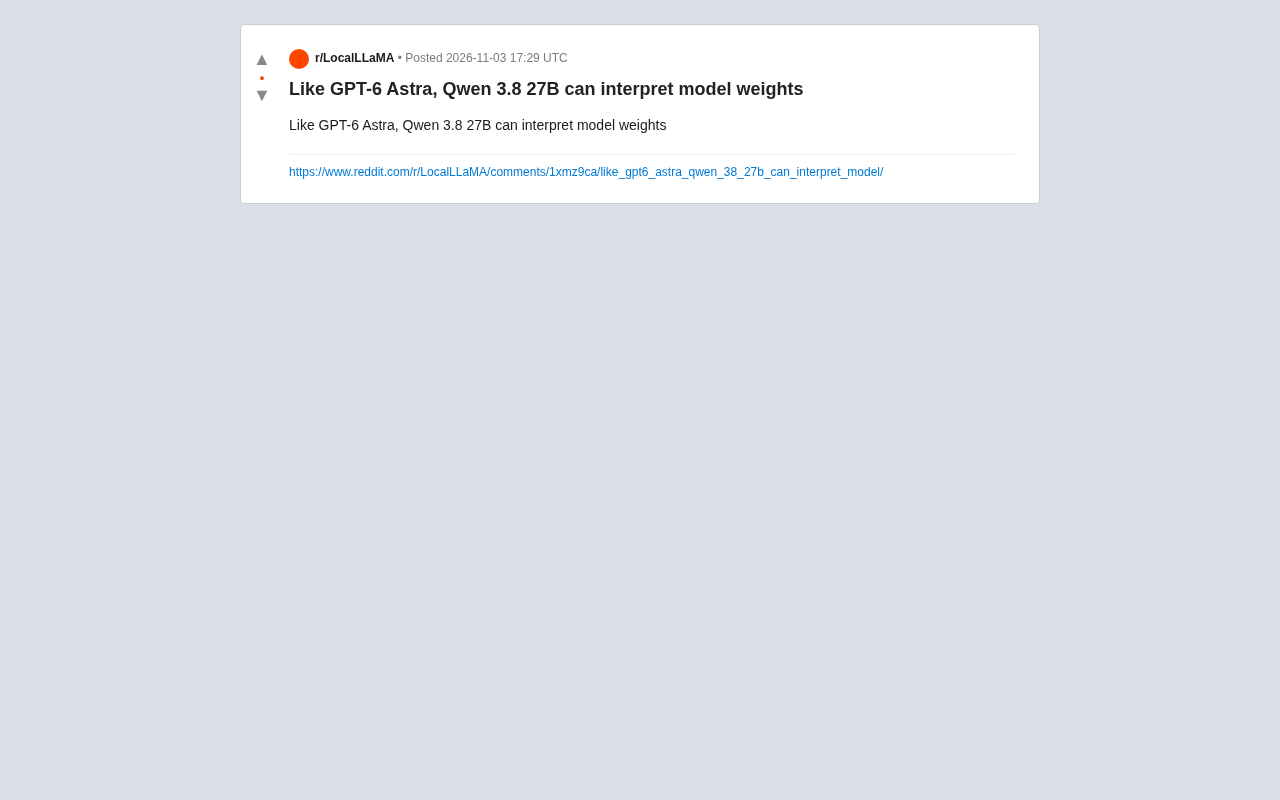
Background: A tip from Reddit
The post title was very brief: "Like GPT-6 Astra, Qwen 3.8 27B can interpret model weights." It included no further technical details, no reproduction steps, and no paper link. The poster simply juxtaposed Qwen 3.8 27B with GPT-6 Astra, implying that the two share a similar capability in "weight interpretation."
It is important to emphasize that, as of publication, this claim comes from a single community post and has not been officially confirmed or independently verified by third parties. In the AI field, similar sensational "amazing capability" claims appear from time to time, and not a few ultimately turn out to be misunderstandings, isolated cases, or marketing rhetoric. Therefore, we should treat it as a discussion starting point worth watching rather than an established fact.
What does "interpreting model weights" mean?
To understand this claim, we first need to clarify what model weights are. In neural networks, weights are parameters learned during training; they determine how the model processes input and produces output. For large language models, the number of weights can reach billions or more, usually stored as matrices.
The literal meaning of "interpreting model weights" is that a model can directly analyze another set of weights and provide a description of their structure, function, or training data. This differs from traditional "interpretability" research—the latter usually understands model behavior from the outside through probing, visualization, or causal intervention, whereas "weight interpretation" implies that the model possesses an introspective, direct understanding of the parameters themselves.
If this capability were real, it would bring entirely new possibilities for model safety, model editing, and knowledge transfer. For example, developers might be able to directly ask the model "what did a certain layer of your weights learn?" to quickly locate sources of harmful behavior or bias.
Model weights are the parameters that a neural network learns during training through backpropagation and gradient descent, typically stored as multidimensional matrices (tensors). Taking a large language model with the Transformer architecture as an example, weights include the embedding layer, the query/key/value projection matrices in the attention mechanism, the weights of feedforward network layers, and layer normalization parameters. These numerical values themselves have no intuitive semantic meaning, but their combination determines the model's behavior.
Interpretability research is a branch of AI aimed at understanding the internal workings of models. Traditional methods include: probing classifiers (training simple classifiers on hidden layers to predict certain attributes), attention visualization, causal intervention (such as activation patching), and so on. These methods usually observe model behavior from the outside rather than directly "reading" weight values. In recent years, mechanistic interpretability has attempted to decompose networks into understandable circuits, but it still requires a great deal of manual analysis.
A hypernetwork is a neural network that generates the weights of other neural networks. Given a description of a target network (such as architecture or task), a hypernetwork can output all or part of its parameters. Weight-space learning studies how to optimize or learn directly in weight space, for example by processing weight matrices with graph neural networks. These techniques show that it is theoretically feasible for neural networks to process the parameters of other networks, but this usually requires specially designed architectures and training procedures rather than a general large language model possessing the capability directly.
Technical plausibility and community reaction
From a technical perspective, having one model interpret another set of weights is not entirely unimaginable. In recent years, research on "weight-space learning" and "hypernetworks" has shown that neural networks can learn to generate or process the parameters of other networks. In addition, some work has attempted to encode weights as token sequences so that they can be processed by Transformers.
However, linking this capability to specific model names such as "Qwen 3.8 27B" and "GPT-6 Astra" currently lacks public evidence. Discussion under the Reddit post is also polarized: some users are excited, believing this is an important step toward model self-awareness; others are skeptical, asking the poster for more details and pointing out that the model version naming in the title is unusual.
Interestingly, the Qwen series of models is released by Alibaba Cloud, and version numbers are usually expressed as combinations of numbers and letters, but the version number "3.8" is not commonly seen in public materials. Likewise, "GPT-6 Astra" is not an officially announced model name from OpenAI. This further increases the uncertainty of the tip.
Encoding weights as token sequences means discretizing or quantizing floating-point weight values into tokens and then processing them with a Transformer as if they were text. For example, some studies flatten weight matrices row by row, mapping each numerical value to a token, thereby using a language model for weight prediction or analysis. However, this approach faces the curse of dimensionality and precision loss, and the model needs to be specially trained for such tasks rather than generalizing zero-shot.
Potential impact on AI research and development
Although its authenticity is doubtful, this topic still touches on several key directions in AI research.
Interpretability and transparency
The black-box nature of large models has always been a pain point in deployment. If a model could describe the role of its own weights in natural language, it would greatly lower the barrier to understanding and help auditors quickly identify potential risks.
Model editing and knowledge updating
Traditionally, modifying model knowledge requires retraining or fine-tuning. If a model could interpret weights, it might be possible to directly locate and modify the parameters corresponding to specific knowledge through instructions, achieving more precise model editing.
Safety and alignment
Weight interpretation capability could also be used to detect backdoors or malicious implants. A model could check its own weights for anomalous patterns and issue an alert before deployment.
However, these ideas all rest on the premise that the capability is real and reliable. At present, we are still quite far from this goal.
A rational view: wait for more evidence
In the AI community, sensational claims that spread quickly often require calm scrutiny. Regarding the claim that "Qwen 3.8 27B can interpret model weights," the most reasonable attitude is to stay attentive while waiting for official responses or reproducible experimental results.
If you are interested in model interpretability, you can follow relevant academic conference papers and open-source projects, where there is more peer-reviewed research for reference. As for this Reddit post, it is more like an opening that reminds us: the boundaries of model capabilities are being continuously explored, and the truth often takes time to reveal.
One-line Summary
A Reddit tip claims Qwen 3.8 27B can interpret model weights like GPT-6 Astra, but evidence is lacking, sparking community discussion.
Paragraph Summary
A recent Reddit post claimed that Qwen 3.8 27B and GPT-6 Astra both possess the ability to "interpret model weights," meaning a model can directly analyze another set of parameters and provide a description. The claim lacks technical details and independent verification, and the model version naming mentioned does not match public information, raising doubts about its authenticity. The article explains the basic concepts of model weights and interpretability research, noting that research such as weight-space learning and hypernetworks makes such a capability theoretically possible, but there is no public evidence that a general large model possesses it zero-shot. If true, it would bring breakthroughs in model safety, editing, and transparency. A rational approach is recommended: wait for official responses or reproducible experiments.
Related articles

Deleted Reddit Post Sparks Debate Over AI Content Moderation
A Reddit post removed with only a 'Removed by Reddit' notice highlights AI content moderation's transparency gaps, misjudgment risks, and appeal challenges for platforms and creators.

DSH + Ollama Local LLM Deployment in Practice: Free Chat with Da Fei Yu
Bilibili creator tests DSH + Ollama local LLM deployment end to end: Ollama install, Xunlei-accelerated downloads, ModelScope GGUF model import, DSH custom API address setup, and a comparison of Qwen 3.5 4B, 8B, Gemma, and other models on 8GB VRAM, with advice on choosing local deployment vs. API calls.

Tested: A $899 Mac Mini vs. a $200/Month AI Subscription
Real-world test of whether an M4 Mac mini can replace a $200 AI subscription: 16GB can't fit large models, and both speed and quality fall short—but privacy, no caps, and near-zero running costs make it an ideal host for an always-on agent. Includes buying advice per configuration and money-saving strategies.