Can Nuclear War Really End Civilization? A Scientific Look at Common Misconceptions

Nuclear war is a massive disaster but not an extinction spell; realistic preparation makes survival meaningful.
The article rebuts exaggerated pop-culture imaginings of nuclear war, arguing that nuclear weapons are not "magic that destroys everything" but a bundle of dangers obeying physics. Blast energy decays with distance, and shelters and terrain significantly affect survival odds. Fallout danger depends on airburst versus groundburst, dose, and isotope half-lives—it's not permanently lethal "death dust." Modern urban fires and toxic smoke are serious, but most of the Earth isn't urban, and many places aren't targets. The real long-term danger is food and systemic breakdown, not universally glowing farmland. Civilization starts from ruins, not zero; preparation, local agriculture, knowledge preservation, and civil defense improve survival chances. Realism is more hopeful than fiction: survival is uneven, but preparation matters.
Can Nuclear War Really End Civilization? A Scientific Look at Common Misconceptions
Nuclear war may be humanity's most famous doomsday fantasy, but many of our assumptions about it are wildly wrong.
From films and games to Cold War nightmares, we've inherited a set of "nuclear apocalypse" images: glowing cities, pitch-black skies, survivors in leather jackets driving dune buggies and fighting over gasoline. Fallout becomes "magic death dust," ruins are forever lethal, and every survivor is doomed to die of cancer, be eaten, or be chased by mutant biker gangs.
But let's be clear: nuclear war is absolutely not a good thing. It could be the worst event in human history, potentially killing millions or even billions, destroying governments, trade, cities, and healthcare systems. However, "horrific" does not equal "supernaturally annihilating everything."
This distinction matters enormously, morally. If nuclear war were an "extinction spell," then fallout shelters, food stockpiles, civil defense, and preserving agricultural knowledge would all be meaningless—leaving only despair. But if it's a "very large, very ugly, very uneven disaster," then distance, shelter, geography, food, water, leadership, farms, and time all matter—realism is more hopeful than fiction.
So the question isn't "will nuclear war end civilization," but "depends on what?"
What Nuclear Weapons Actually Do
A nuclear weapon isn't one danger; it's a bundle of dangers: blast wave, thermal radiation, prompt radiation, electromagnetic pulse, fallout, fire, panic, and systemic collapse.
Modern nuclear programs favor multiple warheads, decoys, and penetration aids for reliability rather than simply maximizing explosive yield—bigger bombs were once used to compensate for poor accuracy, but are largely redundant today.
The key point: explosions obey mundane geometry. The farther from ground zero, the more energy disperses. Terrain, building materials, whether you're outdoors or in a basement, whether you're behind concrete or in a subway tunnel—all can determine life or death. A megaton-class weapon is horrifying at city scale, but it's not planet-scale.
The Cold War saying "we can destroy the world several times over" is emotionally understandable but physically crude. Even at arsenal peak, the issue wasn't that every square mile would be directly bombed, but that enough cities, military bases, ports, command centers, and infrastructure nodes would be destroyed to trigger global catastrophe. That's different from "everyone being vaporized."
Moreover, building a device that could erase an entire continent, or bring every inch of land within a blast radius, isn't realistic even with modern technology. Unless everyone conveniently clusters in big cities, stands outdoors, and faces the flash—which, by the way, is not a recommended civil defense practice.
Cities are the emotional and practical hubs of civilization; losing them could "decapitate" society. But cities aren't the whole world. Farms usually aren't downtown, mines aren't downtown, forests aren't downtown. Only about one to two percent of global land is considered urbanized, yet it houses about half the population. That's why nuclear war isn't just a question of "how many cities were hit," but "what remains connected afterward."
Fallout Is Not Magic Death Dust
Fallout is probably the most misunderstood part of nuclear war. In fiction, it's like a curse: turning entire continents into permanent wastelands, making ruins glow forever, turning people into monsters.
Real fallout is indeed dangerous. If you're downwind of a ground burst and outdoors in the early period, it can absolutely kill you. It contaminates clothing, skin, food, water, roads, and vehicles. But it's not magic—it's dust, debris, isotopes, weather, shielding, distance, and time.
The first key distinction is airburst versus groundburst. An airburst's fireball doesn't touch the ground, so it doesn't kick up large amounts of soil, concrete, and asphalt to mix with fission products, resulting in much less local fallout. A groundburst pulls debris into the radioactive cloud, causing more severe local contamination. Airbursts are typically used to maximize blast damage over urban areas, while groundbursts target hardened targets—which often aren't downtown anyway.
The second key distinction is dose. High-dose short-term whole-body exposure causes acute radiation syndrome, potentially meaning vomiting, weakness, immune collapse, gastrointestinal failure, and even death. At lower doses, the main concern is increased long-term cancer risk—serious, but not equivalent to immediate death, turning into a monster, or growing a third arm.
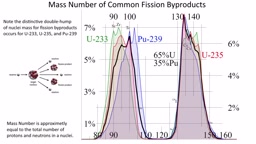
Early fallout danger comes mainly from short-lived fission products. Iodine-131 has a half-life of about 8 days; because the body concentrates iodine in the thyroid, potassium iodide exists in civil defense planning—it's not a radiation antidote and shouldn't be eaten like candy, but taken at the right time it can help block thyroid absorption of radioactive iodine. There's also barium-140 (about 13 days), lanthanum-140 (about 40 hours), molybdenum-99 (about 66 hours), zirconium-95 (about 64 days), niobium-95 (about 35 days), strontium-89 (about 50 days).
Short half-lives are a strange comfort: the more radioactive something is, the faster it usually consumes itself. Half-lives are exponential—after ten half-lives only about one-thousandth remains, after twenty only about one-millionth. A one-day isotope is essentially gone in a week, while a thirty-year isotope persists for decades but is much less intense per gram.
Long-term contamination of greater concern involves cesium-137 (about 30 years) and strontium-90 (about 29 years), which affect long-term cleanup of soil, food, milk, and water—not "hide immediately or die."
Another often-misread quantity: one kiloton of fission yield produces only about 50 grams of fission products. The danger isn't that nuclear weapons create mountains of radioactive material, but that a tiny mass contains an astonishing number of unstable atoms.
Half-life and Radioactivity: Half-life is the time required for the number of radioactive nuclei to decay to half their original number, an intrinsic property of each isotope. The key rule: the shorter the half-life, the more decays per unit time, the more radioactive—but the faster it's exhausted; the longer the half-life, the weaker the radioactivity, but the longer it persists. For example, iodine-131 has an 8-day half-life, extremely dangerous initially but essentially gone after weeks; cesium-137 has a 30-year half-life, much less intense but a long-term contamination source. Understanding this reveals that fallout's threat isn't eternal but changes rapidly over time.
Acute Radiation Syndrome and Dose Thresholds: Acute radiation syndrome is caused by high-dose whole-body radiation over a short period, typically with a threshold around 1 gray (Gy). 1-2 Gy can cause nausea, vomiting, fatigue, but most people survive; 4-6 Gy significantly increases mortality, requiring intensive medical support; over 10 Gy is almost certainly fatal. The key is that fallout-induced acute radiation syndrome requires a sufficiently large cumulative dose, and through shelter, distance, and avoiding early deposition, ordinary people can absolutely keep doses at safe levels. The cinematic portrayal of "certain death upon contact with fallout" confuses high-dose acute exposure with low-dose long-term exposure.
Modern Cities Will Burn, But the World Is Not One City
Modern cities are full of things that are terrible when burning, terrible when smoking, and terrible when toxic: plastics, synthetic fibers, insulation, electronics, tires, cars, batteries, old lead paint, asbestos, solvents, fuels, warehouses, ports, chemical plants, rail yards, hospitals, laboratories...
Modern warehouse fires can produce horrific smoke; port fires can be worse; chemical fires even more so. Nuclear strikes igniting fires in multiple urban locations could cause smoke and exposure far exceeding simple wood-frame or forest fires.
But we shouldn't turn this real concern into a new myth. Consumer-grade air filters aren't magic: HEPA is effective against particulates but not all gases; activated carbon helps with certain chemicals but saturates and has limits. Still, they can genuinely help.
Modern urban fires don't automatically mean everyone in the entire region dies. Firestorms are complex, requiring dense fuel, simultaneous ignition, weather conditions, and urban geometry to work together. Some cities or neighborhoods are more vulnerable; others have wide streets, parking lots, parks, concrete, and low fuel density.
More importantly, most of the Earth isn't urban. Urbanized land is only a small fraction of the planet's surface. Cities are civilization's dense, vital organs; losing them is horrifying, but "cities burning" doesn't equal "the world burning."

And many parts of the world aren't targets at all. No one wastes ICBMs on countries that are neither NATO nor Warsaw Pact. These countries can't fully escape the knock-on effects of global economic collapse, but their infrastructure and populations remain intact initially.
After the Strike, What Happens to Civilization?
After the bombs, the question isn't just who survives—many in directly hit cities will survive too—but what still functions?
Can people drink clean water? Can farms plant and harvest? Is there diesel? Fertilizer? Spare parts? Medicine? Refrigeration? Radio? Local government? Can towns communicate? Can survivors distinguish rumor from fact? Can anyone coordinate food distribution before famine causes more damage than the bombs?
A fallen technological civilization doesn't start from zero; it starts from ruins. That's much better than starting from zero—though with tetanus risk. The world will still have books, tools, roads, railways, warehouses, farms, libraries, radios, pipes, wires, generators, wells, machine shops, vehicles, solar panels, and water towers. Some are broken, some rotting, some rusting. Gasoline goes bad, medicine expires, batteries die, electronics corrode. But steel, glass, books, hand tools, cookware, pipes, bricks, wires, and many machines can last a long time.
In the Starlink era, the internet and phone lines will likely work long after power plants stop. People can charge phones from cars, even laptops with inverters, which obviously helps communication.
The first big industry in a post-apocalyptic world is salvage, and salvage isn't random looting—it becomes organized: people map ruins, strip copper wire, recover tools, sort warehouses, protect libraries, find repair manuals, dismantle machines, learn which roads are passable and which water sources are safe.
You might see communities with rifles, radios, solar panels, wind turbines, LED lights, and antibiotics that can no longer be manufactured. If the world really descends into long-term chaos, this could last generations. In such a world, technology might not all fail at the same time—people might maintain old equipment through ritual or inherited habit, knowing which button to press without understanding why, unable to make microchips but never forgetting electricity exists. That's not the Stone Age, but a mixed-technology salvage civilization.
Civilizational Resilience and "Starting from Ruins": Civilization isn't a single whole but countless redundant systems—knowledge, tools, infrastructure, social networks. A nuclear strike destroys many nodes but not all backups simultaneously. Books, machinery, roads, wells, solar panels—these "civilizational remnants" form the starting point for rebuilding. History has many examples of recovery from ruins, like post-WWII Europe and Japan; despite nuclear war's larger scale, "starting from ruins" has significant advantages over "starting from zero": ready materials, knowledge, and some organizational capacity. This explains why, from a realist perspective, survival and rebuilding aren't hopeless fantasies.
The Real Long-Term Danger: Food and Systems
The biggest long-term danger may not be radiation but food.
Modern agriculture needs fuel, fertilizer, spare parts, transport, storage, weather forecasts, pesticides, refrigeration, finance, and labor. If these chains break, famine could strike places the bombs never touched.
Nuclear winter belongs to this topic too: soot from burning cities could cool the climate and reduce crop yields, but estimates depend heavily on how many cities burn, how much soot reaches the stratosphere, and how the atmosphere responds. The concept is serious but easily exaggerated.
Even without severe nuclear winter, food distribution and production are fragile—that's the real global danger. Not every field glows. Radiation passing through crops or cows is different from radioactive material entering crops or cows. Food doesn't become dangerous just because it's been irradiated, just as luggage doesn't become radioactive after an X-ray. The danger is contamination: radioactive dust settling on leaves, entering soil, being absorbed by plants, washing into water, or concentrating in milk, meat, and bones before decaying or being cleared.
But the bigger global danger remains: farms need tractors, tractors need fuel, fuel needs refineries, refineries need electricity and parts, and all participants need enough food to keep working.
Rebuilding modern industry to peacetime standards is vastly different from improvising enough crude fuel, parts, transport, and electricity to keep farms and repair crews running. Emergency industry is uglier, dirtier, less efficient—but civilization once ran on uglier, dirtier, less efficient, less safe systems.
Equally important, these projects give displaced and unemployed people a recovering role rather than sitting in camps in despair. Refugee camps make sense as short-term triage: registration, food distribution, medical screening, family reunification, quarantine if necessary, getting people out of immediate danger. But as a long-term default state, they can become "civilization stagnation machines": concentrated dependency, disease risk, crime risk, despair, unemployment, political radicalization, sanitation problems, enormous burdens on operators.
So the post-nuclear world would be a gradient map: some areas destroyed, some contaminated, some burned, some starving, some cut off, some militarized, some accepting refugees, some refusing them, some rebuilding, some listening to radio static hoping someone answers. That's not civilization ending everywhere, but civilization under horrifying stress.
Will Nuclear War End Civilization?
It could end nations, governments, cities, families, institutions, and ways of life. It could create famine, dark ages, successor states, refugee crises, and post-war wars. It could kill on a scale almost beyond comprehension.
But it doesn't inevitably lead to all of this, and even if it did, "ending the world as we know it" doesn't equal "ending the world."
Humans are too dispersed, too adaptable, too tool-using, too likely to hide underground with canned food and a radio. To kill everyone, you'd need to reach islands, mountains, deserts, farms, ships at sea, bunkers, villages—all places not targeted because they weren't important enough.
After the bombs, population and civilization regrowing wouldn't necessarily take long. The blueprints for everything are everywhere, rebuildable from ruins. The world won't become a sterile wasteland of mutants. Even if everything really burns, it will regrow in relatively short time.
This doesn't make nuclear war acceptable, but it makes survival meaningful. If survival is uneven, then preparation matters: basements matter, food storage matters, radios matter, wells matter, local farms matter, machine shops matter, civil defense matters, books matter—and yes, getting up from your desk and sheltering under a window matters.
Most importantly, those willing to square their shoulders and keep trying matter. Civilization is fragile but not made of glass. Humans are vulnerable but not helpless.
That's the hopeful part—a cold hope. The post-disaster future is determined not only by what was destroyed, but by what survived, what people remember, what they prepared for, and what they choose to rebuild.
Despair is not wisdom. Doomsday is not a plan. Survival is.
One-line Summary
Nuclear war is a massive disaster but not an extinction spell; realistic preparation makes survival meaningful.
Paragraph Summary
The article rebuts exaggerated pop-culture imaginings of nuclear war, noting that nuclear weapons aren't "magic that destroys everything" but a bundle of dangers obeying physics. Blast energy decays with distance, and shelters and terrain significantly affect survival odds; fallout danger depends on airburst versus groundburst, dose, and isotope half-lives—it's not permanently lethal "death dust." Modern urban fires and toxic smoke are serious, but most of the Earth isn't urban, and many places aren't targets. The real long-term danger after a strike is food and systemic breakdown, not universally glowing farmland. Civilization starts from ruins, not zero; preparation, local agriculture, knowledge preservation, and civil defense all improve survival chances. The article stresses that realism is more hopeful than fiction: survival is uneven, but preparation matters, and despair is not wisdom.
Related articles

Qwen4 Architecture Preview Open-Sourced: 125B Parameters, 512 Experts, Designed for VRAM-Constrained Hardware
Qwen4 isn't released yet, but its architecture is previewed via open-source Qwen3.8 Flash Next: 125B params, 6B activated per token, 512 experts, 262K context, built for VRAM-limited hardware. This article covers official confirmations, key config.json metrics, and local deployment tests on 24G memory.

Run 8K Images on 6GB VRAM! Hands-On Test of Fudan's Open-Source MOSS-Image Model
Fudan OpenMouse team and Shanghai MOSS Intelligence open-source MOSS-Image, a 500M-parameter DT architecture text-to-image model that runs locally on 6GB VRAM with precise text rendering, structured layout control, and 4K Token prompt support—ideal for e-commerce posters and local deployment by individual creators.

Overseas Blogger Tests Local Deployment of 100B-Parameter MoE Model: Key Lessons on Quantization and Tool Calling
Overseas blogger tests local deployment of Alibaba's Qwen 3.8 Flash Next 100B MoE model on a Strix Halo mini PC and CUDA workstation, revealing how quantization precision affects tool-calling success and the real-world performance of the Strata and GUFO inference engines.