Can Qwen3.8-27B Really Take On Fable 5? Breaking Down the GVS5H Benchmark Controversy
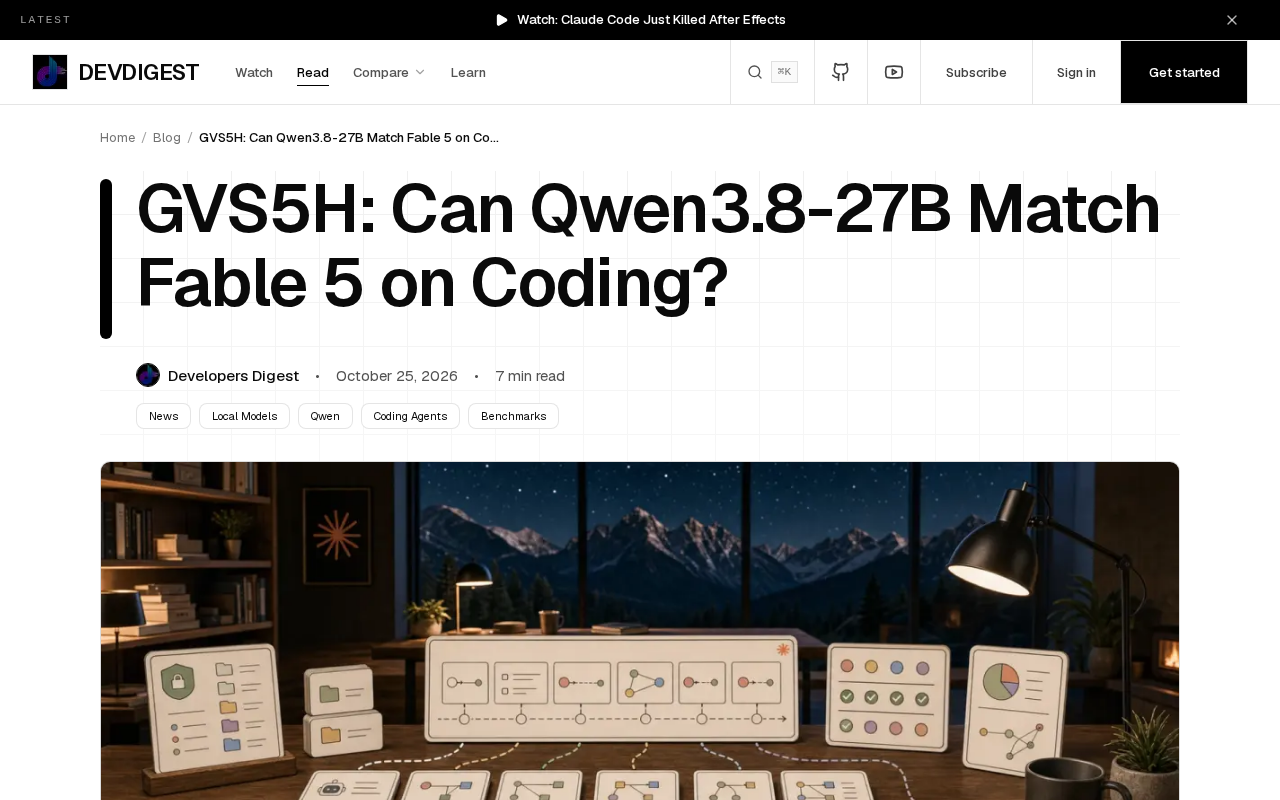
GVS5H benchmarks five Qwen3.8-27B instances against Fable 5 on LiveCodeBench Hard, but opaque costs and aggregation logic raise doubts.
GVS5H is an evaluation orchestration harness that claims five Qwen3.8-27B instances working together match Fable 5 on LiveCodeBench Hard. Hacker News skepticism centers on three points: inference costs are roughly five times that of a single model, making direct comparison with single-call closed-source models questionable; multi-instance aggregation rules themselves may be a hidden variable affecting scores; and evaluation scripts, random seeds, and parameters are not public, so results cannot be reproduced. The article argues that the methodology of "using an ensemble harness to squeeze potential out of mid-sized models" has reference value, but the "parity" claim still needs more transparent experimental support, and suggests examining such claims through three dimensions: cost basis, aggregation logic, and reproducibility.
A Benchmarking Controversy About "Punching Above Your Weight"
Recently, a project called GVS5H has sparked discussion in the tech community. Its core claim is quite eye-catching: five Qwen3.8-27B instances working together match Fable 5 on LiveCodeBench Hard. If true, this would mean that combining multiple mid-sized models can approach the coding capabilities of top-tier closed-source models—a conclusion that cost-sensitive development teams would absolutely dream of.
But the skepticism on Hacker News is equally loud. The controversy centers not on the models themselves, but on "how the test was conducted." This article breaks down what GVS5H actually built, why the community isn't buying it, and which parts of this approach are worth learning from.
What Exactly Is GVS5H
GVS5H is essentially an evaluation orchestration harness, not a new model. It organizes five Qwen3.8-27B instances and processes LiveCodeBench Hard problems through some aggregation mechanism.
LiveCodeBench Hard is a widely recognized high-difficulty coding benchmark. Its problems come from real competition scenarios and place stringent demands on models' reasoning depth and code correctness. By choosing to challenge Fable 5 on this benchmark, GVS5H is directly targeting the "hardest nut" of coding capability.
The key question is: how do the five instances collaborate? Is it simple voting, majority consensus, or divide-and-generate-then-filter? The original information doesn't provide complete details, and this is precisely the prerequisite for understanding the credibility of the results.
LiveCodeBench is a benchmark specifically designed to evaluate large models' code capabilities. Its distinguishing feature is the timeliness of its problem sources—problems are drawn from new problems published on competition platforms like LeetCode and AtCoder within specific time windows, thereby reducing the risk of models having seen the original problems during training (i.e., mitigating benchmark contamination). LiveCodeBench is divided into difficulty tiers including Easy, Medium, and Hard, with Hard-level problems typically requiring multi-step reasoning, complex algorithm design, and edge-case handling, placing extremely high demands on models' one-shot code correctness. The benchmark's evaluation metrics include pass@1 (the proportion of cases where the first generation passes all test cases), emphasizing models' genuine coding ability without additional hints, and is therefore often used as one of the authoritative references for measuring model programming proficiency.
Why Hacker News Is Questioning This Benchmark
Community skepticism focuses on several levels.
Evaluation Costs Are Hidden
Running the same problem with five 27B instances costs roughly five times the inference cost of a single instance. If GVS5H's results are built on "multiplying compute for equivalent scores," then its comparability with Fable 5 is greatly diminished—this isn't parity of model capability, but a conversion of resource investment. Benchmarks typically assume a single model with a single call, and GVS5H's setup deviates from this premise.
Aggregation Strategy May Introduce Bias
If the five instances' answers are aggregated through some rule, the aggregation rule itself becomes a "hidden model." Testers can boost scores by adjusting voting or filtering logic, and there's no explanation of whether this tuning is fair to Fable. Multi-instance ensembles are nothing new academically, but directly benchmarking them against a single closed-source model requires more rigorous controlled experiments.
Multi-instance ensembles are a mature class of techniques in machine learning. Common strategies include: majority voting, where multiple models independently generate answers and the most frequent one is selected; self-consistency, where the same question is sampled multiple times and the most consistent reasoning path is chosen; and generate-and-rerank, where multiple models first generate candidate answers and a scorer or verifier then selects the best solution. These methods can typically improve single-model accuracy, but at the cost of multiplied inference costs. The key point is that the gains from ensembling come partly from "multiple sampling" itself rather than a substantive improvement in model capability—meaning that directly comparing ensemble results with single-call models is methodologically inequitable.
Benchmark Contamination and Reproducibility
Although LiveCodeBench is known for its timeliness, any public benchmark carries the risk of being covered by training data. What the community is asking is: has GVS5H published complete evaluation scripts, random seeds, and aggregation parameters? Without these, results cannot be reproduced, and the persuasiveness of the claim is limited.
Benchmark contamination refers to benchmark problems or answers having been seen by models during pre-training, causing inflated evaluation scores that fail to reflect true generalization ability. For code benchmarks, contamination risk is especially prominent: competition solutions and discussion threads on code hosting platforms like GitHub are often included in training corpora. Reproducibility requires evaluators to publish complete scripts, random seeds, model versions, temperature parameters, and aggregation rules so that third parties can reproduce results under identical conditions. In machine learning research, reproducibility is a basic threshold for judging whether a claim holds; without this information, any "match" or "surpass" conclusion can only be regarded as a preliminary observation awaiting verification.
Three Takeaways Worth Noting
Setting aside the controversy, GVS5H's approach has practical reference value for engineering practice.
First, the cost-effectiveness of ensembling multiple mid-sized models is worth exploring. A single 27B model costs far less than top-tier closed-source models, and if a combination approach can approach their coding performance, it's a realistic path for budget-constrained teams.
Second, the evaluation framework itself needs to be evaluated. A harness's design choices—how to aggregate, how to account for costs, how to report—can significantly affect conclusions. When you see any "model parity" claim, first ask how the test was set up.
Third, community skepticism is healthy. Hacker News's doubts don't deny the capabilities of the Qwen series, but demand that benchmarks return to a reproducible, controlled track. This kind of scrutiny is good for the open-source model ecosystem.
How to View Claims Like This
When you encounter news about "small model combinations matching large models," it's advisable to judge in three steps:
- Check the cost basis: Is it a single-call comparison or multi-instance stacking? Is the compute investment equivalent?
- Check the aggregation logic: How are multi-instance results combined? Are the rules public and have they been tuned?
- Check reproducibility: Are scripts, parameters, and data open? Can third parties reproduce the same scores?
GVS5H currently leaves gaps on all three points, so its claim is better suited as "a direction worth further verification" rather than an established conclusion. Qwen3.8-27B's coding capability is evident to all, but the equation "five of it equals one Fable 5" still needs more transparent experiments to support it.
For developers, what's truly replicable isn't that score, but the methodology of "using an ensemble harness to squeeze potential out of mid-sized models"—provided you're clear about what costs you're paying for.
Related articles
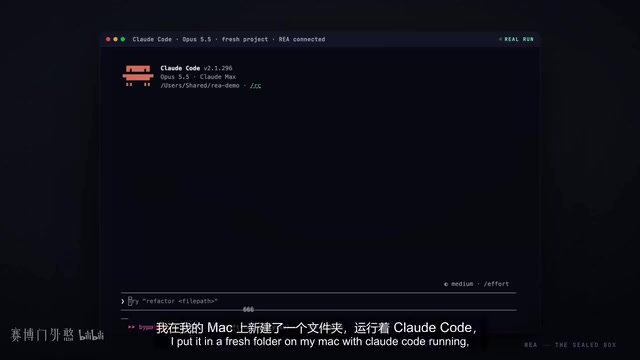
New AI Reverse Engineering Tool REA Lets Claude Clone Any App
REA (Reverse Engineer Anything), GitHub's #1 trending AI reverse engineering tool, lets Claude Code and other agents dissect any app and reproduce features—but also triggers safety blocks. This article covers its capabilities, limits, and ethical boundaries.

How to Provide Effective Context for AI Agents: Start Simple, Build a Single Source of Truth
Explore how to provide effective context for AI agents: start with simple Markdown files, gradually build a central source of truth, and bring in professional vendors at scale. Learn context management strategies for multi-agent collaboration.
6 Genuinely Free AI Coding Tools Tested: Free Tiers and Hidden Limits Explained
Six genuinely free AI coding tools tested: GitHub Copilot, Cursor, Google Antigravity, Amazon Q, Devon Desktop, and Replit. Free quotas, hidden limits, account closure risks, combined-use strategy, and when to pay.