Can Random Search Really Find Task Experts? Neural Thickets Hypothesis Under Scrutiny
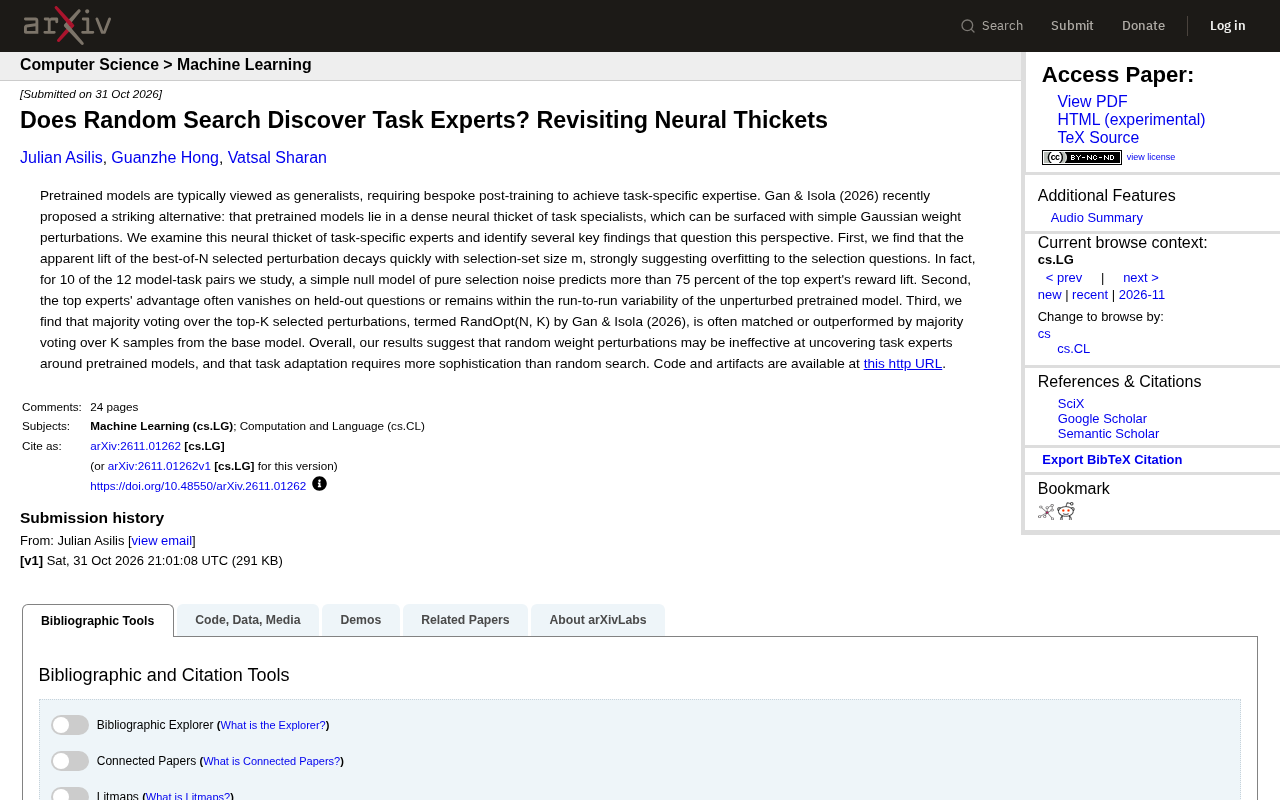
New study challenges neural thickets: random weight perturbation "task experts" are mostly selection bias.
Gan & Isola's neural thickets hypothesis claims task experts are dense around pretrained weights and discoverable via Gaussian perturbations with RandOpt voting. A re-examination finds best-of-N gains decay with selection set size, over 75% of top gains in most combinations are explained by a null noise model, held-out advantages vanish or fall within base run variance, and RandOpt(N, K) is often matched by simple base-model sampling voting. Random weight perturbation may not reliably uncover true task experts.
Pretrained models are often regarded as generalists that require specialized post-training to acquire task-specific capabilities. However, Gan & Isola (2026) proposed a striking alternative view: pretrained models reside in a dense "neural thicket" teeming with task experts, which can be revealed through simple Gaussian weight perturbations. This view challenges our conventional understanding of model adaptability, but a recent study questions the neural thickets hypothesis, arguing that random search may not be sufficient to discover genuine task experts.
The Neural Thickets Hypothesis: An Enticing Prospect
Gan & Isola's neural thickets theory posits that pretrained models are not single generalists but rather a dense collection of experts, each excelling at different tasks. By adding random Gaussian noise to model weights, these hidden experts can be "activated" to perform well on specific tasks. Their proposed RandOpt method further boosts performance through majority voting over multiple perturbed versions (RandOpt(N, K)). If this finding holds, it would dramatically simplify task adaptation—no gradient updates or additional training required, just random search to find experts.
But how effective is this approach in practice? Can it reliably discover task experts, or is it merely overfitting to the selection set?
Gaussian weight perturbation refers to adding random noise independently sampled from a Gaussian distribution (normal distribution) to the weight parameters of a pretrained model, typically with the noise standard deviation scaled to the weight magnitude (e.g., multiplied by the spectral norm of the weight matrix or element-wise standard deviation). This practice is often called "weight-space noise injection" in the Bayesian neural network and model ensemble literature. Its core assumption is that pretrained weights lie in a broad minimum basin, and small random perturbations will not push the model out of this basin, so perturbed models retain base capabilities while potentially biasing toward different tasks due to the local geometry of weight space. RandOpt leverages this property by sampling a large number of perturbed versions to "probe" for task experts within the weight-space neighborhood.
Key Findings: Evidence Challenging Neural Thickets
A recent study re-examining neural thickets (code and artifacts open-sourced at github.com/asil012/RevisitingNeuralThickets) revealed several key issues through systematic experiments, posing challenges to the neural thickets hypothesis.
1. Overfitting to the Selection Set: Best-Perturbation Gains Decay Rapidly with Selection Set Size
The study first examined the "best-of-N" strategy: selecting the best-performing perturbation from N random perturbations based on validation set (selection set) performance. Results showed that the reward gains of this "best expert" decay rapidly as the selection set size m increases. This means that the larger the selection set, the more likely the selected perturbation is overfitting to the selection problem rather than being a genuine task expert with generalization capability.
More convincingly, the researchers constructed a simple null model—assuming all gains come from pure selection noise. Across the 12 model-task combinations studied, for 10 combinations, over 75% of the top expert reward gains could be predicted by this null model. In other words, most seemingly significant gains may simply be artifacts of selection bias.
The "best-of-N" strategy is a common inference-time scaling method: independently sampling N candidate outputs or model variants, then selecting the best according to some scoring (e.g., validation set accuracy or reward model score). In the weight perturbation setting, the N candidates correspond to N randomly perturbed models, and the selection set is labeled data used for scoring. The key point is that as N increases, even if all candidates have the same true quality, the maximum observed score will be systematically inflated due to extreme value statistics—this is selection bias. The smaller the selection set, the more severe this bias, because the scoring itself is noisier. The study quantified this effect by varying the selection set size m, finding that the apparent gains of top experts decay rapidly as m increases, directly confirming the dominant role of selection bias.
2. Advantages Disappear on Held-Out Problems or Fall Within Noise Range
If these perturbations truly found task experts, their advantages should generalize to new problems not involved in selection. However, experiments showed that top experts' advantages often disappear on held-out problems, or at least fall within the run-to-run variance range of the unperturbed pretrained model. In other words, the so-called "experts" are not reliably better than the original model—their performance differences may simply be random fluctuations.
Run-to-run variance refers to performance fluctuations of the same model under different random seeds (e.g., different data shuffling orders, initialization, or inference sampling). When evaluating perturbed models, a common pitfall is mistaking "the difference between a perturbed model and a single run of the base model" for a genuine improvement, while ignoring that repeated runs of the base model itself produce fluctuations of similar magnitude. The study compared top experts' held-out set performance against the distribution of multiple base model runs, finding that the former often falls within the latter's normal fluctuation range, thus demonstrating that the so-called "expert advantage" lacks statistical significance. This methodological reminder is a basic requirement when evaluating any model adaptation technique: one must report the variance of the baseline model rather than comparing only single-point estimates.
3. Majority Voting Strategy Matched or Outperformed by Baseline Model
Gan & Isola's proposed RandOpt(N, K) method—majority voting over top-K perturbations—was shown to often be matched or outperformed by a simple baseline: directly sampling K outputs from the base model for majority voting. This indicates that random weight perturbations do not bring additional diversity or expert information; the base model's own diversity is already sufficient.
Majority voting is a classic ensemble decision rule: generate multiple predictions for the same input, then select the most frequent class (classification) or average numerical outputs (regression). Its effectiveness depends on the balance between diversity and individual accuracy among members. The idea behind RandOpt(N, K) is that majority voting over top-K perturbed models' predictions can leverage the complementarity of different "experts." However, if these perturbed models are essentially just noisy versions of the base model, their diversity is no greater than that obtained by directly and independently sampling K times from the base model, so the expected performance of both voting schemes should be similar. The study's comparative experiments were based on this logic, showing that random weight perturbations do not introduce additional expert information beyond the base model's sampling noise.
Multi-Source Cross-Validation and Disagreement
This study cross-validated through multiple experimental settings and model-task combinations, with results consistently pointing to the limitations of the neural thickets hypothesis. However, Gan & Isola's original work may have emphasized different experimental conditions or evaluation metrics, leading to divergent conclusions. The main disagreement lies in whether perturbation gains generalize, and the effectiveness of the majority voting strategy.
Based on current evidence, random weight perturbations may not be effective at uncovering task experts; task adaptation requires more refined methods than random search.
Implications for AI Practice
For AI practitioners, this study reminds us that in pursuing task-specific performance, relying on random search or simple perturbations may bring false hope. More reliable approaches remain gradient-based fine-tuning, prompt engineering, or structured adapters. Meanwhile, evaluation methods themselves require caution—selection bias and run-to-run variance can mask true effects.
While the neural thickets hypothesis is enticing, current evidence suggests that random search may only be discovering illusions in the noise rather than genuine task experts. Future research needs more rigorous generalization tests and baseline comparisons to clarify the structure of pretrained models' weight space.
References
- Gan & Isola (2026). Neural Thickets: Diverse Task Experts Are Dense Around Pretrained Weights.
- Revisiting study: github.com/asil012/RevisitingNeuralThickets
One-line Summary
New research challenges the neural thickets hypothesis: "task experts" found via random weight perturbation are largely due to selection bias.
Paragraph Summary
Gan & Isola proposed the neural thickets hypothesis, suggesting that task experts are densely distributed around pretrained models and can be revealed by Gaussian weight perturbations, with RandOpt majority voting further boosting performance. However, a re-examination study systematically challenges this: best-of-N perturbation gains decay rapidly as the selection set grows; a null model shows over 75% of top expert gains in most combinations can be explained by selection noise; top experts' advantages on held-out problems disappear or fall within base model run-to-run variance; and RandOpt(N, K) is often matched or outperformed by majority voting directly sampling from the base model. The study indicates that random weight perturbations may not effectively discover genuine task experts, and task adaptation still requires finer methods like gradient fine-tuning.
Related articles

DSH + Ollama Local LLM Deployment in Practice: Free Chat with Da Fei Yu
Bilibili creator tests DSH + Ollama local LLM deployment end to end: Ollama install, Xunlei-accelerated downloads, ModelScope GGUF model import, DSH custom API address setup, and a comparison of Qwen 3.5 4B, 8B, Gemma, and other models on 8GB VRAM, with advice on choosing local deployment vs. API calls.

Tested: A $899 Mac Mini vs. a $200/Month AI Subscription
Real-world test of whether an M4 Mac mini can replace a $200 AI subscription: 16GB can't fit large models, and both speed and quality fall short—but privacy, no caps, and near-zero running costs make it an ideal host for an always-on agent. Includes buying advice per configuration and money-saving strategies.

RSTGameTranslation: Real-Time OCR Localization + Offline Translation with Local LLMs
RSTGameTranslation is an open-source real-time Windows game translation tool: OCR for English, Japanese, and Korean with Chinese overlays in place, plus Ollama or LM Studio local LLM offline translation and Whisper speech transcription for games, manga, and visual novels.