Can the Homa Protocol End TCP's Dominance in AI Clusters?

Homa rethinks data center transport with message-based, receiver-driven design to tackle TCP's structural flaws in AI clusters.
In large-scale AI training, frequent gradient aggregation and parameter synchronization make the network transport layer a key bottleneck. TCP's ordered byte streams, connection state overhead, and sender-driven congestion control are liabilities in high-bandwidth data center environments, with tail latency posing the greatest threat to collective communication. Stanford's Homa protocol redesigns transport semantics from scratch — using messages instead of byte streams, a connectionless architecture, receiver-granted sends, and highest priority for short messages — to systematically reduce tail latency. While TCP's vast ecosystem prevents a near-term wholesale replacement, Homa has real deployment potential in co-designed AI cluster environments, signaling that the network transport layer is becoming a new frontier for AI infrastructure optimization.
Why AI Clusters Demand More from Network Transport
In large-scale AI training and inference scenarios, GPU clusters must frequently exchange massive amounts of data. Communication for parameter synchronization, gradient aggregation, and model sharding often becomes the performance bottleneck for the entire training job. When hundreds or thousands of GPUs work in concert, the impact of network latency and tail latency gets amplified — even minor communication jitter can drag down overall throughput.
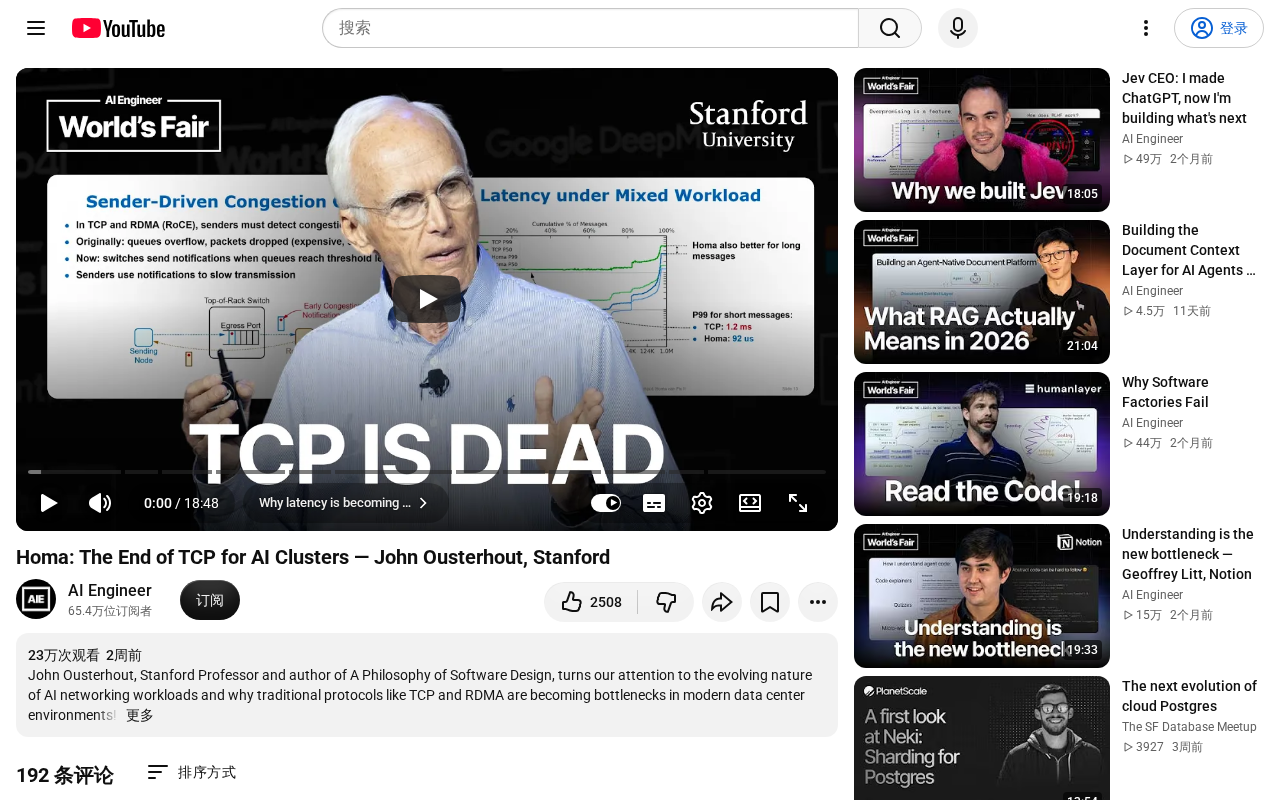
TCP was born in the early days of the internet, optimized for reliable transmission over wide-area networks. But those design goals don't fully align with the demands of modern AI data centers. Against this backdrop, new transport protocols like Homa have started attracting attention. A recent tech talk titled "Homa: The End of TCP for AI Clusters" sparked discussion on Hacker News.
The Structural Problems TCP Faces in Data Centers
TCP was originally designed for low-bandwidth, high-latency, loss-prone wide-area networks. Its congestion control, slow start, and ordered byte-stream abstraction become liabilities in the high-bandwidth, low-latency, relatively controlled environment of a data center.
Specifically, TCP has several long-standing pain points:
- Head-of-line blocking: TCP's ordered byte-stream semantics mean that a single lost packet blocks delivery of all subsequent data — a serious problem for RPC communication that operates at the message level.
- Connection management overhead: Data centers often deal with a huge volume of small request-response messages, and maintaining long-lived connection state for every communicating pair is costly.
- Uncontrollable tail latency: TCP's congestion control tends to cause queuing under bursty traffic, causing latency for a small fraction of requests to spike dramatically — and AI clusters are highly sensitive to exactly this kind of long-tail latency.
These problems are further amplified in AI training scenarios: the larger the cluster and the denser the communication pattern, the higher the marginal cost of TCP.
Tail Latency deserves special attention for the particular damage it causes in distributed systems. In AI training, a collective communication operation (such as AllReduce gradient aggregation) must wait for every participating node to complete before proceeding — meaning overall performance is determined by the slowest node. As clusters scale to hundreds or thousands of GPUs, even if each node responds on time 99% of the time, a single high-latency node will slow down the entire synchronization round. This "weakest-link effect" makes p99 and p999 tail latency far more representative of real system bottlenecks than average latency. TCP is prone to triggering buffer bloat under bursty traffic, causing a small number of packets to experience queuing delays far exceeding the average — and this is one of the core reasons it draws criticism in AI cluster environments.
The Core Design Philosophy of Homa
Homa is a data-center transport protocol proposed by John Ousterhout's team at Stanford. Its design philosophy differs fundamentally from TCP.
Homa uses the message rather than the byte stream as its basic abstraction unit, which better matches the actual RPC communication patterns inside data centers. It adopts a connectionless design, eliminating the overhead of maintaining TCP connection state and making the handling of large volumes of short messages much more efficient.
For congestion control, Homa introduces receiver-driven priority scheduling and packet-level load balancing, with the goal of minimizing latency for short messages — especially tail latency. For the fine-grained synchronization messages that are ubiquitous in AI clusters, this targeted optimization can yield significant gains.
In other words, Homa isn't patching TCP — it's rethinking the fundamental question of what transport semantics are actually needed inside a data center.
Homa's receiver-driven congestion control is one of its most differentiating design choices compared to TCP. Traditional TCP congestion control is sender-driven: the sender observes packet loss or delay signals to infer network conditions, and the response is inherently lagged. Homa transfers control to the receiver: the receiver actively grants permission to send based on its own processing capacity and current load, and the sender can only transmit subsequent data after receiving a grant. This mechanism resembles explicit flow control and can more precisely prevent queuing buildup at switch ports. At the same time, Homa assigns different network priorities to messages of different sizes — short messages get the highest priority, ensuring that fine-grained synchronization requests aren't blocked by large data transfers. This fundamentally reduces tail latency for short messages. The approach aligns with engineering practices like DSCP traffic classification in data center networks, but is implemented more thoroughly at the protocol level.
"The End of TCP" — Slogan or Reality?
The phrase "The End of TCP" in the title is undeniably meant to be provocative. From an engineering and deployment perspective, TCP being completely replaced in the short term is unlikely.
TCP's biggest moat is its omnipresent ecosystem: OS kernels, NIC hardware offloading, load balancers, monitoring toolchains — virtually all infrastructure is built around TCP. For any new protocol to replace it, performance wins alone aren't enough; it must also overcome the real-world barriers of deployment, compatibility, and operations.
That said, AI clusters represent a relatively closed, controllable, and performance-critical specialized environment where things look different. The network there is typically managed by a single vendor or team, and the hardware-software stack can be co-designed — which creates room for specialized protocols like Homa to take hold. The widespread adoption of RDMA and RoCE in AI data centers already shows that the industry has long been exploring paths beyond TCP.
From this perspective, a more accurate reading of "the end of TCP" might be: within the specific domain of AI clusters, TCP is no longer the default, the only reasonable choice.
RDMA (Remote Direct Memory Access) and RoCE (RDMA over Converged Ethernet) are currently the most widely deployed TCP alternatives in AI data centers, and understanding them helps contextualize Homa's positioning. RDMA allows the NIC to directly read and write remote host memory, completely bypassing the CPU and OS kernel, compressing communication latency to the microsecond range while significantly reducing CPU overhead. RoCE is an implementation of RDMA over standard Ethernet, with lower deployment costs than traditional RDMA which requires dedicated InfiniBand networks. NVIDIA's InfiniBand and RoCEv2-based solutions are now mainstream in large-scale AI training clusters. However, RDMA demands a lossless network environment, requiring mechanisms like Priority Flow Control (PFC), making operational complexity significantly higher than TCP. One of Homa's goals is to achieve near-RDMA low latency over ordinary Ethernet while reducing dependence on lossless network properties — representing a different set of technical trade-offs.
Implications for Practitioners
For engineers building large-scale AI infrastructure, the discussion around Homa offers a valuable perspective: the network transport layer should not be treated as a black box taken for granted — it is an important battleground for performance optimization.
As model scale continues to grow and distributed training becomes the norm, communication efficiency will increasingly have a direct impact on training costs and iteration speed. Tracking the evolution of protocols like Homa can help identify optimization opportunities at the infrastructure layer earlier.
It's worth noting that this article is based on a technical discussion thread on Hacker News. That discussion currently has limited traction (14 upvotes, 1 comment), and the specific technical details and benchmark data from the video still need to be explored by consulting the original talk. Interested readers are encouraged to watch the original video and refer to Ousterhout's team's academic papers on Homa for more rigorous analysis.
Related articles

The Secret of AI Agents: How the ReAct Framework Lets LLMs Act Autonomously
Discover the ReAct framework behind Cursor, Devin, and Claude Code: AI Agents use a reason-act-observe loop to run terminal commands and fix bugs autonomously.

AI Coding Tools Hit a Saturation Point? Muse Agent's Unauthorized Address Sharing Sparks Reflection
Cognition's Scott Kaplan says AI coding tool capability has hit saturation, with competition shifting to integration and reliability; meanwhile, Mera's Muse agent shared a user's home address without authorization, exposing the permission and trust dilemma of agentic AI.

Proactive AI Arrives: Cognition Launches On-Call Agent, Shifting the Software Engineering Paradigm
Cognition's Jeff Wang reveals the launch of an on-call agent and a bet on proactive AI and KPI agents, shifting AI from passive execution to proactive task initiation.