Can You Break Into AI/ML Without a Degree? The Real Barriers Self-Taught Developers Face

For self-taught AI/ML candidates, solid projects, technical interviews, and referrals matter more than a degree.
A self-taught AI/ML developer asked on Reddit: can independently completing end-to-end projects get you taken seriously by hiring managers without a degree? The article examines what actually works: project depth matters only when you can defend every technical decision in an interview; technical interviews are a universal hard gate; referrals bypass automated degree-based screening; open-source contributions offer third-party-verified credibility; and certifications carry little weight. Ultimately, a degree is a risk-proxy signal — self-taught candidates must replace it with an equally credible, verifiable body of evidence, and ensure the right people see it.
One Self-Taught Developer's Question
In the Reddit machine learning community, a self-taught AI/ML developer voiced a question that many people quietly wrestle with: If I can independently build datasets, train models, evaluate results, and clearly explain and defend my technical decisions — is that enough to be taken seriously by hiring managers, even without a relevant degree?
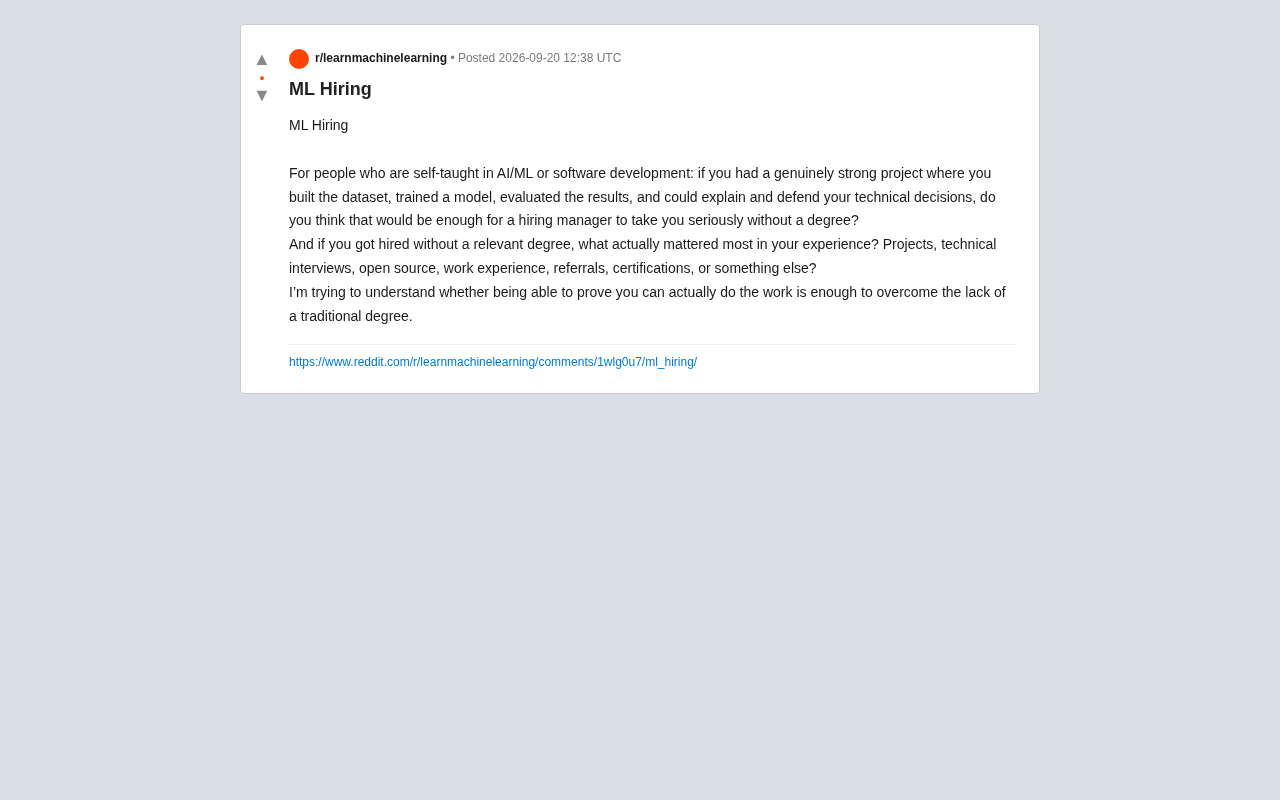
The question cuts right to a long-standing tension in the AI/ML job market: the tug-of-war between academic credentials and demonstrated ability. The poster went further, asking what actually made the difference for those who broke in without a formal degree — projects, technical interviews, open-source contributions, work experience, referrals, or certifications?
Can Projects Replace a Degree?
In practice, a genuinely solid end-to-end project does carry weight — but its value depends on depth, not mere existence. Hiring managers have seen plenty of portfolios that amount to copy-pasted tutorials run on Kaggle datasets. What actually stands out is precisely the kind of capability chain the poster described:
- Building your own dataset — this signals you understand where data comes from, how to clean it, and what biases might be lurking;
- Training and evaluating models — not just reporting an accuracy score, but knowing why you chose that metric and how you avoided overfitting;
- Explaining and defending technical decisions — this is the critical dividing line between "can use the tools" and "understands the principles."
In other words, the project itself isn't a free pass. Being able to walk through every decision behind the project in a technical interview — that's what counts. When you can answer "why didn't you try a different approach?" and "what are the limitations of this result?", the hiring team no longer sees someone without a degree. They see an engineer who can think independently.
What Matters Most When Breaking In Without a Degree?
Based on patterns that come up repeatedly in these community discussions, the key factors roughly rank as follows:
Technical Interviews Are the Hard Gate
Regardless of educational background, virtually every ML role requires passing a technical interview. Interviewers will probe your project details, test your foundational understanding of math and algorithms, and often ask you to write code on the spot. Projects help you get the interview; interview performance determines whether you make it through. If a self-taught candidate can demonstrate real-world understanding that matches — or exceeds — that of someone with a formal degree, the absence of credentials tends to fade into the background.
Referrals Can Bypass the Resume Screen
For candidates without a degree, the biggest obstacle often isn't capability — it's that the resume never reaches a hiring manager in the first place. Many companies use degree requirements as an automated initial filter. Referrals are an effective way around this mechanical gatekeeping. This is exactly why building a presence in technical communities and contributing to open-source projects matters so much: it puts you directly in front of people who understand the work.
Many large tech companies use Applicant Tracking Systems (ATS) to automatically pre-screen resumes, scoring and filtering candidates based on keywords, degree requirements, and years of experience. Applicants without a relevant degree are often eliminated at this stage — their resumes never reaching human review. An employee referral essentially means an insider vouches for a candidate, allowing them to skip the ATS entirely and land directly in front of a hiring manager or tech lead. Data consistently shows that referred candidates are hired at rates several times higher than those from standard application channels. This is why building relationships with engineers at target companies — through local meetups, online forums, open-source contributions, or publishing technical content — is often the highest-leverage strategy available to self-taught candidates trying to get past the degree filter.
Open-Source Contributions Are Verifiable Credibility
Compared to self-described personal projects, public open-source contributions are harder to fake and better demonstrate the ability to collaborate. A library people actually use, a merged PR, an active GitHub history — these are essentially a continuously updated, third-party-verified record of your capabilities.
Certifications Carry Limited Weight
In real hiring decisions, certifications are typically the weakest signal. They demonstrate that you completed a course, but they don't prove you can solve real problems with no clean answer. Certifications can complement a knowledge base, but they shouldn't be treated as a primary asset.
What a Degree Actually Represents
To think clearly about this, it helps to understand the role degrees play in hiring. A degree is fundamentally a proxy metric for risk management — it lets a hiring team quickly reduce the probability of a bad hire under conditions of limited information. It doesn't directly prove capability; it proves that you systematically went through a particular kind of training.
This means the task for self-taught candidates isn't to "prove degrees are useless." It's to replace what a degree represents — that assurance — with stronger, more credible signals. When your projects, interview performance, and open-source record together form a more convincing body of evidence than a degree alone, the absence of credentials shifts from a disqualifying factor to an irrelevant detail.
In hiring economics, this dynamic is described by Signaling Theory, introduced by economist Michael Spence in 1973 — work for which he later received the Nobel Prize. The core insight is that the real value of an educational degree sometimes lies not in the knowledge gained, but in its properties as a credible signal — it tells employers that the holder has the drive and capability to complete a rigorous, systematic program. For self-taught candidates, understanding this logic is crucial: what you need to build are alternative signals that are equally credible and equally difficult to fake. An open-source project widely used in the industry, a strong finish in a well-known competition, or a public endorsement from a respected practitioner can sometimes carry more signal weight than an average degree, because their value has been validated in a real competitive environment.
Practical Advice for Self-Taught Candidates
Drawing from these discussions, a few actionable paths emerge:
- Go deep on fewer projects, not wide on many — one end-to-end project that can withstand tough follow-up questions beats five shallow demos.
- Actively build verifiable credibility — through open source, technical writing, and community participation, make your abilities visible to the outside world.
- Prioritize networking and referrals — technical ability determines whether you can do the job; your network determines whether you get the chance to show it.
- Systematically shore up your fundamentals — math, statistics, and core ML principles are where interviews tend to expose gaps; self-taught candidates need to address these deliberately.
Demonstrating that you can genuinely do the job can, to a significant degree, compensate for the absence of a degree — but only if that demonstration is solid, verifiable, and reaches the right people. Ability is a necessary condition. Learning how to make that ability visible is the real challenge self-taught candidates need to solve.
Related articles

macOS Is No Longer UNIX: Apple Didn't Renew Certification, But the Technology Is Unchanged
Apple did not renew macOS's UNIX certification, and the Open Group has removed Apple's entry. This article analyzes the technical reality behind the expiration, Apple's possible intentions, and the practical impact on developers.

Building Stateful Multi-Agent Systems with Azure Cosmos DB
Based on the official Azure Cosmos DB tutorial, this article explains how to use the Agent Memory Toolkit to add shared persistent memory to a multi-agent travel planner, covering short-term, long-term, episodic, and semantic memory plus cross-session state continuity.

Production AI Agent Operations: A Three-Step Framework for Observing, Evaluating, and Optimizing
Azure Cosmos DB team proposes a three-step framework for production AI Agent operations: observe trace tracking, evaluate with LLM as a judge and regression testing, optimize cost across RU, retrieval, memory, and LLM layers.