Canary Rollouts: A Practical Guide to Zero-Downtime AI Model Upgrades in Production

Canary rollouts turn risky AI model hard swaps into controlled, observable, zero-downtime upgrades.
Upgrading AI models in production via hard swaps risks full-blast-radius failures and costly cold-start rollbacks. Canary rollouts solve this with three mechanisms: phased traffic ramping to limit exposure, metric gates to automate promotion decisions, and automatic rollback that leverages the always-live old deployment for near-instant recovery. Dedicated inference environments — with their high GPU cold-start costs — benefit most from this approach.
Upgrading AI models in production has never been a simple task. A hard swap — cutting all traffic to the new model at once — means every user is simultaneously exposed to a new model the moment it goes live. If the new model suffers from performance regression, latency spikes, or degraded output quality, the blast radius is total. Rollback is equally painful: you're cold-starting the old deployment under pressure, with no guarantee of service quality during that window.
Canary rollouts were designed precisely to solve this problem. Through phased traffic ramping, metric-gated progression, and automatic rollback, they transform a model upgrade from a high-stakes binary event into a controlled, observable, and reversible gradual process.
The Cost of a Hard Swap
To appreciate the value of canary rollouts, it helps to understand exactly what's wrong with hard swaps.
When you shift all traffic from the old model to the new one in a single cut, you're betting everything on a single deployment event. No matter how well the new model performs in offline evaluation, that evaluation can never fully replicate the distribution of real production traffic — edge cases, long-tail requests, and concurrent load can all trigger problems you never anticipated.
The rollback story is even worse. If the old deployment has already been scaled down or taken offline, rolling back requires a full cold start — pulling model weights, loading them into GPU memory, warming up the inference engine. For large models, this can take several minutes. And those minutes happen to be exactly when the user experience is at its worst. You're performing your most time-consuming operation at the moment of highest pressure, after a failure has already occurred.
The Three Core Mechanisms of Canary Rollouts
In dedicated inference deployments, canary rollouts rely on three complementary mechanisms to reduce upgrade risk.
Phased Traffic Ramping
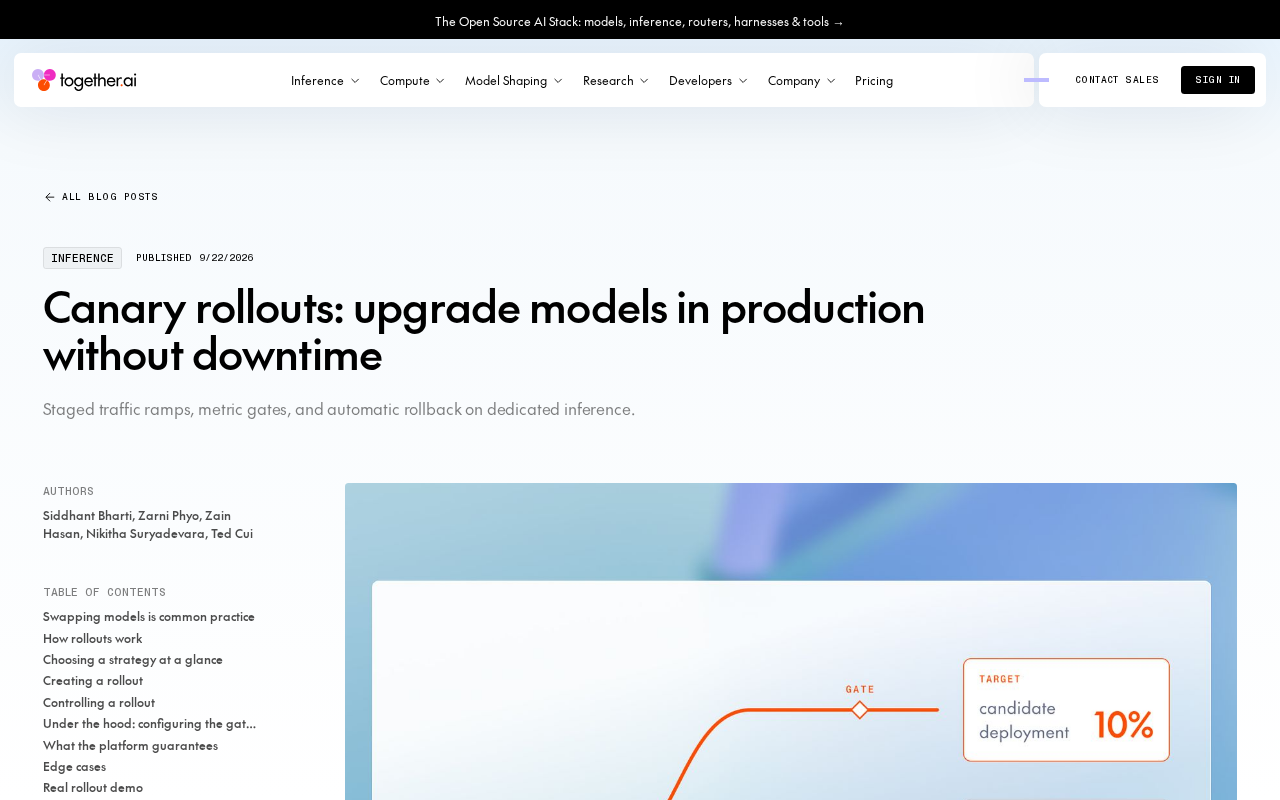
Rather than switching all at once, the new model starts by handling a very small percentage of traffic. A typical progression might begin at 1–5%, then step up to 10%, 25%, 50%, and finally 100% after observation windows at each stage.
The power of this gradual ramp is containment: even if the new model has issues, only a small subset of users are affected. The exposure radius is strictly bounded within acceptable limits. At the same time, even a small slice of real traffic is enough to validate the new model's actual behavior in production — far more reliable than inferring performance from offline benchmarks alone.
Metric Gates
Traffic ramping alone isn't sufficient. At each stage, you need clearly defined metric gates: thresholds that the new model must meet before traffic is allowed to increase further.
Common gate metrics include inference latency (P50/P99), error rates, and throughput — as well as more business-oriented output quality signals. Metric gates translate human judgment into automated promotion rules. The new model must prove itself with data before it earns more traffic. This removes the subjectivity of gut-feel deployments and makes the entire rollout process auditable.
Output quality gating is often the hardest part to implement in practice — and the easiest to skip. Latency and error rates can be captured directly by standard monitoring systems, but model output quality degradation tends to manifest in subtler ways: shorter responses, higher refusal rates, formatting failures, or declining multilingual capability. Common approaches include rule-based heuristics (checking output length distributions or format compliance rates), using an LLM-as-Judge to score canary traffic outputs in real time, or comparing new and old model responses to identical inputs via Shadow Mode. Shadow Mode is a particularly useful complementary technique — the new model processes production requests in parallel without serving responses to users, with outputs logged for quality evaluation. This lets you accumulate quality signals before the model ever touches live traffic.
Automatic Rollback
When a metric gate detects an anomaly — latency exceeding a threshold, error rates spiking — the system should immediately roll back automatically, without waiting for human intervention.
The critical advantage of automatic rollback is speed. Because the old model remains live throughout the ramp (just handling a progressively smaller share of traffic), rollback is essentially just re-weighting the traffic split back to the old deployment. No cold start is required. This means rollback is nearly instantaneous — users barely notice.
This is the most fundamental improvement canary rollouts offer over hard swaps: rollback goes from a high-risk cold-start operation to a low-cost traffic rebalancing. The worst-case scenario becomes far less catastrophic.
Why Dedicated Inference Especially Needs This
In dedicated inference deployments, models occupy fixed GPU resources and carry high initialization costs. This amplifies the pain of hard-swap rollbacks — cold-starting a large model deployment is orders of magnitude more expensive than restarting a typical web service.
Canary rollouts address this by keeping both versions alive during the transition, trading a short-term increase in resource usage for safety throughout the upgrade process. For production services with high availability requirements, this tradeoff is almost always worth it: the extra cost is the temporary resource overhead during the transition window; what you gain is a zero-downtime upgrade path and near-instant rollback capability.
Dedicated inference and serverless inference are fundamentally different deployment models. In serverless mode, model instances spin up on demand and are torn down when idle — the platform handles elastic scaling and users don't manage underlying GPU resources. In dedicated inference, users reserve a fixed pool of GPU instances for a specific model; those instances run continuously and are always ready to accept requests. The benefit is stable, low-latency, high-throughput performance. The cost is that resources are always occupied, and every model deployment change involves substantial initialization overhead — including loading model weights from storage (for models with 70B+ parameters, weight files can reach hundreds of gigabytes), mapping parameters into GPU memory, and running warm-up requests through the inference engine. It's precisely this high cold-start cost that makes model upgrades in dedicated inference an order of magnitude more expensive than rolling back a typical web service — and what makes the canary rollout principle of "keeping the old deployment live" so critical in this context.
Practical Recommendations
A few things are worth keeping in mind when putting canary rollouts into practice.
The pacing of traffic ramps should reflect your business's risk tolerance — high-stakes services benefit from slower ramps with longer observation windows. Metric gate thresholds should be calibrated against historical baseline data: too loose and real problems slip through; too tight and you'll trigger false-positive rollbacks constantly. It's also worth explicitly including output quality monitoring in your gate criteria, rather than relying solely on system metrics like latency and error rates — the most insidious risks in model upgrades often come from quality regression, not outright failures.
At its core, canary rollouts transform a model deployment from a binary, all-or-nothing decision into a continuous, observable, gradual process. For production systems that increasingly depend on large models, this deployment pattern is shifting from a nice-to-have to a foundational infrastructure requirement.
Related articles

macOS Is No Longer UNIX: Apple Didn't Renew Certification, But the Technology Is Unchanged
Apple did not renew macOS's UNIX certification, and the Open Group has removed Apple's entry. This article analyzes the technical reality behind the expiration, Apple's possible intentions, and the practical impact on developers.

Building Stateful Multi-Agent Systems with Azure Cosmos DB
Based on the official Azure Cosmos DB tutorial, this article explains how to use the Agent Memory Toolkit to add shared persistent memory to a multi-agent travel planner, covering short-term, long-term, episodic, and semantic memory plus cross-session state continuity.

Production AI Agent Operations: A Three-Step Framework for Observing, Evaluating, and Optimizing
Azure Cosmos DB team proposes a three-step framework for production AI Agent operations: observe trace tracking, evaluate with LLM as a judge and regression testing, optimize cost across RU, retrieval, memory, and LLM layers.