Capslane: One API for YouTube Subtitle Extraction and Auto-Transcription
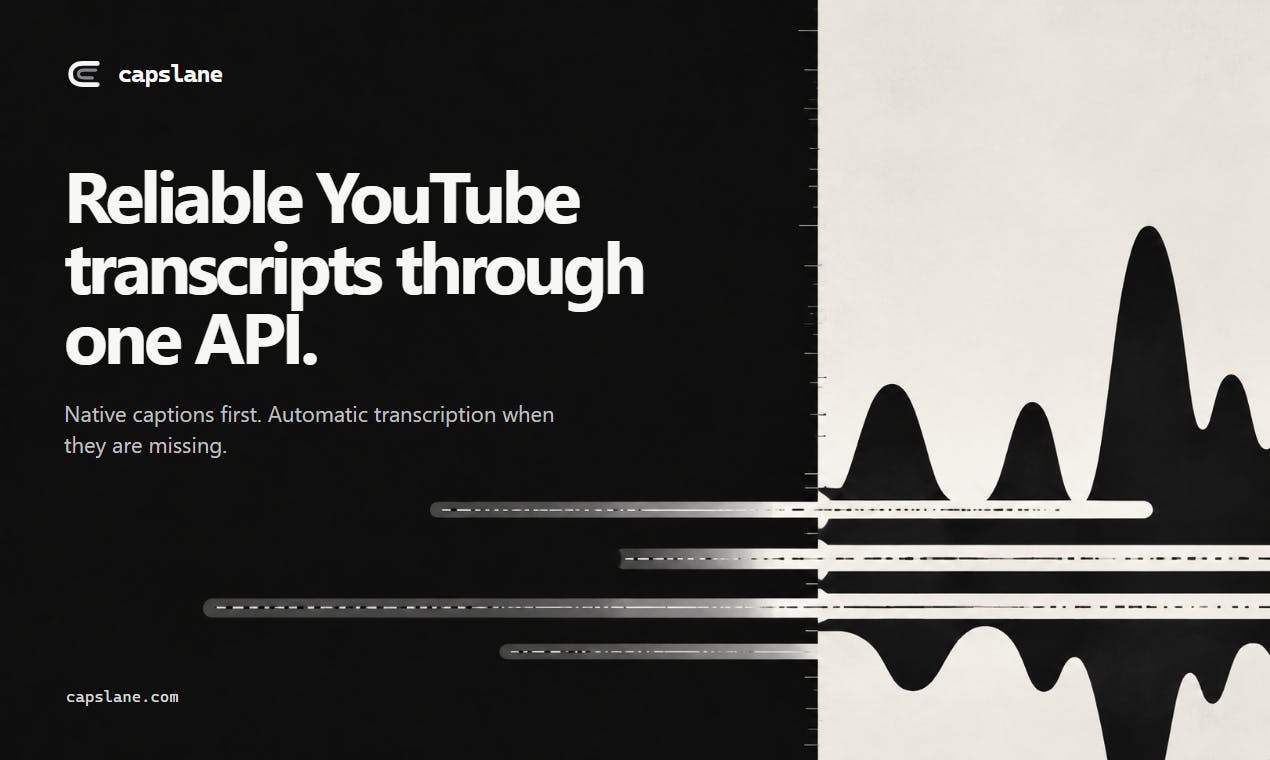
Unified API for YouTube subtitle extraction with auto-transcription fallback and MCP protocol support
Capslane simplifies YouTube subtitle extraction through a single API that returns native subtitles when available or generates timestamped transcriptions automatically. Supporting JavaScript and Python SDKs, MCP protocol, and n8n integration, it serves developers building video analysis, content summarization, and AI applications with 50 free monthly requests.
The Core Pain Points of YouTube Subtitle Extraction and Capslane's Solution
For developers working with YouTube video content, obtaining reliable subtitles has always been a tricky problem. Video creators may not upload subtitles, or subtitle formats may be inconsistent, making automated processing complex.
Technical Background of YouTube's Subtitle System: YouTube's subtitle system falls into two categories: manually uploaded subtitle files by creators (typically SRT or VTT format) and YouTube's auto-generated subtitles (based on speech recognition technology). Auto-generated subtitles rely on Google's speech-to-text engine, supporting multiple languages but with accuracy affected by video audio quality, accents, technical terminology, and other factors. From a technical implementation perspective, YouTube does not provide an official subtitle extraction API. Developers typically need to parse embedded data from video pages or use unofficial libraries (such as youtube-transcript-api). These methods face challenges including anti-scraping mechanisms, data structure changes, and legal compliance issues, making stable subtitle extraction a technical challenge.
Capslane, as a dedicated YouTube subtitle API service, provides a unified solution: it returns native subtitles when they exist, and automatically generates timestamped transcription text when subtitles are missing. This design philosophy embodies pragmatism at the tooling level—developers don't need to worry about underlying implementation details; they just call one interface to obtain structured subtitle data. For building video analysis, content summarization, multilingual translation, and other application scenarios, this stability is crucial.
Core Features and Technical Characteristics
Capslane's API design prioritizes developer experience, with core functionality covering the following areas:
- Dual Format Return: Supports both plain text and structured segment formats, with the latter including complete timestamp information for implementing video navigation, content positioning, and other interactive features
- Multi-language Support: Developers can specify target languages to retrieve subtitles, which is particularly important for cross-border content processing
- Multi-platform SDK Coverage: Provides JavaScript and Python SDKs, covering mainstream development languages
In terms of integration ecosystem, Capslane supports MCP (Model Context Protocol) and n8n integration.
Industry Significance of MCP Protocol: Model Context Protocol (MCP) is an open protocol launched by Anthropic in 2024, designed to standardize interactions between AI models and external data sources and tools. Traditional AI applications require writing customized integration code for each data source, while MCP provides a unified interface specification, enabling AI Agents to access resources like file systems, databases, and APIs through standardized protocols. For tools like Capslane, supporting MCP means they can be directly called by large models like Claude and GPT without requiring additional adaptation layers. This protocol-level standardization is similar to how OAuth unified identity authentication in the early days and is seen as an important marker of maturity in the AI application ecosystem.
n8n and the No-code Automation Trend: n8n is an open-source workflow automation platform that allows users to connect different applications and services through a visual interface, similar to Zapier but offering self-hosting options and stronger customization capabilities. In the no-code/low-code movement, n8n represents the trend of technology democratization—enabling non-technical personnel to build complex automation workflows. Capslane's integration with n8n means that marketers, content creators, and other non-developers can also use its subtitle extraction capabilities, such as automatically transcribing YouTube videos and sending them to content management systems or translation services. This multi-channel access strategy expands the product's potential user base from pure technical developers to business operations personnel.
Management features include API key management and usage monitoring, with transparent usage statistics helping with cost control and service optimization.
Pricing Strategy and Market Positioning
Capslane adopts a freemium model, providing 50 free requests per month.
Business Logic of the Freemium Model: The freemium (free + premium) business model is widely adopted in the developer tools space, with typical examples including GitHub, Vercel, and Stripe. Its core logic is to lower the trial barrier through a free tier, allowing developers to validate value in actual projects, then achieve commercial monetization through premium features or higher quotas in paid tiers. For API services, the design of 50 free requests per month needs to balance two objectives: sufficient to support proof of concept (PoC) but insufficient to support production environments, thus creating natural upgrade momentum. The success of this model depends on the product's irreplaceability and user switching costs—once developers integrate Capslane into production systems, the cost of migrating to other solutions will encourage them to choose paid renewal.
This quota is sufficient for small projects or proof-of-concept phases while also lowering the barrier for product promotion. Judging from its Product Hunt launch performance with 12 votes and a #11 ranking, market demand for such developer tools is real.
Compared to building a custom subtitle extraction system, the advantages of using third-party APIs like Capslane include saving development time and maintenance costs. YouTube's subtitle system is not fully open, and direct scraping presents technical barriers and legal risks. Capslane, as an intermediary layer, provides both a stable interface and shares the burden of compliance issues.
Use Cases and Potential Value
The most direct application scenarios for this YouTube subtitle API include:
- Video Content Analysis Platforms: Batch extraction of video text for data analysis
- Educational Technology Products: Automatically generating video notes and learning materials
- Multi-language Subtitle Generation Tools: Cross-language content localization
- AI Training Data Collection: Video transcription text is an important source of training data for large language models
Value of Video Transcription in AI Training: Video transcription text is one of the important data sources for training large language models. Compared to written text, video transcripts contain colloquial expressions, conversational scenarios, domain-specific terminology, and other characteristics that can improve model performance on tasks such as dialogue generation and question-answering systems. YouTube has over 800 million videos covering almost every domain including education, entertainment, and technology, making it the largest video knowledge base on the internet. OpenAI's Whisper model training used extensive multilingual video data. However, batch acquisition of YouTube subtitles faces both technical and legal challenges: YouTube's terms of service restrict large-scale data scraping, while manual processing is costly. Compliant API services like Capslane provide an intermediary solution for data acquisition for AI researchers and enterprises.
From a developer tools perspective, Capslane's value lies in simplifying complex problems into standardized interfaces. It doesn't attempt to reinvent the wheel but provides better abstraction layers on top of existing technology stacks.
Boring Technology Philosophy: "Boring Technology" is a pragmatic philosophy in software engineering proposed by Etsy engineer Dan McKinley. The core idea is to use mature, reliable, well-documented technology stacks rather than chasing the latest frameworks and tools. This philosophy emphasizes that technology selection should prioritize stability, maintainability, and team familiarity, concentrating innovation tokens on core business logic that truly creates differentiated value. For infrastructure-type tools, boring technology means not showing off, not over-engineering, but focusing on reliably solving a specific problem. Capslane's product positioning embodies this thinking: it doesn't try to reinvent subtitle processing technology but standardizes the common need for YouTube subtitle extraction into simple API calls, allowing developers to focus on upper-layer application logic.
This "boring technology" philosophy often solves practical problems better than chasing new concepts.
For teams building AI applications, MCP protocol integration is a signal worth noting—it indicates that founder Luca Deguin is paying attention to the development trends of the AI Agent ecosystem, attempting to make Capslane a standard component in AI workflows. With the explosive growth of video content and the rise of multimodal AI, subtitle extraction, a seemingly basic need, may have even greater market potential.
Related articles
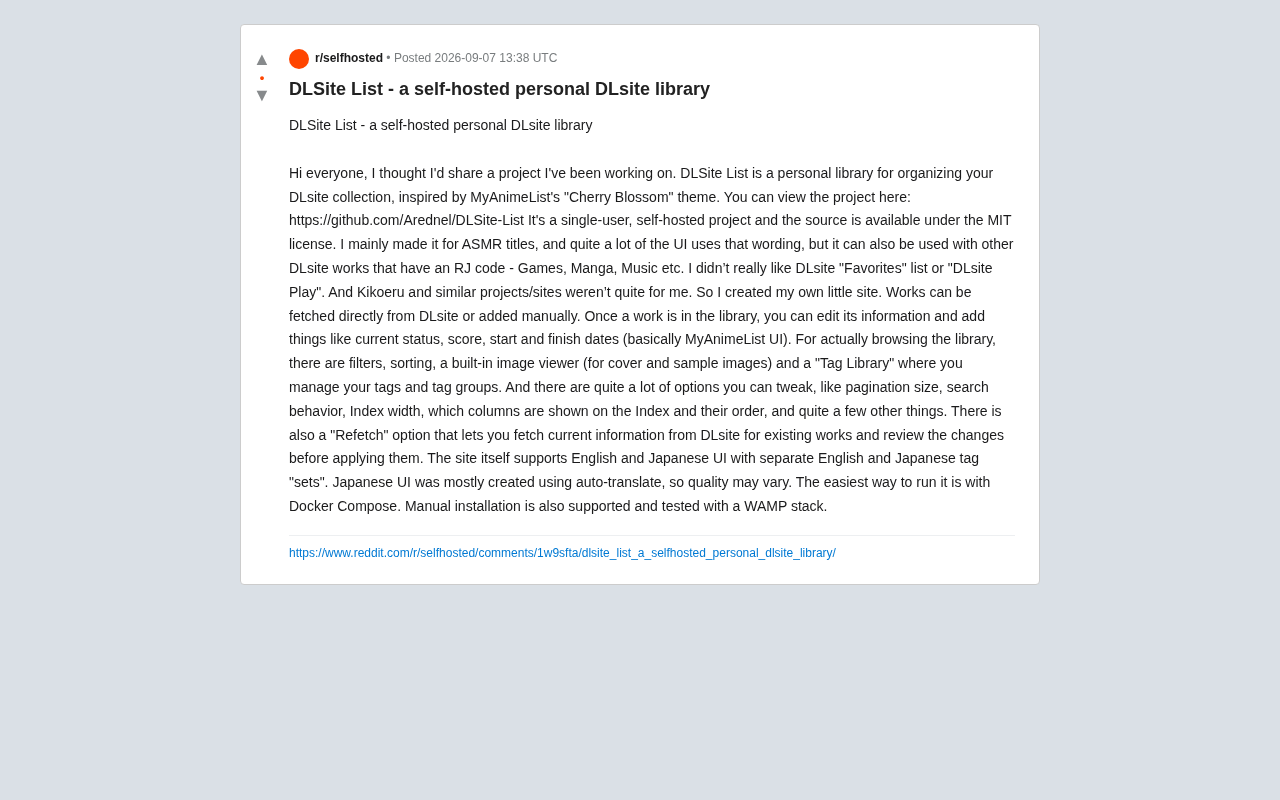
DLSite List: Complete Guide to the Open-Source Self-Hosted Digital Content Management System
DLSite List is an open-source self-hosted management system for DLsite digital content, supporting ASMR, games, manga, and RJ-numbered content scraping, categorization, and tracking. Complete guide to its features, architecture, and Docker deployment.
Intent.md Reshapes AI Development: Anthropic's New Paradigm for Agent Collaboration
Anthropic releases an AI-native SDLC handbook using Intent.md to restructure human-AI collaboration across the full development lifecycle, from requirements to maintenance.
Uncle Bob on AI Programming: Taming Agents with Deterministic Tools
Uncle Bob shares his AI programming methodology: using deterministic tools like CRAP scoring and mutation testing to constrain agents, building multi-agent pipelines for 4-5x productivity gains, while emphasizing software architecture fundamentals remain timeless.