CardioLM: A Cardiology-Focused Multilingual Small Model Suite Breaking Through Clinical NLP Resource Bottlenecks

CardioLM builds a seven-language cardiology NER benchmark and finds multilingual joint training outperforms domain-specific pretraining.
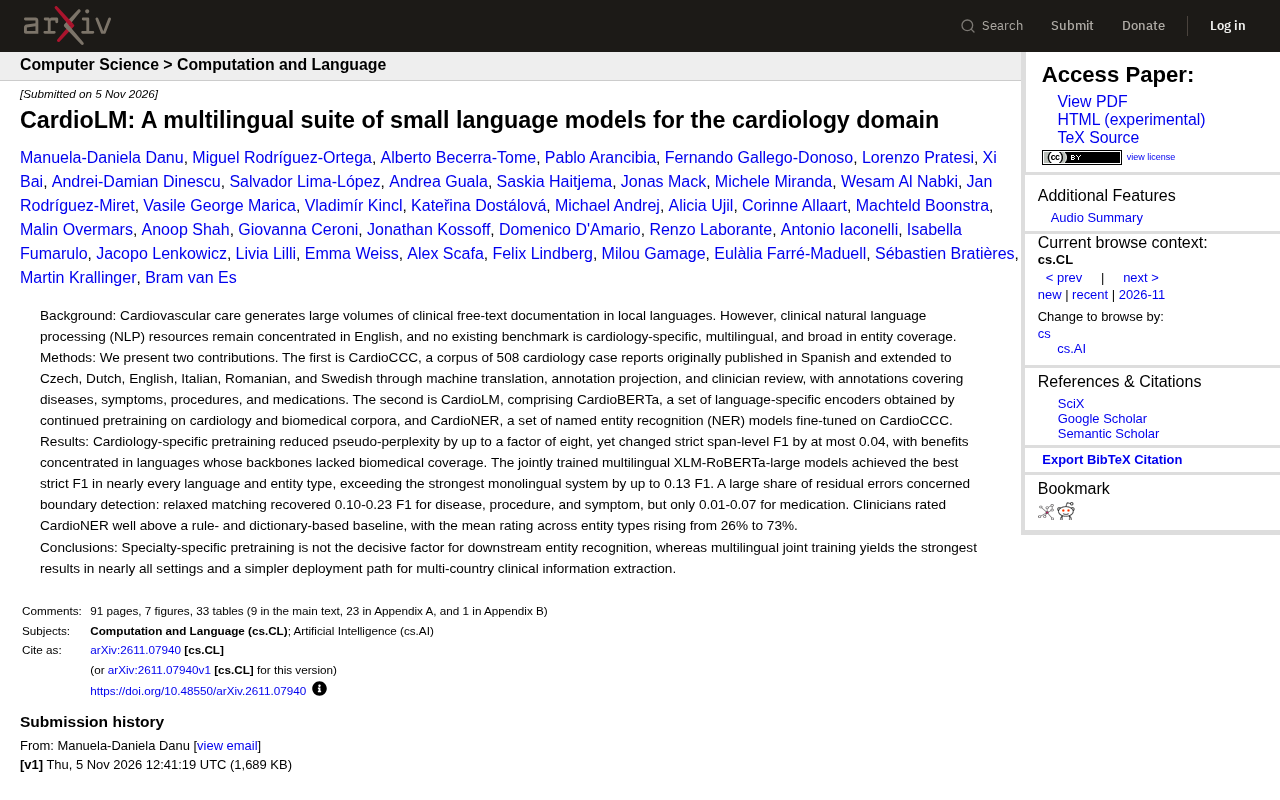
This study proposes the CardioCCC corpus and the CardioLM model suite to fill the gap in multilingual clinical NLP benchmarks for cardiology. CardioCCC contains 508 Spanish case reports expanded through translation and annotation projection into seven languages, covering diseases, symptoms, procedures, and medications. Experiments show that cardiology-specific pretraining reduces pseudo-perplexity by up to eightfold but changes strict span-level F1 by at most 0.04; the jointly trained multilingual XLM-RoBERTa-large achieves the best strict F1 on almost all languages and entity types, up to 0.13 higher than the strongest monolingual system. Error analysis shows boundary detection is the main bottleneck, especially for medication entities. In clinician evaluation, CardioNER's average score rises from 26% for rule-based baselines to 73%.
Cardiovascular care generates a large volume of clinical free-text records in local languages, yet clinical natural language processing (NLP) resources have long been concentrated in English, and there is a lack of a benchmark that is cardiology-specific, multilingual, and broad in entity types. A recent paper proposes CardioLM to fill this gap.
Two Core Contributions: The CardioCCC Corpus and the CardioLM Model Suite
The first contribution of this study is CardioCCC—a corpus containing 508 cardiology case reports. These reports were originally published in Spanish and were expanded to Czech, Dutch, English, Italian, Romanian, and Swedish through machine translation, annotation projection, and clinician review. The annotations cover four entity types: diseases, symptoms, procedures, and medications.
The second contribution is the CardioLM model suite, composed of two parts: CardioBERTa is a set of language-specific encoders obtained through continued pretraining on cardiology and biomedical corpora; CardioNER is a collection of named entity recognition (NER) models fine-tuned on CardioCCC.
According to the paper, CardioCCC is one of the few benchmarks that simultaneously satisfies the three conditions of being cardiology-specific, multilingual, and broad in entity coverage. This positioning itself is valuable—the clinical NLP community has long lacked non-English, specialized evaluation resources.
Key Finding: Domain-Specific Pretraining Is Not the Decisive Factor
The most counterintuitive result of the study is that cardiology-specific pretraining reduced pseudo-perplexity by up to eightfold, but strict span-level F1 changed by at most 0.04. In other words, the language model became "more familiar" with the specialized corpus, but this did not significantly translate into improved downstream entity recognition performance.
The paper points out that the gains from pretraining are concentrated in languages where the backbone model itself lacks biomedical coverage. For languages that already have a good biomedical pretraining foundation, continued pretraining on cardiology corpora hardly changes NER performance.
This finding has direct practical implications: if the goal is clinical entity recognition, investing substantial compute in domain-specific pretraining may not be worthwhile, especially when the backbone model already possesses biomedical knowledge.
Pseudo-perplexity is a metric for evaluating how "familiar" an autoregressive language model is with a text: each word in a passage is masked in turn, the model predicts that word and its negative log-likelihood is computed, then exponentiated or averaged. The lower the value, the better the model can "predict" the text, i.e., the better it fits the language distribution of that domain. It does not require human annotation, so it is often used to measure whether domain pretraining has allowed the model to learn specialized language patterns. However, pseudo-perplexity only reflects language modeling ability and does not directly correspond to the discriminative performance of downstream tasks (such as entity recognition); there may be a clear disconnect between the two.
Strict span-level F1 is a stringent evaluation method in named entity recognition: a prediction counts as a true positive only when the predicted entity's boundaries exactly match the ground-truth entity and the type is also correct. In contrast, relaxed/partial matching gives partial credit as long as the prediction overlaps with the ground-truth entity. Strict F1 has zero tolerance for boundary errors, so it better reflects the precision of a system in actual extraction, and also explains why boundary detection issues significantly lower this metric.
Multilingual Joint Training Wins
In contrast to domain-specific pretraining, the jointly trained multilingual XLM-RoBERTa-large model achieved the best strict F1 on almost all languages and entity types, outperforming the strongest monolingual system by up to 0.13 F1.
This means that cross-lingual transfer is indeed effective in clinical NER. For clinical information extraction scenarios that need to cover multiple countries and languages, a jointly trained multilingual model is not only more effective but also simpler to deploy—there is no need to maintain a separate model for each language.
The paper's conclusion also clearly points to this: domain-specific pretraining is not the decisive factor for downstream entity recognition, while multilingual joint training delivers the strongest results in almost all settings.
XLM-RoBERTa-large is a multilingual pretrained encoder released by Facebook AI (now Meta AI), based on the RoBERTa architecture, trained on the CommonCrawl corpus covering 100 languages, with approximately 560 million parameters. Its core advantage lies in the shared subword vocabulary and cross-lingual pretraining objective, enabling the model to transfer semantic representations across multiple languages. In clinical NER scenarios, joint training means using the same set of parameters to learn annotated data in seven languages simultaneously; the model can leverage signals from high-resource languages (such as English and Spanish) to improve performance on low-resource languages, which is also an important reason why its strict F1 generally leads monolingual models.
Error Analysis: Boundary Detection Is the Main Bottleneck
Analysis of residual errors shows that a large proportion of errors are related to entity boundary detection. When relaxed matching is used, F1 for diseases, procedures, and symptoms recovers by 0.10 to 0.23, but medication entities recover by only 0.01 to 0.07.
The boundary problem for medication entities is harder to mitigate, possibly because their expressions are more complex and more heavily nested. This detail is informative for future improvement directions: simply increasing model capacity or pretraining data volume may not solve annotation boundary consistency issues.
Relaxed matching differs from strict matching in the criterion for determining true positives: relaxed matching allows partial overlap between the predicted entity and the ground-truth entity (for example, predicting "acute myocardial infarction" when the ground truth is "myocardial infarction"), and counts it as correct as long as the overlap reaches a certain proportion or the type is consistent. Strict matching requires boundaries to be exactly identical. The F1 difference between the two directly quantifies the extent to which boundary errors drag down system performance. In the paper, diseases, procedures, and symptoms recover by 0.10–0.23 F1 under relaxed matching, indicating that the recognition content for these entities is basically correct and only the boundary segmentation is inaccurate; while medication entities recover by only 0.01–0.07, meaning that errors for medication entities come more from missed detections or type misclassification rather than simple boundary shifts.
Clinician Evaluation: Far Above Rule-Based Baselines
In manual evaluation by clinicians, CardioNER scored far higher than rule- and dictionary-based baseline systems, with average scores across entity types rising from 26% to 73%.
This result shows that although the improvements on automatic metrics may not seem dramatic, clinicians clearly perceive the practical usability of the model outputs. For tasks such as clinical information extraction that ultimately need to be integrated into real workflows, endorsement from human evaluation is more convincing than F1 numbers alone.
Implications for Clinical NLP Practice
CardioLM's work offers several actionable insights. Multilingual joint training is a robust choice for clinical NER, especially suitable for cross-national healthcare scenarios. The value of domain-specific pretraining depends on the biomedical coverage of the backbone model and should not be assumed to be a necessary step. Entity boundary detection remains the main source of error in current NER systems, especially for medication entities.
The research team has also open-sourced the corpus and model suite, providing a reusable foundation for subsequent cardiology multilingual NLP research. For researchers hoping to enter the field of non-English clinical NLP, CardioCCC and CardioLM constitute a reasonable starting point.
Related articles

Agent Clan: Command Multiple AI Coding Assistants Simultaneously with Mid-Air Gestures
Agent Clan turns Claude Code and Codex agents into a 3D team on screen, supporting fist summoning, pinch selection, drag-to-approve permissions, and local gesture and voice processing, free on Mac and Windows.

Inkling 2 Small: A 594B MoE Model That Can "See" and Revise
Thinking Machines Lab releases Inkling 2 Small, a 594B-parameter MoE model activating only 17B, focused on long-horizon coding and visual tasks where it can see and refine its own output, with inference and fine-tuning via the Tinker platform.

Deduplication: How Tech 'Steals' Everyday Words
Deduplication uses Wikipedia pageview data to quantify 719 words redefined by tech across 14 domains, revealing which meaning wins. Free and open by HackerNoon.