Career Transition Guide for Linguistics Professionals in the AI Era: Four Paths Analyzed in Depth

A strategic guide for linguistics professionals navigating career transitions in the age of LLMs and AI Agents.
This article analyzes four career transition paths for linguistics and localization professionals facing disruption from LLMs: diving into NLP engineering, staying in localization management, pivoting to conversational AI/AI Agents, or becoming an AI Product Manager. It argues that cross-domain skill combinations—linguistic insight plus technical literacy plus product thinking—offer the strongest positioning, with practical advice on the European AI job market.
Introduction: A Linguistics Professional at a Crossroads
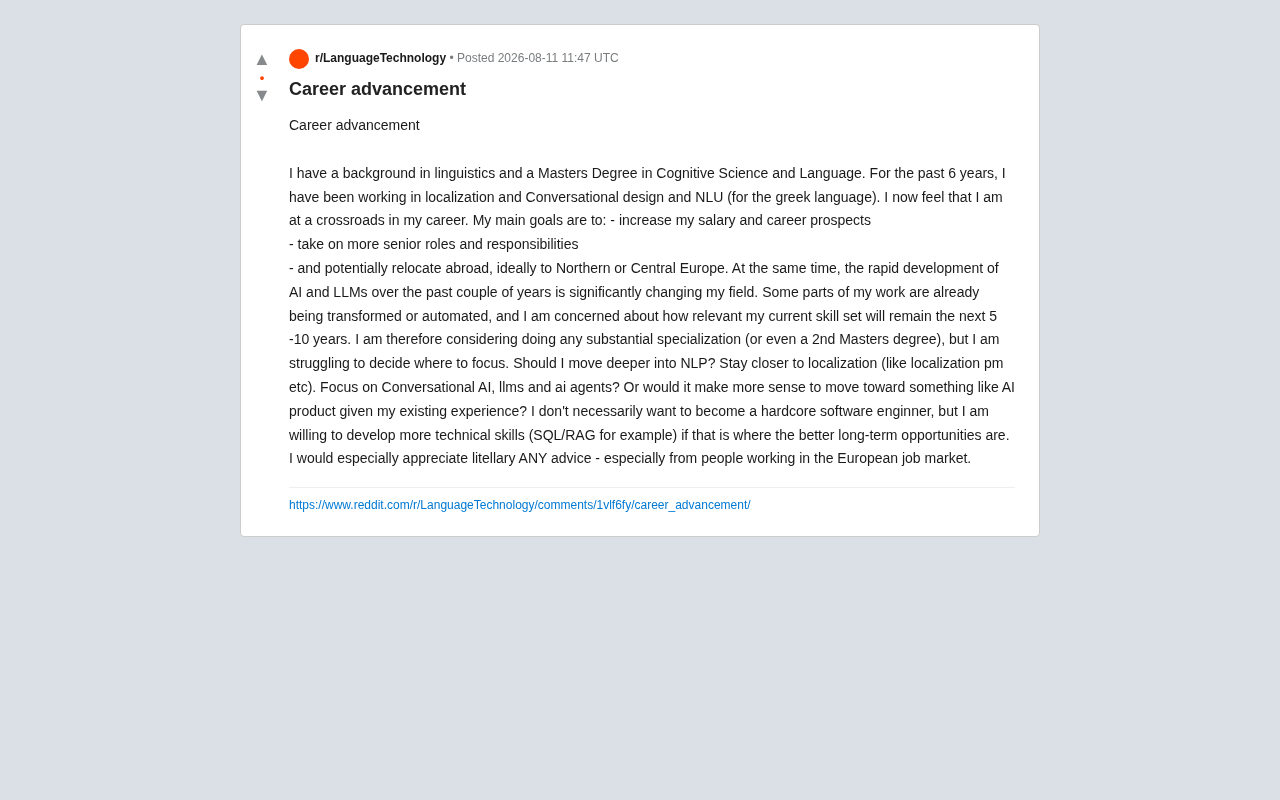
In Reddit's career development forums, a professional with a Master's degree in Cognitive Science and Linguistics raised a highly representative question. With six years of deep experience in Localization, Conversational Design, and Greek Natural Language Understanding (NLU), he now finds himself at a career crossroads.
His confusion is far from unique—it represents a defining challenge faced by countless linguistics and language technology professionals today: As Large Language Models (LLMs) reshape the entire language processing industry at an astonishing pace, how long can traditional language skills remain competitive? Which direction should one pivot toward over the next 5 to 10 years?
This article takes this professional's specific situation as a starting point to provide an in-depth analysis of transition paths and windows of opportunity for language-related roles in the AI wave.
What Is AI Changing in the Language Industry?
Traditional Functions Being Eroded by Automation
This professional candidly admits that parts of his work have "already been transformed or automated." This is an honest and clear-eyed assessment. In fact, localization and NLU are among the fields most directly impacted by LLMs:
- Leap in machine translation quality: The multilingual capabilities of models like GPT-4 and Claude have drastically simplified traditional rule-based or statistical translation workflows.
- Restructuring of conversational design: Intent recognition and dialogue trees that previously required careful manual crafting can now be rapidly achieved through Prompt Engineering and fine-tuning.
- Generalization of NLU tasks: Work that once involved training specialized models for specific languages (like Greek) is being replaced by the zero-shot/few-shot capabilities of general-purpose large models.
To understand the depth of these changes, one needs to grasp the full picture of the localization industry. Localization is not merely translation—it's the complete process of adapting products, content, or services to a specific target market, encompassing language translation, cultural adaptation, UI/UX adjustments, legal compliance, and more. The global localization industry had a market size of approximately $27 billion in 2023, long dominated by players like SDL (now RWS) and TransPerfect. However, as Neural Machine Translation (NMT) technology matures and LLMs emerge, the traditional human translation-review-typesetting workflow is being replaced at scale by MTPE (Machine Translation Post-Editing) models, with both industry margins and human labor demand undergoing structural adjustment.
Equally noteworthy is the paradigm shift in conversational design. Before LLMs, dialogue systems primarily relied on rule-based state machines and Intent-Entity frameworks, with representative platforms including Google Dialogflow, Microsoft LUIS, and Rasa. Designers needed to manually write hundreds of intent classifications, design complex dialogue trees, and fallback logic. The emergence of LLMs fundamentally changed this paradigm—systems can now autonomously generate responses through contextual understanding. But this doesn't mean the design role disappears; rather, it elevates the design needs to higher-level concerns like conversation strategy, safety boundaries, and brand voice consistency.
In the NLU field, changes are equally dramatic. NLU is a subfield of NLP focused on enabling machines to understand the meaning of human language, including intent recognition, entity extraction, sentiment analysis, and semantic disambiguation. Before LLMs, building NLU systems for low-resource languages (like Greek) required large amounts of annotated data and specialized model training. Models like GPT-4, through large-scale multilingual pretraining, demonstrate powerful zero-shot and few-shot cross-lingual transfer capabilities, making many previously specialized NLU engineering tasks generalizable. However, these general-purpose models still show notable shortcomings in dialect processing for specific languages, morphologically rich languages (like Greek's complex inflections), and culturally specific expressions.
Opportunities Hidden Within the Crisis
However, being automated does not mean being eliminated. The real opportunity lies in this: Those who understand language are precisely the ones who best understand these AI systems' deficiencies and boundaries at the linguistic level. A purely technical engineer can build a RAG system but may not be able to judge subtle semantic nuances in Greek contexts—and this is exactly where linguistics professionals have a unique competitive moat.
Four Transition Paths for Linguistics Professionals: An In-Depth Comparison
This professional proposed four possible directions. Let's analyze the long-term value of each.
Path One: Diving into NLP Technical Core
Moving closer to the technical core of Natural Language Processing means mastering hard skills like machine learning, deep learning, model training, and evaluation. This path has a high ceiling but a steep learning curve. For someone who "doesn't want to become a hardcore software engineer," a pure NLP research role may not be the best choice—unless he's willing to invest in a second, more technical Master's degree.
Path Two: Staying in the Localization Industry (e.g., Localization Project Manager)
Transitioning to a Localization PM is a relatively stable path. It preserves existing domain experience while pivoting toward management and coordination. The risk, however, is that as translation workflows become automated, the localization industry's overall scale may contract, and growth potential for management roles faces a ceiling.
Path Three: Conversational AI, LLMs, and AI Agents
This is currently the hottest and fastest-growing direction. His six years of conversational design experience can transfer almost seamlessly here.
AI Agents refer to AI systems capable of autonomously perceiving their environment, making decisions, and executing actions to achieve goals. Unlike traditional chatbots, Agents possess capabilities like tool calling, multi-step reasoning, memory management, and self-reflection. Since 2024, AI Agents have become the core direction for enterprise AI applications, with representative frameworks including LangChain, AutoGen, and CrewAI. Building Agents requires not only engineering skills but also deep understanding of human-computer interaction logic, task decomposition strategies, and dialogue management—precisely where conversational design practitioners have experiential advantages. Gartner predicts that by 2028, 33% of enterprise software will integrate Agent capabilities.
Combined with supplementary technical skills like SQL and RAG, he could become a rare bridge-type talent connecting language understanding with engineering implementation.
Path Four: Transitioning to AI Product Manager
Given his six years of industry experience, transitioning to an AI Product Manager (AI PM) may offer the highest return on investment.
The AI Product Manager is a rapidly emerging composite role that differs from traditional PMs in a core way: it requires understanding AI models' capability boundaries, data requirements, evaluation metrics, and iteration methods. AI PMs don't need to train models themselves but must be able to engage in deep technical conversations with data scientists and ML engineers while translating complex AI capabilities into clear user value propositions. The role typically requires basic data analysis skills (SQL/Python), understanding of model evaluation metrics (precision, recall, F1, etc.), and familiarity with the unique lifecycle of AI products (including data flywheels, model drift monitoring, etc.).
An AI PM doesn't require you to write code yourself, but demands that you simultaneously understand user needs, language technology boundaries, and business value. This precisely combines his linguistic insight, industry experience, and willingness to learn technical skills. For linguistics professionals in transition, serving as an AI PM on NLP/conversational AI product lines is a highly aligned positioning.
Core Strategies for Linguistics Professionals in Transition
Skill Combinations Over Single-Point Deep Expertise
In the AI era, what's most resilient isn't a single skill, but cross-domain capability combinations. For this professional, the ideal positioning is:
Linguistic insight + Conversational AI experience + Basic technical skills (SQL/RAG/API) + Product thinking
This combination ensures he won't be replaced by pure engineers, nor outpaced by purely business-oriented professionals.
Prioritize Building "Technical Translator" Capabilities
He mentioned willingness to learn SQL and RAG—this direction is absolutely correct.
RAG (Retrieval-Augmented Generation) is an architecture that combines external knowledge retrieval with LLM generation. Its core idea is: before the LLM generates an answer, it first retrieves relevant document fragments from a knowledge base, injects them as context into the prompt, enabling the model to generate more accurate, evidence-based responses. RAG addresses two major pain points of pure LLMs—hallucination and knowledge timeliness. A typical RAG system includes document chunking, vector embedding, vector database storage, semantic retrieval, and answer generation.
With these skills, he would be able to:
- Communicate efficiently with engineering teams
- Independently verify the linguistic output quality of AI systems
- Design and evaluate RAG effectiveness
For linguistics professionals, understanding RAG means being able to evaluate retrieval quality, optimize chunking strategies, design better prompt templates, and judge the linguistic accuracy of generated content. This makes him an indispensable "technical translator" within teams—someone who understands both the technical implementation and maintains quality control over language output.
On the European AI Job Market and Relocation
His goal is to relocate to Northern or Central Europe. What you might not have noticed:
- Germany, the Netherlands, and Nordic countries have strong demand for AI product and conversational AI roles, with English-friendly work environments.
- A multilingual background is a significant advantage in the European market, especially for roles managing multilingual AI product localization.
- AI Agents and enterprise-level LLM applications are currently high-frequency keywords in European tech company hiring.
The European AI job market has unique structural characteristics. First, influenced by GDPR and the soon-to-be-fully-implemented EU AI Act, European enterprises have exceptionally strong demand for AI governance, compliance, and responsible AI, creating numerous non-purely-engineering AI roles. Second, cities like Berlin, Amsterdam, Stockholm, and Copenhagen have formed mature tech ecosystems with high acceptance of English-language work environments. Furthermore, Europe's multilingual market naturally requires AI talent with cross-linguistic capabilities—a professional who can simultaneously understand the characteristics of multiple European languages holds irreplaceable value in multilingual AI product localization, quality assessment, and user research.
Conclusion: Turning a Linguistics Background into Leverage for the AI Era
This professional's anxiety is essentially the collective anxiety of all traditional skill holders facing technological revolution. But the answer doesn't lie in abandoning the past—it lies in recombination.
Six years of conversational design and NLU experience isn't a burden—it's a natural advantage for understanding AI language systems. True transition isn't about learning to code from scratch; it's about layering sufficient technical sensitivity and product vision on top of existing professional depth to become that crucial "understands both language and technology" role in AI deployment.
For readers with similar backgrounds, this case offers a clear lesson: As AI reshapes industries today, rather than fearing replacement, proactively position yourself in the intersections that machines find difficult to replace.
Key Takeaways
Related articles

Grok Bot vs ChatGPT Agent: Which AI Agent Is More Powerful?
How does Grok Bot differ from ChatGPT Agent? This comparison examines how they work: Grok Bot has a cloud computer and runs persistently inside tools to execute multi-step tasks automatically; ChatGPT Agent operates web pages in a browser and is more mature at general tasks. Includes selection advice.

Walmart Agent Gateway: AI Shops for You Automatically—Why Is Amazon Going the Opposite Way?
Walmart's Agent Gateway lets ChatGPT, Gemini and other AI assistants access its product catalog to search, compare and add to cart, with spending limits and per-purchase approval. Amazon blocks external AI agents—two retail giants, opposite paths. Currently US-only, India may follow.

Walmart Opens Shopping to AI Agents: ChatGPT and Gemini Can Place Orders
Walmart launches Agent Profiles, allowing AI agents like ChatGPT, Gemini, and Meta Muse to shop for users with spending limits, per-transaction approval, and isolated orders—no Walmart Plus required. This article analyzes how it works and its industry impact, in stark contrast to Amazon's blocking of AI agents.