CarMaker AI Agent: A New Paradigm for Simulation Engineering Efficiency

CarMaker AI Agent embeds MCP tools into simulation workflows, returning engineers from repetitive operations to objective judgment.
The article introduces CarMaker AI Agent shared by IPG digital engineer Zhang Li, aimed at solving four major efficiency pain points in simulation testing: parameter searching, time-consuming preparation, repetitive operations, and result analysis. The system shifts the workflow from "human operating software" to "human defining objectives, Agent executing, human reviewing results." Technically, CarMaker's simulation capabilities are encapsulated via the MCP protocol into standardized tools covering pre-simulation, preparation, execution, and result stages, usable by this Agent and other Agent platforms. A live demo shows the Agent automatically completing 6 groups of SUV double lane change simulations, from condition loading to report output.
In today's simulation-driven development landscape, the core challenge engineers face is often not "not knowing how to do it," but "doing it repeatedly." In a Bilibili presentation, IPG digital engineer Zhang Li demonstrated how CarMaker AI Agent embeds large language model capabilities into simulation workflows, freeing engineers from tedious configuration and comparison tasks.
The pain point of simulation efficiency was never a single-point problem
A complete testing task, from objective to result, has efficiency-impacting steps throughout the entire process. Zhang Li categorized them into four levels: Usage threshold — engineers know the test objective, but which parameters correspond to that objective and how to set them still requires repeated searching through documentation and interfaces; Preparation time — when adjusting parameters such as vehicle load and road surface friction coefficient, locating and modifying them consumes time; Repetitive operations — lateral comparison testing requires repeatedly setting variables, and manually switching conditions is error-prone and tedious; Result analysis — after simulation ends, identifying differences and organizing comparison data also requires effort.
These pain points are not isolated. When the test scale expands from a single set to multiple coupled conditions, the cumulative effect of repetitive operations significantly amplifies time costs. The entry point of CarMaker AI Agent is precisely to connect these steps together, using the Agent to take over "execution" and return engineers to "judgment."
How the Agent reconstructs the simulation workflow
After adding CarMaker AI Agent, the workflow shifts from "human operating software" to "human defining objectives, Agent executing steps." The user submits a testing requirement, and the Agent lists a test plan and checklist for confirmation; after confirmation, it automatically runs the simulation; upon task completion, it intelligently compares results and returns a report for review. During the process, users can supplement or adjust conditions at any time, and the Agent updates the checklist and continues execution.
In this mode, the engineer's role is redefined into three key nodes: grasping validation objectives, execution confirmation, and result review. The specific operations are completed by the Agent, but control always remains in human hands.

Interaction interface and task orchestration
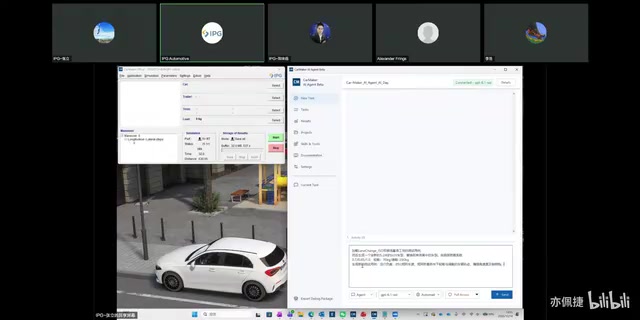
The Beta version interface of CarMaker AI Agent is divided into several functional areas: the left menu bar covers Task (historical task status), Result (centralized viewing of simulation results), Projects (project management), Skill and Tool (skills and MCP tools), Documentation (documentation and knowledge base integration), and Setting (model and parameter configuration). The middle is the main conversation and execution area, with the task input area below, providing quick options for work mode, AI model reasoning intensity, and operation permissions. The right area is used to view current task records, results, and previews.
A live demonstration of six simulation groups
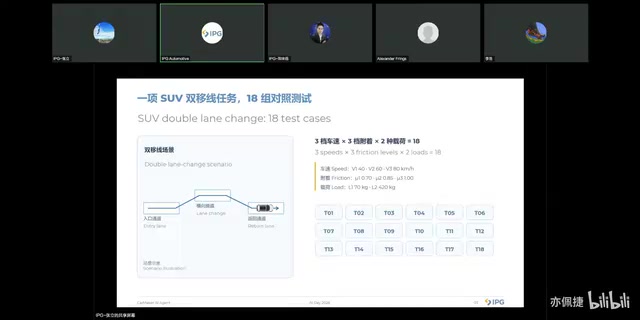
Zhang Li demonstrated the Agent's actual operation using an SUV handling stability test as an example. The original task required testing three vehicle speeds (40, 60, 80 km/h), three road surface friction coefficients (0.7, 0.85, 1), and two loads (light load 70KG, full load 280KG) in combination, totaling 18 double lane change simulations. In the demonstration, to save time, it was simplified to 6 groups: loading the ISO double lane change baseline condition, generating a 5.2-meter SUV model to replace the default model, and generating and running test cases based on road surface friction coefficients of 0.5, 0.85, 1.0 combined with two loads.
After granting Full Access permission, the Agent automatically completed condition loading, model replacement, test case generation, and simulation execution. The interface displayed load switching and execution progress in real time, and the dialog box synchronized feedback on the current running status. After all were completed, the Agent quickly read the results and generated a report, answering comparison questions about metrics such as yaw rate and roll.
Double Lane Change (ISO 3888-1) is a classic benchmark condition in vehicle handling stability testing: the vehicle completes two consecutive reverse lane changes at a constant speed, used to evaluate metrics such as yaw rate, roll angle, and lateral acceleration, reflecting the vehicle's handling stability and rollover resistance in emergency obstacle avoidance scenarios. In testing, different road surface friction coefficients (e.g., 0.5 simulating wet and slippery roads, 1.0 simulating dry asphalt) and different load states are often used as variables to examine the vehicle's performance under boundary conditions. Combining three vehicle speeds, three friction coefficients, and two loads in a full factorial design constitutes the 18-group test matrix described in the article. This type of multi-variable coupled testing is precisely the scenario that takes the longest time for manual operation and is also where the Agent's automation value is most prominent.
Technical architecture: MCP is the key connecting the brain and the tools
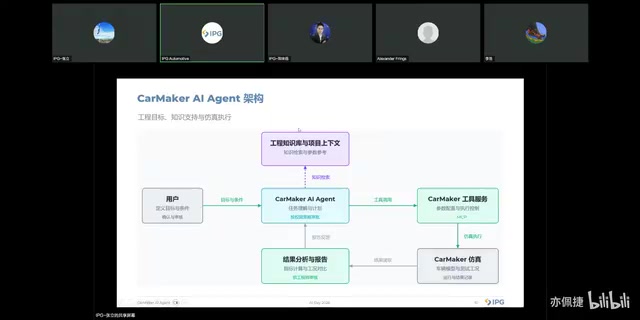
The entire system architecture is divided into three layers from left to right: the user defines the test objective, CarMaker AI Agent understands the requirements, orchestrates the plan, and invokes tools according to permission policies, and the CarMaker tool service exposes capabilities such as parameter configuration and simulation execution to the Agent through MCP. Above is the engineering knowledge base and project context, providing background knowledge references for the Agent. After the simulation ends, the result report is returned for user review.
MCP tools are divided into four categories by simulation stage: pre-simulation engineering information reading and query tools, helping the Agent understand which test cases and parameters exist in the current project; preparation stage vehicle configuration and test case modification tools; execution stage simulation start, status query, and output recording tools; result stage result reading and metric calculation tools. These tools encapsulate CarMaker's simulation capabilities into standardized interfaces callable by the Agent, and can also be integrated into other Agent platforms — if the team already has its own Agent platform, after adaptation, the entire set of CarMaker MCP tools can be reused. Zhang Li mentioned that Yisu's AI test automation platform also integrated simulation capabilities through CarMaker MCP.
MCP (Model Context Protocol) is an open protocol proposed by Anthropic at the end of 2024, aimed at establishing a standardized connection method between large language models and external tools and data sources. In traditional integration solutions, each new tool often requires custom interface development, whereas MCP abstracts tool capabilities into standard primitives such as "resources," "tools," and "prompts," enabling Agent platforms to discover and invoke external services in a unified way. Its architecture is similar to "USB-C for the AI field": tool providers only need to implement an MCP server once, and any MCP-compatible client (such as Claude Desktop or a self-developed Agent platform) can directly reuse it. In the CarMaker scenario, this means that once simulation capabilities are encapsulated as standardized MCP tools, they not only serve CarMaker AI Agent but can also be quickly integrated by other MCP-compatible Agent platforms, significantly reducing the cost of ecosystem expansion and cross-platform integration.
The return of engineer value
The goal of CarMaker AI Agent is not to replace engineers, but to reallocate their energy to higher-value steps. When parameter searching, repetitive configuration, and data organization are taken over by the Agent, engineers can focus more on defining test objectives, judging the reasonableness of results, and making engineering decisions. This collaborative model of "human gatekeeping, Agent execution" may be the most pragmatic evolution path for simulation engineering in the AI era.
One-line Summary
CarMaker AI Agent embeds MCP tools into the simulation workflow, returning engineers from repetitive operations to objective judgment.
Paragraph Summary
The article introduces CarMaker AI Agent shared by IPG digital engineer Zhang Li, aimed at solving the four major efficiency pain points in simulation testing: parameter searching, time-consuming preparation, repetitive operations, and result analysis. The system shifts the workflow from "human operating software" to "human defining objectives, Agent executing, human reviewing results," with engineers focusing on three nodes: validation objectives, execution confirmation, and result review. In terms of technical architecture, CarMaker's simulation capabilities are encapsulated through the MCP protocol into standardized tools covering the four stages of pre-simulation, preparation, execution, and results, which can be invoked by this Agent and also integrated into other Agent platforms. In the live demonstration, the Agent automatically completed condition loading, model replacement, case generation, and report output for 6 groups of SUV double lane change simulations, embodying the pragmatic collaborative model of "human gatekeeping, Agent execution."
Related articles

Aircad: A New Choice for Professional Drafting and 3D Modeling in the Browser
Aircad showcases browser-based professional drafting and 3D modeling on Hacker News, exploring an install-free CAD workflow. This article analyzes its positioning, potential advantages, and the uncertainties of an early-stage project.

Why Audiences Reject AI-Generated News
AI is becoming the information gateway, yet audiences still resist AI-generated news. This article analyzes the roots of the trust deficit, the boundary between information gateway and content production, and practical implications for media organizations adopting AI.

How Law Firms Can Use AI to Reshape Legal Practice: The Gilbert + Tobin Experience
Gilbert + Tobin partner and CEO Sam Nickless discusses how law firms can use AI to rethink their legal business model—moving from efficiency tools to business logic restructuring, and why CEO-level involvement in AI strategy matters.