CATT 0.2.1: Testing AI Agents Against a Muse/Instinct Simulator in CI
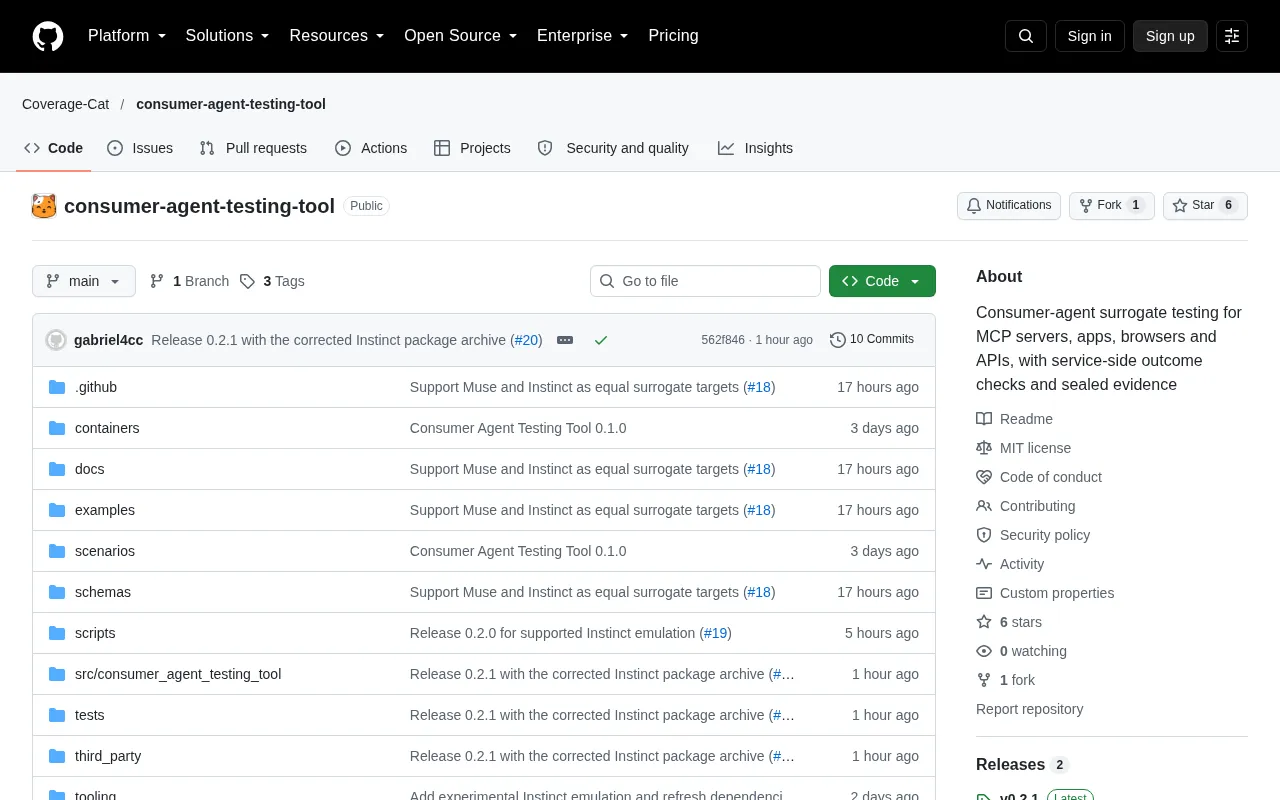
CATT 0.2.1 aims to automate AI agent behavior testing through a simulated environment plus CI integration.
CATT 0.2.1 is an early-stage tool from Hacker News for testing AI agents/services in CI against a Muse/Instinct-like simulator. It builds a simulated runtime environment and integrates with CI to automatically verify agent tool calls, exception handling, and response compliance after each commit, addressing the gap left by traditional unit tests. The project is very early, with little community feedback and unclear details on open source status, language support, and simulation fidelity.
Why Do AI Agents Need a New Testing Tool?
As AI agents and intelligent services become more widespread, developers face a practical challenge: how do you ensure these agents run reliably across a wide range of scenarios? Traditional unit tests struggle to cover complex behaviors such as an agent's interactions with external tools and multi-turn conversations. CATT 0.2.1 (full name not disclosed, but its purpose is clear), which recently appeared on Hacker News, was built to solve exactly this problem. It lets developers test agents and services in a Muse/Instinct-like simulated environment within their continuous integration (CI) pipeline.
According to the Hacker News post, CATT 0.2.1 is positioned as "Test agents/services against a Muse/Instinct-alike, in CI." Although project details are limited, this approach targets a real pain point in AI engineering today: the lack of a repeatable, automatable way to validate agent behavior.
AI agents are intelligent programs that can perceive their environment, make decisions autonomously, and call external tools (such as search, databases, and APIs) to complete multi-step tasks. Typical examples include tool-calling agents built on large language models. Unlike single-turn Q&A, an agent's behavior is a sequence of actions: plan, select a tool, execute, observe the result, and plan again. This multi-turn loop makes it hard for traditional unit tests to cover, because you cannot verify correctness simply by asserting that one input maps to one output. You must simulate the external tool environment and inspect the entire behavior trace.
Continuous integration (CI) is the practice of frequently merging code into the main branch and then running builds, tests, and deployments through an automated pipeline. Its core idea is to "find problems early," automatically triggering tests on every commit so that defects don't accumulate until release. Bringing AI agent testing into CI means validating agent behavior after every code change in a repeatable, automated way—exactly the problem CATT tries to solve.
CATT 0.2.1: Core Approach and Value
Simulating a Realistic Agent Runtime Environment
Muse and Instinct may be the names of specific agent frameworks or services (the original post doesn't elaborate). CATT builds an "alike" simulated environment so that developers can test agent logic without relying on real external services. This is similar to a Mock Server in front-end testing, but it targets an AI agent's tool calls, state management, and response generation.
Mock Server is a common stand-in service in software testing: it doesn't execute real business logic but instead returns fixed or programmable responses according to preset rules, letting the code under test run without depending on external systems. In AI agent testing, this idea is extended into a "simulated tool environment": fake external APIs, fake knowledge bases, or fake services return controlled results, so you can precisely observe whether the agent correctly selects tools, handles error responses, or transitions between states. Unlike an ordinary mock, an agent's output is often natural language and non-deterministic, so the testing tool also needs to support assertions on the behavior trace (which tools were called, whether the parameters were correct), not just matching the final text.
Seamless CI Pipeline Integration
Bringing agent testing into CI is CATT's biggest selling point. After each commit, CATT can automatically run preset scenarios to verify that the agent calls tools as expected, handles exceptions, or generates compliant responses. This helps catch regressions early and prevents the agent from "hallucinating" or taking wrong actions in production.
Changing How Developers Work
Traditionally, agent testing has relied on manual scripts or scattered unit tests, with low coverage and high maintenance burden. CATT's standardized testing framework lets teams define test cases declaratively and get pass/fail results just like with ordinary tests. This lowers the barrier to testing AI agents, and it is especially well suited to intelligent service projects that need frequent iteration.
Potential Limitations and Open Questions
Since the project is at an early 0.2.1 stage, and the Hacker News post has only 4 points and zero comments, community feedback is essentially nonexistent. It is currently unclear whether CATT is open source, which programming languages it supports, and how faithful the simulated environment is. In addition, the exact meaning of "Muse/Instinct-alike" depends on context—if Muse/Instinct is a specific commercial product, CATT's general applicability may be limited. Developers will need to assess its compatibility with their existing tech stack themselves.
Summary and Outlook
CATT 0.2.1 represents one direction for making AI agent testing a first-class tool: bringing agent behavior into the traditional CI/CD system. Although information is limited, the idea is worth watching. Teams building agent services may want to follow the project's progress, or borrow its "simulated environment + CI integration" model to build their own testing solution.
Key points:
- CATT 0.2.1 provides a Muse/Instinct-like simulated environment for testing AI agents and services in CI.
- Its goal is to automate agent testing and catch regressions early.
- The project is early-stage, with limited details and community feedback, so it should be evaluated carefully.
One-line Summary
CATT 0.2.1 aims to automate AI agent behavior testing through a simulated environment plus CI integration.
Paragraph Summary
CATT 0.2.1 is an early-stage tool that appeared on Hacker News, positioned as "test agents/services against a Muse/Instinct-alike, in CI." The article notes that traditional unit tests struggle to cover complex behaviors such as an agent's interactions with external tools and multi-turn conversations. CATT addresses this by building a simulated runtime environment, letting developers validate agent logic without relying on real external services, and by integrating testing seamlessly into the CI pipeline so that after every commit it can automatically check whether the agent calls tools as expected, handles exceptions, or generates compliant responses. However, the project is at an early 0.2.1 stage and community feedback is essentially nonexistent. It is unclear whether it is open source, which languages it supports, and how faithful the simulated environment is, and its general applicability may be limited by what "Muse/Instinct-alike" specifically refers to, so developers should evaluate compatibility carefully.
Related articles
Don't Rush AI to Write Code: 4 Skills That Turn Design into Executable Tasks
A 20-year veteran engineer explains why AI coding means humans should focus on design and planning, not code. Use architecture.md to anchor architecture with four skills—design, architecture review, HTML docs, and planning—to turn technical plans into executable tasks and improve software quality.

The Early History of the AI Revolution: Google, Musk, and the Race That Changed Everything
From Google's DeepMind acquisition to ChatGPT's surprise breakout, The Vergecast and Kevin Roose's new book reveal the early decisions that changed AI forever.

Gmod TTT in Horror Mode: Vampires and Werewolves New Roles Tested
Yogscast Halloween Gmod TTT special: Vampire conversion, Werewolf silver-bullet weakness, Frenchman wall-penetrating baguette kills, and role draft strategy shifts—plus balance feedback from the match.