Caught Between Two Worlds: Content Creators Want Search Visibility But Reject AI Training
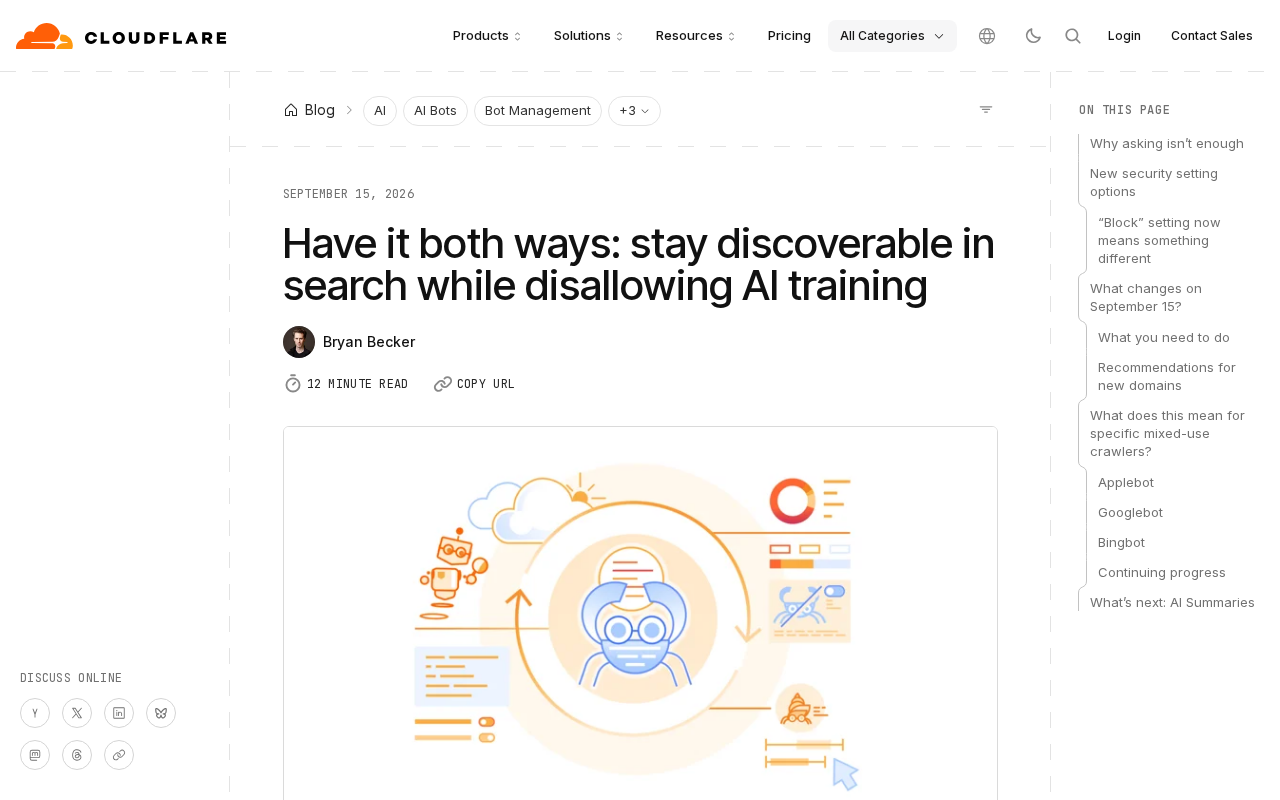
Creators want to be searchable but not AI-trainable — and current tools can't fully deliver that.
The rise of generative AI has broken the implicit "crawl for traffic" bargain between search engines and content creators, who increasingly want their content indexed but not used for AI training. Yet robots.txt is an unenforceable honor system that can't distinguish between search and training crawlers. Practical options — fine-tuning robots.txt, using meta tags, tracking emerging AI licensing protocols — only work against compliant crawlers. A real solution awaits the maturation of content licensing models, unified technical standards, and a new balance of interests among creators, search engines, and AI companies.
A Growing Tension
Website operators and content creators are facing an unprecedented dilemma: they want their content indexed by search engines and discoverable online, yet they don't want that same content used to train large language models. What seems like a straightforward request turns out to be surprisingly complex when confronted with technical and commercial realities.
In the past, there was an implicit bargain between search engines and publishers — crawl my pages, send me traffic in return. But the rise of generative AI has upended that exchange. AI models now ingest content and deliver answers directly to users, who no longer need to click through to the original site. Creators lose the traffic and revenue they would otherwise have earned.
The Limits of robots.txt
Traditionally, websites use a robots.txt file to control crawler behavior. But this mechanism has shown clear weaknesses in the age of AI. Many AI training crawlers lack transparent identifiers, or a single company may use different User-Agents for search indexing versus model training — making it extremely difficult for site operators to achieve the fine-grained control of "allow search, block training."
More problematic still: robots.txt is fundamentally an honor system with no enforcement power. Compliance is entirely at the crawler's discretion. Once content has been scraped and incorporated into a training dataset, it is nearly impossible to trace or retract.
robots.txtis a plain-text file placed in a website's root directory. It usesUser-Agentfields to specify which crawlers a rule applies to, andDisalloworAllowdirectives to declare which paths may be accessed. The protocol dates back to 1994 and was originally designed only to prevent crawlers from overloading servers — it was never intended to carry legal weight. Any crawler can simply ignore the file and bypass all restrictions, and site owners have no technical means to verify whether crawlers actually comply. Additionally,robots.txtis publicly readable, which means the list of User-Agents a site operator uses to block certain crawlers can itself be used by bad actors to disguise their identity. This fundamental flaw is significantly amplified in AI scraping scenarios.
How Platforms Are Responding
Major search engines and AI companies have begun splitting their crawler identifiers in an attempt to offer more granular control options. Some vendors now provide separate User-Agents for search indexing and AI training, allowing site operators to block training crawlers in robots.txt while preserving search indexability.
But this approach depends on cooperation and standardization across vendors. Currently, identifier naming conventions and compliance levels vary widely across platforms. Creators must configure rules separately for each provider, the operational overhead is high, and it's nearly impossible to cover every potential scraper.
What Creators Can Do
Under current conditions, content owners can take several pragmatic steps:
- Fine-tune your robots.txt: Explicitly list known AI training crawler User-Agents and block them, while preserving access for search engine crawlers.
- Use meta tags for page-level control: Some platforms support page-level meta tags that declare whether content may be used for AI training.
- Follow emerging standards: The industry is exploring new protocols specifically designed to express "AI usage preferences," providing clearer signaling mechanisms for content licensing.
It's important to be clear-eyed about the limits here: the effectiveness of these measures ultimately depends on whether scrapers choose to respect them. Technical blocking can only stop rule-abiding crawlers. Against actors who deliberately circumvent identifiers, these measures offer limited protection.
Page-level
<meta>tag solutions currently rely on non-standardized custom attributes such asnoaiandnoimageai, with no unified standard in place. More mature options include Google's extendedgooglebotdirectives and values likenoindexandnosnippetwithin therobotsmeta tag supported by some platforms. Emerging proposals under discussion include the TDM Reservation Protocol (designed specifically for text and data mining authorization) and proposals like AI.txt, which attempt to establish declaration mechanisms similar to robots.txt but tailored for AI use cases. Whether these drafts will gain broad adoption among major AI companies remains highly uncertain. Creators tracking these developments should evaluate each proposal based on actual implementation progress, not just its name.
The Deeper Power Struggle
Beneath this debate lies a fundamental restructuring of how content value is distributed. When AI can digest vast amounts of web content and generate direct answers, the original "crawl for traffic" ecosystem is no longer sustainable. Creators, search engines, and AI companies need to establish a new balance of interests — whether through paid content licensing, clear technical standards, or regulatory intervention.
For now, no consensus has emerged across the industry. Creators' desire to be "searchable but not trainable" can only be partially met in the short term through imperfect technical measures and vendor goodwill. A real solution may not arrive until content licensing business models and technical standards mature in tandem.
Early experiments in content licensing have already emerged in the news media sector: OpenAI, Google, and others have signed licensing agreements with institutions like The New York Times, Axel Springer, and the Associated Press, exchanging one-time or ongoing payments for rights to use content in training. But these deals are currently accessible only to large media organizations with real negotiating power — independent creators and small-to-mid-sized websites have almost no seat at the table. Another potential path is a collective licensing model, similar to ASCAP in music rights or equivalent organizations in other countries, where an intermediary represents a large pool of creators to negotiate collectively and distribute revenue. Whether this model can be transplanted to web content faces practical obstacles including difficulty establishing content ownership and the absence of measurement standards — but it represents a structurally sound approach worth exploring.
Related articles

Letting AI Build AI Tools: A 7-Day, 31-Commit Bootstrapping Post-Mortem
An engineer ran a fully autonomous AI-builds-AI pipeline for 7 days, 31 commits, with a 1-in-6 success rate. This post-mortem covers 5 failure types, 11 structural rules, and how every mistake became a permanent immunity gate.
Building an AI-Powered E-Commerce Business from Scratch: A Real-World Account of Multi-Agent Architecture for Print-on-Demand
A blogger builds a print-on-demand e-commerce company from scratch using AI agents — documenting specialized Agent profiles, GPT-5.6 vs Claude Fable multi-model orchestration, and reusable skill accumulation.

AI Agent Earns $10K in One Week: 3 Key Upgrades Explained
A blogger shares how he earned $10K in a week with an AI Agent — not by adding more skills, but through verification, approval gates, and subagents to raise trust and enable true automation.