CC: An AI Assistant for Families — Exploring a New Product Direction

CC is a family-focused AI Agent aiming to fill the gap that mainstream productivity-oriented AI has long ignored.
While most AI products focus on workplace productivity and coding, the family context — with its high-frequency, fragmented needs — has been largely overlooked. CC attempts to bring AI Agent capabilities to family collaboration, covering scheduling, chores, parenting reminders, and more. The Agent's proactivity and contextual understanding make it a better fit for these tasks than traditional tools. However, the direction faces three core challenges: the extreme sensitivity of family data demands a higher trust bar than any workplace setting; multi-user collaboration introduces complex permission boundaries and preference conflicts; and family tools universally struggle with post-download abandonment. The article concludes that family AI Agents are a differentiated direction with real potential, but success hinges on building trust, designing for low-barrier use, and delivering sustained everyday value.
An Overlooked AI Use Case: The Home
Most AI assistants today are built around productivity, coding, and workplace efficiency — from code completion to document processing, product designers have largely assumed their users are knowledge workers. A new product called CC takes a different path, bringing AI Agent capabilities into the family context.
This approach is worth paying attention to. The home is a high-frequency environment that mainstream AI products have long overlooked: scheduling coordination, household task division, parenting reminders, shopping lists, information sync between family members — these mundane but very real needs are precisely where general-purpose assistants fall short. CC's positioning attempts to fill that gap.
It's worth noting that the available information on this product is still limited (discussion on Hacker News remains early-stage, with only a handful of comments). This article is therefore more of an analysis of the product's positioning than a review of a mature product.
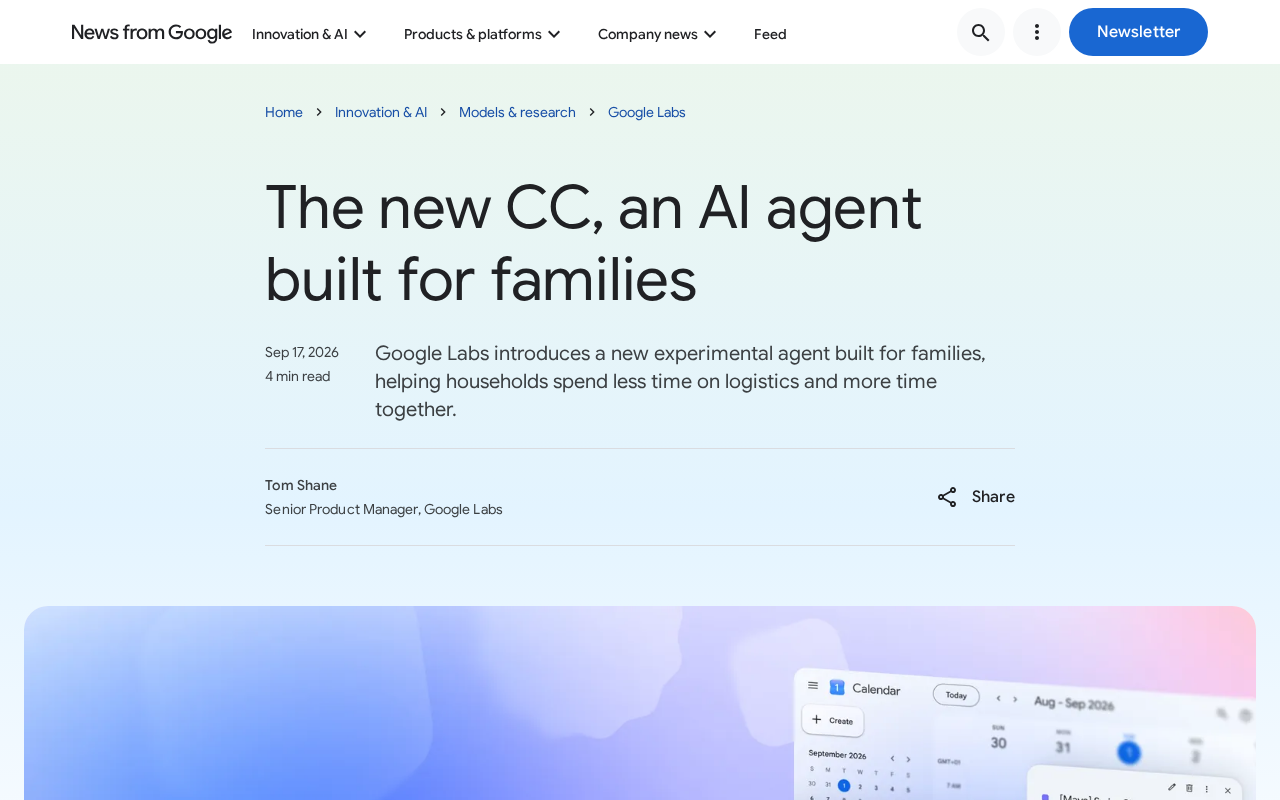
Why a Family AI Agent Is a Worthwhile Direction
Fragmented Needs, But Real and High-Frequency
Family life is characterized by scattered tasks, multiple participants, and constant context-switching. A typical household deals with an enormous daily information stream spanning multiple members, time-sensitive events, and varied task types. Traditional tools — calendars, notes, group chats — can record information, but they can't proactively understand intent, coordinate across tasks, or anticipate needs.
This is exactly where AI Agents shine: proactivity and contextual understanding. Unlike a chatbot that simply responds to queries, an Agent can track task states, chain together multi-step actions, and loop back on progress — a pattern that maps directly onto the "arrange, remind, follow up" cycles of family life.
The fundamental difference between an AI Agent and an ordinary chat assistant lies in autonomous action. Chat assistants (like directly querying ChatGPT) are reactive — you ask, it answers, and the interaction ends at the dialog box. An Agent architecture allows the AI to autonomously decompose goals, call external tools (calendar APIs, shopping platforms, push notifications, etc.), execute multi-step tasks, and adjust strategy based on intermediate results. In a family context, this means the system doesn't just tell you "you should buy groceries today" — it can check your pantry records, compare them against last week's shopping list, and place an order directly after your confirmation. This end-to-end task closure is the core value that distinguishes Agents from ordinary conversational AI.
A Different Set of Priorities from Productivity Tools
Workplace AI products optimize for maximum efficiency and output quality. Family settings, by contrast, prioritize collaboration, warmth, and accessibility. Family members vary widely in technical ability, so the product must be simple enough for grandparents and children to use. This imposes very different interaction design requirements than productivity tools — lowering the barrier to entry may matter more than stacking features.
The Core Challenges the Product Faces
Privacy and Trust: The First Barrier
Family data is far more sensitive than office data — it encompasses schedules, health information, location, spending habits, and even children's data. An AI Agent that requires deep access to family life must offer a credible, trustworthy approach to privacy protection. This is not just a technical problem; it's a process of building trust. Any risk of data leakage or misuse will drive users away.
The privacy challenge for family AI products is more complex than for enterprise software, because the "family" is not a single trust entity. Enterprise data ownership is clear, and employees are bound by company policy. Family members, however, define information boundaries in emotional, dynamic, and informal ways. Does a parent have the right to view an adult child's schedule? Are both spouses' spending records fully visible to each other? There are no universal answers. Product design must offer sufficiently granular permission controls — not just a simple "family sharing" toggle. Beyond that, the choice between on-device AI and cloud processing directly affects users' sense of control over their data: the more sensitive the family data, the lower users' tolerance for "uploading to the cloud."
The Complexity of Multi-User Collaboration
Unlike a personal assistant, a family Agent serves multiple users simultaneously, managing permission structures, information-sharing boundaries, and conflicting preferences across members. What can a child see? Which details are visible between spouses? These questions require careful design. The multi-stakeholder collaboration logic here is far more complex than a single-user assistant.
Retention and Real-World Value
Family tools often fall into the "download and forget" trap. Whether a product gets used day after day depends on whether it genuinely solves pain points — not just whether it offers novelty. This is a persistent challenge for all family collaboration apps.
Observations and Outlook
The "family AI Agent" category that CC represents is a niche direction that remains largely underdeveloped. As large model capabilities mature and Agent architectures become more widespread, there is a reasonable case for expanding AI from personal productivity tools into family collaboration contexts.
Whether this direction proves viable ultimately depends on a few critical factors: establishing user trust around privacy, designing an interaction that every family member is willing to use, and consistently delivering real value in daily life. A novel positioning is only the starting point — the real test is in execution.
For practitioners watching how AI applications land in the real world, "atypical" scenarios like the home are worth watching closely — they often represent the next wave of opportunities for general AI capabilities to reach a much broader audience.
Related articles

Chain of Thought Isn't Just for AI: How Humans Can Use CoT to Improve Thinking Quality
Chain of Thought isn't just a prompt trick for large models. Starting from a Hacker News discussion, this article analyzes why CoT works for human thinking too, breaks down actionable ways to transfer it, and highlights the key differences between human CoT and machine CoT.
Cloudflare Teams Up with OpenAI: Closi…
Cloudflare Teams Up with OpenAI: Closing the Loop from Vulnerability Discovery to Defense with AI
Cloudflare uses OpenAI Daybreak to investigate security vulnerabilities and generate reviewable remediation plans, while developers use Codex to boost coding efficiency and quality.

Orca Multi-Agent Orchestration in Practice: A Guide to Parallel Collaboration with Claude and Codex
Orca is Stable AI's free open-source agent workbench supporting 34 agents like Claude Code and Codex in parallel. Learn its Git worktree isolation, multi-model orchestration, and mobile management.