Celliad: A Daily Excel Game — A French Developer Turns Spreadsheets into a Daily Challenge
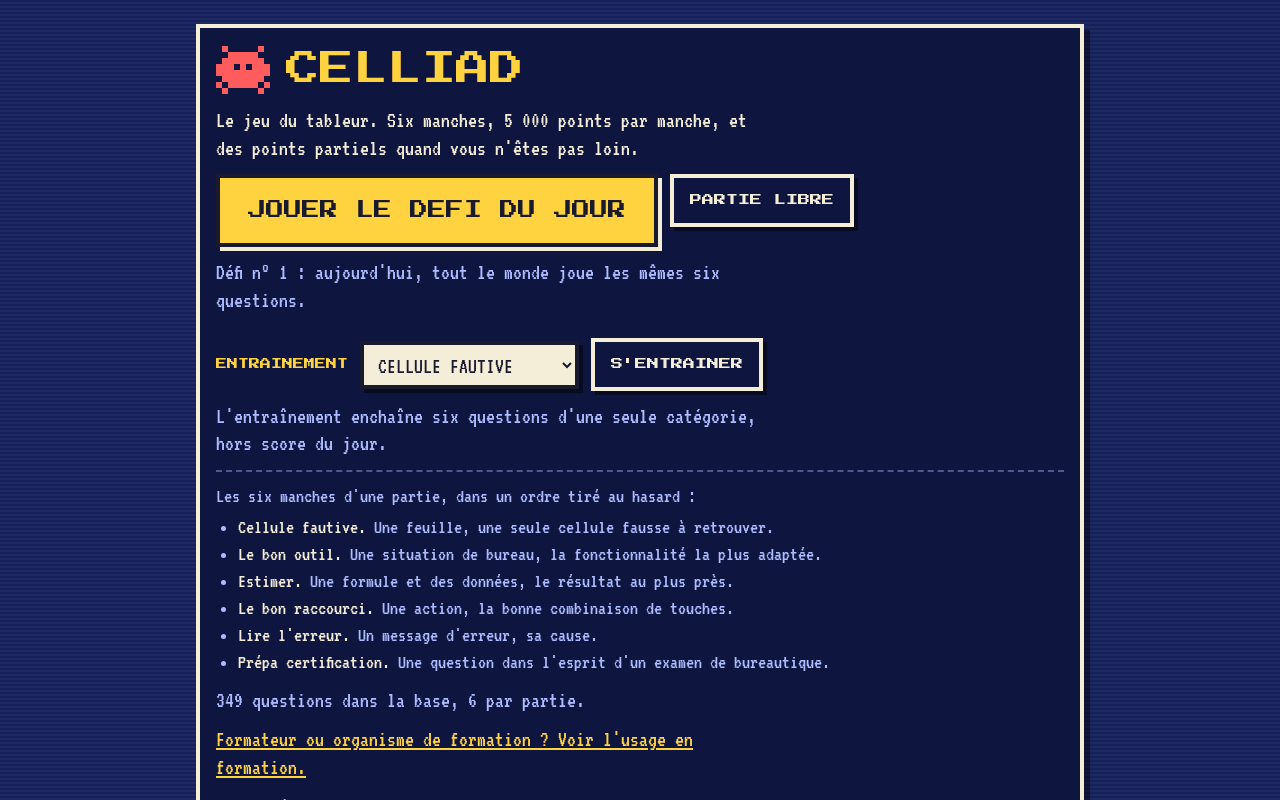
Celliad uses a gamified daily-question format to help French-speaking users practice Excel skills with a low barrier to entry.
Celliad is a French-interface daily Excel game where users complete one formula, data-organization, or function-application challenge each day to unlock the next level. It received only 7 points and 0 comments on Hacker News — very low heat — yet it reflects the real need of ordinary users who lack Excel proficiency and low-pressure practice scenarios. The article analyzes two major advantages of the daily game model — lightweight habit-building and social-sharing potential — as well as its limitations: limited content volume and the difficulty of designing a proper difficulty curve. Choosing the French market for launch is seen as a differentiated strategy to avoid the crowded English market and first validate the model. The author argues that, as AI devours repetitive spreadsheet work, humans' ability to understand spreadsheets still has value, and this "small entry point, high frequency" product thinking offers reference value for educational tool developers.
When Excel Becomes a Daily Game
A project called Celliad has quietly appeared on Hacker News. Its positioning is simple: a daily-updated Excel game with a French interface. No flashy 3D engine, no backing from a large AI model — the star is simply the spreadsheet that almost every office worker can't escape.
The project's core idea is the "daily game" model. Each day, users face an Excel-related challenge — perhaps writing a formula, organizing data, or applying a function — and only by completing that day's task can they unlock the next level. This design turns a learning tool into a habit-building mechanism, giving dry spreadsheet operations a touch of puzzle-game flavor.
The Hacker News post received only 7 points and 0 comments — not much attention. But it's precisely this kind of "niche" project that reflects an overlooked need: a large number of ordinary users have limited proficiency with Excel, yet lack low-barrier, low-pressure practice scenarios.
Why Excel, Why French
Excel has an enormous global user base, but the proportion of people who truly master functions and data operations is not high. Most people stay at the level of manual entry and simple summation, and get stuck when they encounter VLOOKUP or PivotTables. The traditional learning approach is watching tutorials and enrolling in courses — high barrier, slow feedback. Celliad lowers the startup cost with a daily-question format: open the webpage, do one question, and immediately know whether you got it right.
Choosing French as the launch language indicates the project is targeting French-speaking users. This itself is a noteworthy product strategy — avoiding fierce competition in the English market and first validating the model in a segmented language market. If the daily Excel game proves viable among French users, expanding to other languages is just a matter of translation and localizing the question bank.
VLOOKUP is one of the most frequently mentioned lookup functions in Excel, used to search for a value in the first column of a table and return data from a specified column in the same row. Typical use cases include looking up a name by employee ID or matching a price by product code. For beginners, the parameter order of VLOOKUP (lookup value, table array, column index number, exact/approximate match) is easy to confuse, and when the lookup value isn't in the first column of the range, it throws an error outright — which is exactly where many people get stuck. Understanding how VLOOKUP works is often the first step toward relational data queries, and a threshold that separates manual entry from automated processing.
The Product Logic of the Daily Game Model
The daily game category has repeatedly emerged on the web in recent years, from word-guessing games to geography quizzes, with a core mechanic of "once a day, time-limited, shareable results." Celliad transplants this mechanic into Excel skills training, with two potential advantages:
First, it creates a lightweight habit. Spending just a few minutes a day won't burden users, but sustained participation builds a muscle-memory-style learning rhythm.
Second, it's naturally suited to social sharing. If users can share their results or completion times, it can spark conversations among colleagues and learning groups, driving organic growth.
Of course, this model also has clear limitations. A daily question means limited content volume, and question design quality directly determines user retention. If one day's question is too hard or too easy, users may simply not come back the next day. For a tool like Excel with a wide skill range, how to provide an appropriate difficulty curve for users at different levels is a problem the product must solve.
The popularity of the daily game category was largely driven by Wordle. At the end of 2021, this word-guessing game went viral rapidly thanks to its design of "one puzzle a day, six attempts, results shared as colored squares," and was eventually acquired by The New York Times. Its core mechanics — a unified date, a unified puzzle, and a shareable spoiler-free results grid — were later reused by a large number of products such as geography quizzes, math challenges, and music recognition games. This model works because it turns content consumption into a daily ritual: users don't face the choice pressure of an infinite question bank, they just complete the day's single task, and sharing results naturally carries social currency.
The Observational Value of Niche Projects
Celliad's low heat on Hacker News doesn't mean it's meaningless. On the contrary, such projects offer an observation angle: AI tools and automation are devouring repetitive spreadsheet work, but humans still have a real need to understand spreadsheets. Learning to write formulas and understand data structures isn't about competing with machines — it's about knowing what to tell the machines to do.
The French developer's choice to enter this field through gamification is a pragmatic approach. It doesn't try to be a comprehensive Excel course platform; instead, it uses the single lightweight action of a daily challenge to try to cultivate users' daily practice habits. This "small entry point, high frequency" product thinking offers reference value for developers building educational and productivity tools.
Whether the project can keep updating its question bank, form a user community, or expand from the French-speaking market to a broader one all remain unknown. But as one of many small projects on Hacker News, Celliad at least raises a good question: can we spend a few minutes a day getting good at Excel, the way we play a game?
Hacker News is a tech community operated by the incubator Y Combinator, where content exposure is determined by user-submitted links and community voting. The "points" a post receives are essentially upvotes, while the comment count reflects discussion activity. Because the community is large and fast-moving, newly submitted projects are easily buried. Getting 7 points and 0 comments usually means a project has barely entered the mainstream view, but that doesn't mean the project itself lacks value — many early tools were equally obscure when they first appeared on Hacker News. For observers, Hacker News is more like a sample pool, where niche and hit projects coexist, providing raw material for understanding the developer ecosystem and product trends.
One-line Summary
Celliad uses a gamified daily-question format to help French-speaking users practice Excel skills with a low barrier to entry.
Paragraph Summary
Celliad is a French-interface daily Excel game where users complete one formula, data-organization, or function-application challenge each day to unlock the next level. It received only 7 points and 0 comments on Hacker News — very low heat — yet it reflects the real need of ordinary users who lack Excel proficiency and low-pressure practice scenarios. The article analyzes two major advantages of the daily game model — lightweight habit-building and social-sharing potential — as well as its limitations: limited content volume and the difficulty of designing a proper difficulty curve. Choosing the French market for launch is seen as a differentiated strategy to avoid the crowded English market and first validate the model. The author argues that, as AI devours repetitive spreadsheet work, humans' ability to understand spreadsheets still has value, and this "small entry point, high frequency" product thinking offers reference value for educational tool developers.
Related articles

The Secret to High-Yield Tomatoes: How Consistent Watering Makes Container Tomatoes Outperform Ground-Planted Ones
A YouTube growing log shows container tomatoes far outyield ground-planted ones. The grower credits consistent, adequate water—not fertilizer—for the longer fruiting period and higher yield.

Reverse Role-Play: When You Become an LLM's Subagent in a Game
A reverse role-play game appears on Hacker News where players act as an LLM's subagent. This article analyzes its game mechanics, the philosophical implications amid the AI agent boom, and how indie developers use lightweight interaction to explore human-machine power relations.
Can a TV Be Too Big? An In-Depth Look at a 65-Inch OLED Upgrade
Can a TV be too big? An author encountered unexpected challenges after upgrading to a 65-inch OLED. Based on the original report, this article analyzes the trade-offs of large-screen TVs in terms of space, viewing distance, and content quality, offering practical advice for users considering an upgrade.