CertiSum: Bitwise-Identical MXFP4 Training Across Platforms

CertiSum uses statistical certification plus on-demand exact recomputation to make MXFP4 training bitwise-consistent across hardware and parallelism layouts.
As a 4-bit microscaling format, MXFP4 reduces memory and bandwidth pressure but produces different training results across parallelism layouts or GPU vendors due to non-associative floating-point accumulation, hurting debugging, auditing, and train-inference consistency. CertiSum observes that native FP32 accumulation of MXFP4 products is often already exact, and designs three layers: statistical certification during quantization, exact recomputation only for uncertified outputs, and an exact kernel fallback. In a 200-step Qwen3-8B-Base experiment it kept training state bitwise-identical between AMD MI350X and NVIDIA GB200 and across parallel configurations on MI350X, at the cost of 11.8%–60.5% higher step latency but still up to 1.24x faster than BF16 and 1.70x faster than deterministic BF16.
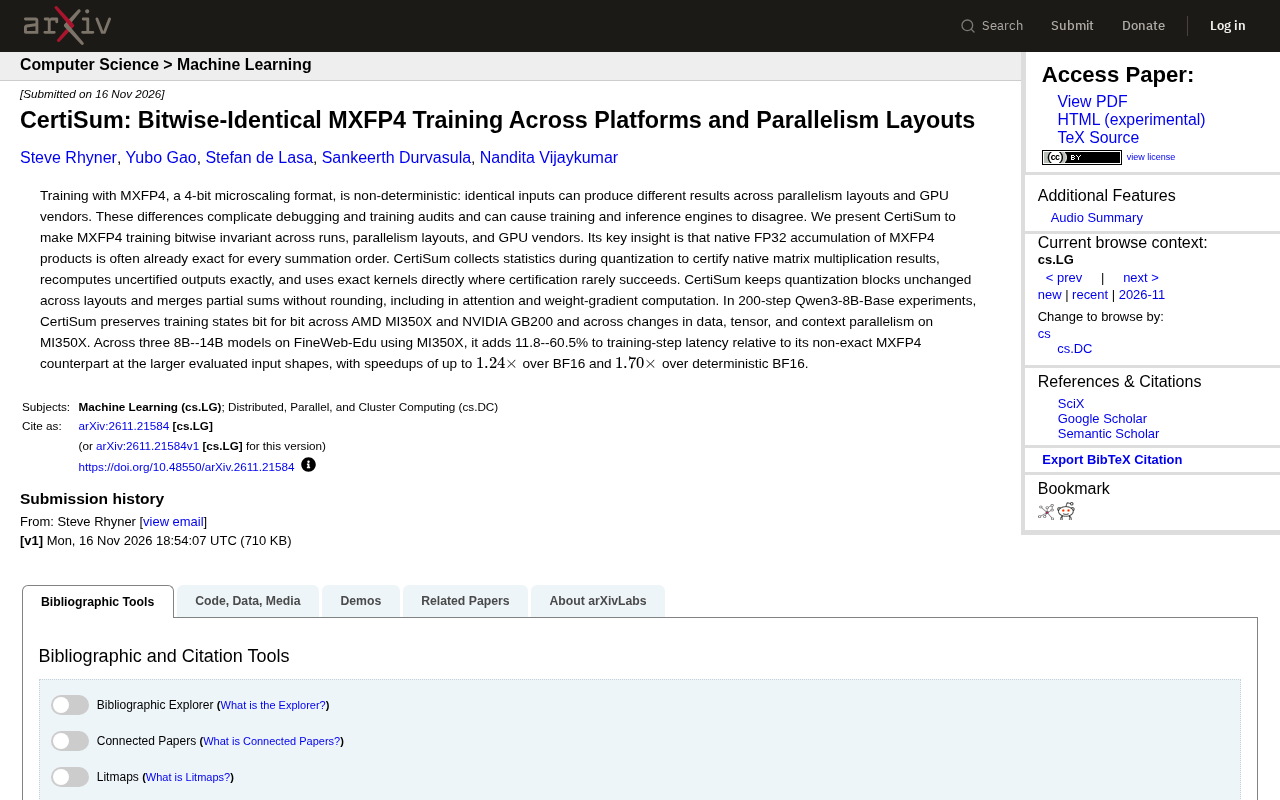
MXFP4 is a 4-bit microscaling format that is becoming an important option for reducing memory and bandwidth pressure in large model training. But it has an easily overlooked side effect: training results are not reproducible. The same input can produce different results under different parallelism layouts or on different GPU vendors, which creates headaches for debugging, auditing, and consistency between training and inference engines. CertiSum is proposed to make MXFP4 training a bitwise-invariant operation.
The Problem: Why MXFP4 Training Drifts
The core of MXFP4 is to split data into small blocks, each sharing a scaling factor, with elements within a block represented in 4 bits. This design has advantages in storage and compute efficiency, but the accumulation process introduces nondeterminism.
The original article notes that when training with MXFP4, the same input produces different results across different parallelism layouts and GPU vendors. This difference is not negligible jitter in error, but something that actually affects the consistency of the training state. For scenarios that need to audit the training process, reproduce experimental results, or require the training engine and inference engine to produce identical outputs, this is a serious flaw.
The root cause is the non-associativity of floating-point accumulation: once the summation order of a matrix multiplication changes, the way rounding errors accumulate changes too. A change in parallelism layout means a change in reduction order, and different vendors' hardware implementations may also choose different accumulation paths, so the results naturally fail to match.
MXFP4 format details: MXFP4 belongs to the OCP (Open Compute Project) microscaling format family. Each 32-element block shares an 8-bit E8M0 scaling factor (exponent only, no mantissa), and the 4-bit elements within a block are E2M1 (1 sign bit, 2 exponent bits, 1 mantissa bit), capable of representing a finite set of values such as 0, ±0.5, ±1, ±1.5, ±2, ±3, ±4, ±6. This block-shared scaling design makes the effective bit width far lower than FP4, but the coupling between block boundaries and reduction order amplifies layout sensitivity.
Non-associativity of floating-point accumulation: Real-number addition satisfies (a+b)+c = a+(b+c), but floating-point addition does not satisfy associativity because each operation rounds to finite precision. The reduction in matrix multiplication is a long chain of additions. Tensor parallelism splits the K dimension across multiple GPUs, data parallelism changes the batch composition order, and context parallelism changes the way sequences are concatenated—all of these change the parenthesization of the additions and thus produce different rounding trajectories. This is the mathematical root of all nondeterministic training and has nothing to do with MXFP4 itself, but low precision amplifies its visibility.
Key Insight: FP32 Accumulation Is Often Already Exact
CertiSum's key observation is rather counterintuitive: native FP32 accumulation of MXFP4 products is often already exact for every summation order.
In other words, in many cases there is no rounding error to fix—the accumulated result itself is accurate. This insight shifts the problem from "how to make floating-point accumulation associative" to "how to determine which results are already reliable and which need remediation."
Based on this, CertiSum designs a certification mechanism: collect statistics during the quantization stage to certify whether native matrix multiplication results are exact; recompute outputs that fail certification in an exact manner; and in scenarios where certification rarely succeeds, directly use an exact kernel.
Why FP32 accumulation is often exact: MXFP4 products come from two 4-bit mantissas (each with 1 explicit mantissa bit plus an implicit 1 bit), so the product's mantissa has a very short effective bit length; FP32, by contrast, has a 24-bit mantissa. When the number of elements within a block is limited (32) and the product's dynamic range is constrained by the shared scaling factor, the addition of partial sums and subsequent products in FP32 often requires no rounding, or the rounding error is canceled by subsequent terms. Therefore, for many summation orders, the result of native FP32 accumulation happens to equal the infinite-precision result—this is precisely the basis on which the certification mechanism can cover most cases at low cost.
Implementation Mechanism: Certification, Recomputation, and Exact Kernels
CertiSum's operation can be broken down into three layers.
The first layer is statistical certification. Sufficient information is collected incidentally during quantization to determine whether the current matrix multiplication output falls within the exact range. This step does not change the quantization blocks themselves, so it introduces no additional layout dependence.
The second layer is exact recomputation. Only outputs that fail certification are recomputed, keeping the extra overhead within the necessary range. This is a pay-as-you-go strategy rather than uniformly using the exact path for all computations.
The third layer is the exact kernel fallback. In some scenarios certification rarely succeeds, and in those cases directly using an exact kernel is more cost-effective than repeatedly recomputing.
In addition, CertiSum keeps quantization blocks unchanged across layouts and performs no rounding when merging partial sums; the same principle is followed in attention computation and weight gradient computation. Together, these points guarantee identical bitwise results under different parallelism layouts.
The meaning of exact kernels versus deterministic BF16: An exact kernel refers to a matmul implementation that performs reductions at higher precision (such as FP64 or FP32 with error compensation) and accumulates in a fixed order, at the cost of reduced throughput. "Deterministic BF16" in the article refers to a BF16 training path that uses a fixed reduction order to guarantee bitwise reproducibility, which is itself slower than regular BF16; CertiSum still achieves up to 1.70x speedup over it, showing that the certification mechanism covers most computations and the exact path is triggered only in a few cases.
Partial sum merging and attention: Under tensor parallelism, the partial sums computed by each GPU must be merged across GPUs; if merging first rounds to low precision and then adds, it introduces layout dependence; CertiSum requires no rounding during the merging stage. The softmax reduction in attention computation and the cross-token accumulation in weight gradients also have reduction-order issues, and the same principle must be followed to guarantee end-to-end bitwise consistency.
Experiments: Bitwise Consistency Across AMD and NVIDIA
In a 200-step Qwen3-8B-Base experiment, CertiSum maintained bitwise-identical training state between AMD MI350X and NVIDIA GB200; on MI350X, changing the data parallelism, tensor parallelism, and context parallelism configurations likewise produced bitwise-identical results.
This means that after moving the same training configuration to different hardware or different parallelism splits, there is no longer any need to worry about result drift. For teams that need to reproduce experiments across clusters or audit training, this is a substantive change.
In terms of performance, the original article gives an explicit cost: testing three 8B–14B models on MI350X with FineWeb-Edu, under larger evaluation input shapes, CertiSum increases training step latency by 11.8%–60.5% relative to the non-exact MXFP4 counterpart; however, it still achieves up to 1.24x speedup over BF16 and up to 1.70x over deterministic BF16.
This set of data shows that CertiSum is not a free lunch; its positioning is to trade for bitwise reproducibility while preserving MXFP4's speed advantage over BF16. Whether it is worth it depends on how hard the scenario's consistency requirements are.
Who Needs Bitwise-Consistent MXFP4
Judging from the motivations emphasized in the original article, CertiSum targets several types of needs: eliminating interference from parallelism layouts when debugging training anomalies, auditing whether the training process is contaminated by irreproducible factors, and ensuring that the training and inference engines give consistent results for the same input.
Among multiple sources, this work comes from a technical release on the rss channel; the screenshot is consistent with the original content, and no cross-verification from other independent sources was found, so the above performance and consistency conclusions should be based on the original article.
One direction worth watching is that the low-precision training ecosystem is shifting from "can it train" to "can it be trusted to train." Hardware support for MXFP4 is expanding, but without mechanisms like CertiSum, cross-platform result differences will become a hidden cost in engineering deployment. CertiSum's approach—using statistical certification to identify exact cases and paying the exact-computation cost only for uncertain parts—may be borrowed by more low-precision formats.
Of course, the 11.8%–60.5% latency increase still cannot be ignored in some pretraining scenarios that are extremely sensitive to throughput. How to achieve a better balance between certification coverage and overhead is a question such methods will need to answer going forward.
One-line Summary
CertiSum uses statistical certification plus on-demand exact recomputation to make MXFP4 training bitwise-consistent across hardware and parallelism layouts.
Paragraph Summary
As a 4-bit microscaling format, MXFP4 can significantly reduce memory and bandwidth pressure, but because floating-point accumulation is non-associative, the same input produces different training results across different parallelism layouts or GPU vendors, affecting debugging, auditing, and train-inference consistency. CertiSum's key insight is that native FP32 accumulation of MXFP4 products is often already exact for most summation orders. Based on this, it designs a three-layer mechanism—collecting statistics during quantization to certify whether native matrix multiplication is exact, exactly recomputing only uncertified outputs, and directly using an exact kernel when certification rarely succeeds; and it keeps quantization blocks unchanged across layouts and introduces no rounding in partial-sum merging or attention/weight-gradient computation. A 200-step Qwen3-8B-Base experiment maintained bitwise-identical training state between AMD MI350X and NVIDIA GB200, and across different data/tensor/context parallelism configurations on MI350X. The cost is an 11.8%–60.5% increase in training step latency under larger input shapes, but it is still up to 1.24x faster than BF16 and up to 1.70x faster than deterministic BF16.
Related articles

VP ≠ VNP: A Major Breakthrough in Computational Complexity Theory
A study claiming to prove VP ≠ VNP over every field sparks heated discussion on Hacker News. This article analyzes the algebraic complexity background of VP and VNP, the proof approach, community controversy, and its potential impact on computational complexity theory.

Developer Naming Woes: The Technical Names That Drive Us Crazy
Why is technical naming so maddening? From Nginx and Vite to Qt and Sudo, a YouTube creator rants about the chaos of developer naming and pronunciation, revealing the tug-of-war between creators' intentions and community habits, and the cultural roots behind spelling traps like PyPI and GNOME.

Figma Workplace Scandal: Employee Sues CEO for Forcing Confrontation with Harasser
Figma and its CEO are sued by a current employee alleging sexual harassment and discrimination, and forcing the victim to confront her harasser. This article outlines the background, potential impact, and industry reflection.