CHAP Protocol Explained: The Core Solution for Standardizing Human-AI Agent Collaboration

CHAP protocol aims to standardize human-AI Agent collaboration as a key piece of the Agent protocol stack.
CHAP (Collaborative Human Agent Protocol) addresses a critical gap in AI Agent infrastructure: standardizing how Agents interact with humans during complex task execution. Positioned alongside MCP (Agent-Tool) and A2A (Agent-Agent), CHAP completes the protocol stack by covering the Agent-Human relationship, enabling structured authorization, clarification, and intervention workflows.
The Collaboration Challenge in the AI Agent Era
As AI Agents powered by large language models rapidly proliferate, a critical technical challenge is emerging: When AI Agents execute complex tasks, how can they collaborate with humans efficiently and in a structured manner?
AI Agents are software systems capable of perceiving their environment, making autonomous decisions, and taking actions to achieve specific goals. Unlike traditional chatbots, Agents possess capabilities such as Planning, Memory, Tool Use, and Reflection. A typical Agent architecture includes a large language model as the "brain," combined with external tool invocation, long/short-term memory management, and task decomposition mechanisms. Since 2023, the emergence of projects like AutoGPT, BabyAGI, and LangChain Agent has marked the transition of AI Agents from academic concepts to engineering practice.
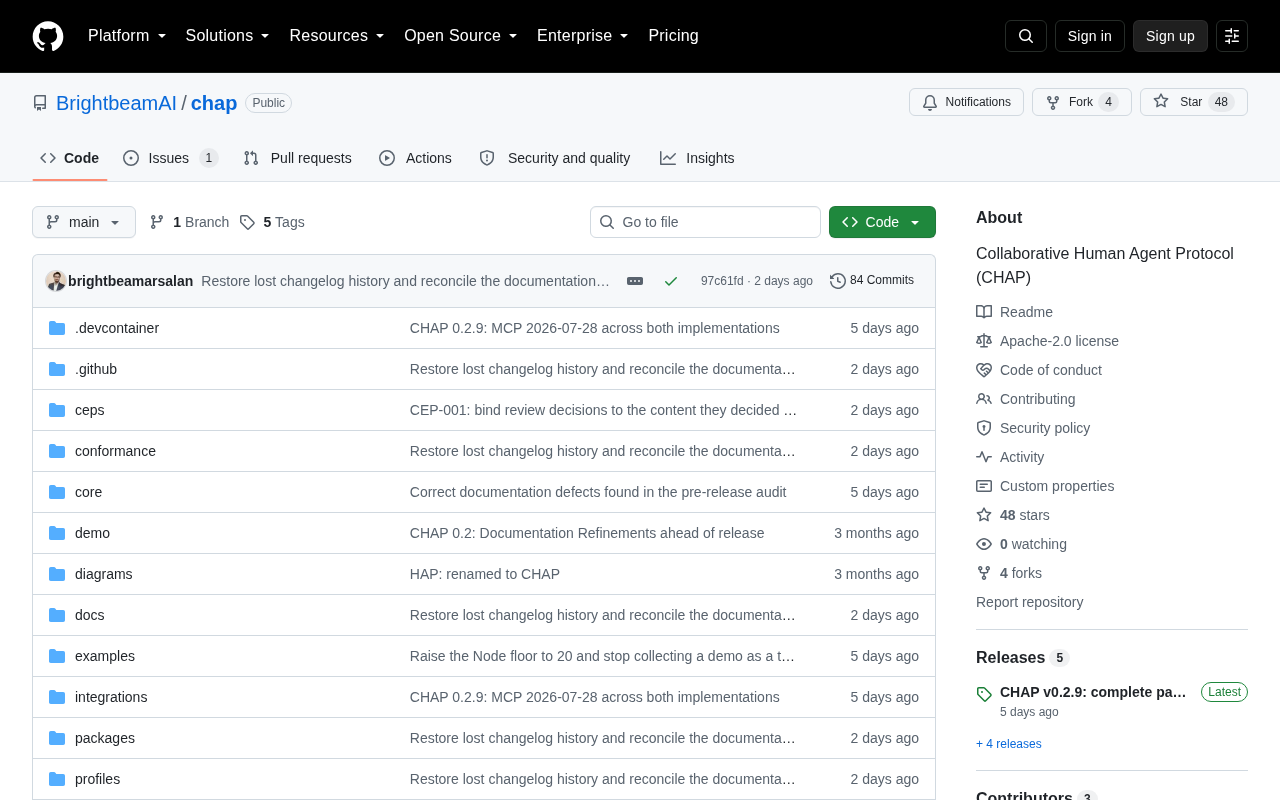
The Collaborative Human Agent Protocol (CHAP) recently discussed on Hacker News addresses precisely this problem. Although the discussion is still in its early stages (19 upvotes, 3 comments), it targets a core pain point in current AI application deployment—the standardization of human-machine interaction.
This article explores the core philosophy of the CHAP protocol, examines why we need a human-agent collaboration protocol, and discusses the value it can bring to the AI Agent ecosystem.
Why We Need a Human-Agent Collaboration Protocol
The Current Dilemma of AI Agent Collaboration
Most mainstream AI Agent systems today adopt a "black-box" automation model: users input instructions, the Agent autonomously executes a series of operations, and finally returns results. Black-box automation refers to an operational model where the system's internal decision-making process is invisible to users—they can only see the input and final output, while the reasoning chain, tool invocation order, error handling logic, and other intermediary steps remain hidden. This model originates from the design philosophy of early RPA (Robotic Process Automation) and batch processing systems. Its advantage lies in simplifying user interaction, but its disadvantage is that once problems arise, users lack the means to intervene. As the complexity of tasks executed by Agents increases—potentially involving dozens of operational steps—the risks associated with this opacity amplify accordingly.
This model performs adequately for simple tasks, but when encountering complex scenarios requiring human judgment, authorization, or supplementary information, problems become concentrated and exposed.
Here are several typical collaboration bottleneck scenarios:
- An Agent encounters ambiguity during task execution and needs human clarification of intent
- Sensitive operations (such as payments or data deletion) require explicit human authorization
- Anomalies arise during task execution, requiring human intervention in decision-making
- Long-running tasks require continuous human monitoring of progress
Without a unified protocol, every AI application handles these interactions in its own way, resulting in fragmented user experiences and forcing developers to reinvent the wheel.
The Core Value of Protocol Standardization
The core idea behind CHAP is to define a standardized communication specification for human-agent collaboration. This is analogous in positioning to what HTTP is for the Web, or what Anthropic's MCP (Model Context Protocol) is for AI tool invocation.
MCP is an open protocol launched by Anthropic in late 2024, designed to standardize the connection between large language models and external data sources and tools. Before MCP, every AI application needed to write custom integration code for each data source, creating an M×N complexity problem. By defining a unified client-server architecture, MCP simplifies this to M+N: any AI application supporting MCP (client) can connect to any MCP server (resource provider). MCP uses JSON-RPC 2.0 as its communication format, supports both stdio and HTTP+SSE transport methods, and its core concepts include Resources (data resources), Tools (callable functions), and Prompts (predefined interaction templates).
The value of a standardized protocol manifests at two levels: on one hand, it enables Agent systems from different vendors to request human assistance in a consistent manner; on the other hand, it allows humans to intervene and control AI behavior in predictable ways, striking a balance between efficiency and controllability.
Design Philosophy of the CHAP Protocol
From "Full Automation" to "Human-Agent Collaboration"
The philosophy CHAP represents reflects an important shift in AI Agent design philosophy—from pursuing full automation to embracing human-agent collaboration.
The industry is gradually forming a consensus: in many high-risk, high-complexity scenarios, "human-in-the-loop" is not a stopgap measure but a necessary architectural design choice. Human-in-the-Loop (HITL) is a system design pattern originally widely applied in machine learning model training and active learning. In this architecture, the system pauses automatic execution at specific nodes, hands decision-making authority to humans, and incorporates human feedback into the system's subsequent behavior. HITL contrasts with two related patterns: Human-on-the-Loop (humans only supervise without directly intervening in the process) and Human-out-of-the-Loop (full automation). In high-risk fields such as military, healthcare, and finance, HITL has become part of compliance requirements. Core problems that HITL design in the AI Agent domain needs to solve include: selection of interruption points, context preservation and restoration, and asynchronous handling of human responses.
CHAP's goal is to formalize and structure this collaborative relationship, providing clear guidelines for questions like "when is human intervention needed," "in what form should intervention occur," and "how to continue after intervention."
CHAP's Position in the AI Agent Protocol Ecosystem
Notably, CHAP does not exist in isolation. The AI Agent field is currently forming an increasingly rich protocol stack:
- MCP (Model Context Protocol): Solves the connection problem between Agents and external tools/data sources
- A2A (Agent-to-Agent Protocol): Solves collaborative communication between multiple Agents
- CHAP (Human Agent Protocol): Solves collaborative interaction between Agents and humans
The A2A protocol was proposed by Google in April 2025, aiming to solve interoperability issues between AI Agents built by different vendors and frameworks. In multi-Agent systems, individual Agents may be developed by different teams using different technology stacks. A2A provides a standardized communication mechanism enabling them to discover each other's capabilities, negotiate task assignments, and pass intermediate results. Key A2A concepts include Agent Card (metadata describing Agent capabilities), Task (task lifecycle management), and Artifact (outputs passed between Agents). A2A and MCP are complementary: MCP handles Agent-to-tool connections, while A2A handles Agent-to-Agent collaboration.
These three can be viewed as three puzzle pieces for building a complete Agent ecosystem, covering the three critical relationships of "Agent-Tool," "Agent-Agent," and "Agent-Human" respectively. CHAP fills precisely the gap of human-machine interaction standardization, making the entire protocol stack more complete.
Potential Application Scenarios and Challenges for CHAP
Most Promising Application Directions
If human-agent collaboration protocols like CHAP achieve widespread adoption, the following areas will benefit first:
Enterprise-level automation workflows: In business processes requiring human oversight such as financial approvals and contract processing, Agents can request authorization through standardized methods while generating auditable collaboration records to meet compliance requirements.
AI-assisted development tools: AI coding assistants can request developer confirmation through a unified protocol before executing destructive operations (such as bulk code modifications or production deployments), reducing the risk of accidental errors.
Intelligent customer service: When AI customer service encounters complex issues it cannot handle independently, it can seamlessly transfer the conversation to human agents in a structured manner, passing complete context information and preventing users from having to repeat their problems.
Real-World Challenges in Adoption
Any new protocol faces multiple barriers from proposal to becoming an industry standard. CHAP needs to address the following key issues:
Cold-start problem of ecosystem adoption: A protocol's value comes from network effects—only when enough vendors and developers adopt it does the standard have practical significance. Network effects refer to the economic phenomenon where the value of a product or service grows as user numbers increase. For technical protocols, this creates a classic "chicken-and-egg" dilemma. Historically successful protocol standardization cases offer several breakthrough paths: one is strong advocacy by industry giants (like Google pushing A2A); two is organic bottom-up growth from the open-source community (like HTTP); three is deep integration with existing ecosystems (like MCP leveraging the Claude ecosystem). As a community-driven protocol, CHAP may need to find a sufficiently compelling "killer application" to prove its value, or seek deep integration with the MCP/A2A ecosystem to gain traction. In the current landscape where AI Agent protocols are flourishing, how CHAP accumulates early users and becomes a de facto standard is the primary challenge.
Complexity of interaction scenarios: Human-agent collaboration involves numerous subtle scenario variations. Designing a protocol specification that is both flexible enough and not overly complex requires repeated trade-offs between generality and usability.
Balancing automation and human intervention: Too many human confirmations undermine the efficiency gains of automation, while too few interventions may introduce security risks. The protocol needs to provide sufficient mechanisms to help developers set reasonable intervention thresholds for different scenarios.
Summary and Outlook
The CHAP protocol is still in its early discussion phase, but the direction it represents holds long-term value for attention. As AI Agents gradually move from technical demonstrations to real production environments, the standardization of human-agent collaboration will become an unavoidable topic.
We are currently in a critical period of rapid evolution in AI Agent infrastructure. Protocols like MCP, A2A, and CHAP collectively form the foundational framework for future intelligent agent applications. For developers and enterprises, closely tracking the evolution of these protocol standards and proactively reserving compatibility space in architectural design will help gain first-mover advantages in the Agent era.
Regardless of whether CHAP ultimately becomes a mainstream standard, the core question it raises—how to enable better collaboration between AI and humans—will remain a key proposition that the entire industry needs to continuously explore.
Related articles

Chain of Thought Isn't Just for AI: How Humans Can Use CoT to Improve Thinking Quality
Chain of Thought isn't just a prompt trick for large models. Starting from a Hacker News discussion, this article analyzes why CoT works for human thinking too, breaks down actionable ways to transfer it, and highlights the key differences between human CoT and machine CoT.
Cloudflare Teams Up with OpenAI: Closi…
Cloudflare Teams Up with OpenAI: Closing the Loop from Vulnerability Discovery to Defense with AI
Cloudflare uses OpenAI Daybreak to investigate security vulnerabilities and generate reviewable remediation plans, while developers use Codex to boost coding efficiency and quality.

Orca Multi-Agent Orchestration in Practice: A Guide to Parallel Collaboration with Claude and Codex
Orca is Stable AI's free open-source agent workbench supporting 34 agents like Claude Code and Codex in parallel. Learn its Git worktree isolation, multi-model orchestration, and mobile management.