Character AI Bankruptcy Auction of User Chat Logs Draws Joint Opposition from Multiple State Attorneys General
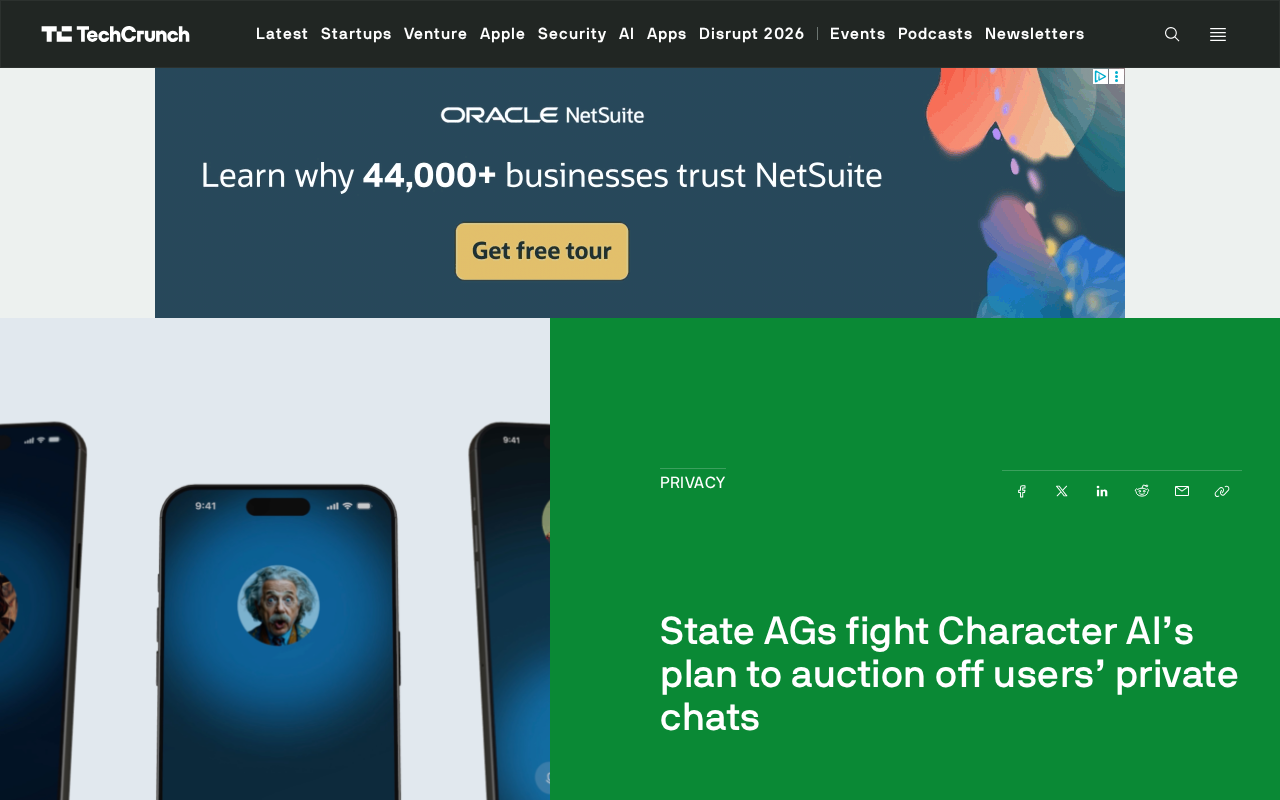
Character AI's bankruptcy plan to auction data from 21 million accounts draws joint opposition from state attorneys general on privacy grounds.
In its bankruptcy proceedings, Character AI plans to sell sensitive personal data from over 21 million U.S. accounts as an asset, about 2.1 million of which are registered under minors' names, prompting joint opposition from multiple state attorneys general. The core dispute: when an AI company goes bankrupt, can intimate chat logs between users and virtual characters be treated as auctionable assets? Attorneys general argue that the privacy terms users agreed to at registration do not authorize data transfers in bankruptcy, and that minors' data may violate state consumer protection and children's online privacy laws. The case could reshape data governance practices and valuation logic for emotional companionship AI products; the transaction structure, buyer identity, and court ruling remain unclear.
Why Did a Bankruptcy Auction Alarm Multiple State Attorneys General?
Character AI's bankruptcy proceedings are turning into a public controversy over user privacy. According to an RSS source, the company plans to transfer sensitive personal data from over 21 million U.S. accounts as part of its bankruptcy sale, including 2.1 million accounts registered under minors' names. This plan has drawn joint opposition from several state attorneys general.
The core of the dispute is not complicated: when an AI company goes bankrupt, can the massive trove of user conversation records it has accumulated—often containing highly intimate emotional disclosures, identity information, and interactions involving minors—be publicly auctioned as an "asset"? The attorneys general's answer is clearly no.
Why User Chat Logs Become Sensitive Assets
The data from role-playing dialogue platforms like Character AI is uniquely sensitive because users' interactions with virtual characters are often more private than those on ordinary social media. Users may reveal their real names, addresses, mental states, or even family relationships in conversations, and while this content is protected by privacy policies during normal platform operation, once bankruptcy proceedings begin, the boundaries of protection become blurred.
According to the same source, the data slated for transfer covers more than 21 million U.S. accounts, of which 2.1 million are registered for use by minors. The handling of minors' data is especially sensitive, and this is the direct trigger for the attorneys general's intervention.
In the context of bankruptcy law, the debtor's "estate" in principle includes all assets it owns, which may encompass databases, user lists, and business records. But whether personal user data can be treated as freely sellable assets depends on privacy policy terms, the scope of contractual authorization, and state law restrictions. Under U.S. law, transfers of bankruptcy estate assets are typically subject to the "as-is" principle, but if a transfer violates privacy commitments or consumer protection laws, a court may reject it or impose conditions. In addition, asset sales in bankruptcy proceedings require court approval, and interested parties (including regulators) may file objections. This explains why state attorneys general can intervene at the bankruptcy auction stage to argue that user data is not freely transferable bankruptcy estate property.
The Attorneys General's Legal Reasoning
The state attorneys general's opposition centers on two points: first, the privacy terms users agreed to at registration did not authorize the platform to sell data as an asset in a bankruptcy scenario; second, the transfer of minors' data may violate state consumer protection laws and regulations on children's online privacy.
From a regulatory perspective, this case raises a question with few precedents: should an AI company's bankruptcy estate include user conversation data? If the auction is allowed, the buyer would gain disposal rights over a massive volume of intimate conversations, which fundamentally conflicts with the privacy commitments the platform made to users.
State attorneys general in the United States are the chief law enforcement officers at the state level and have broad authority in consumer protection and privacy enforcement. They typically initiate investigations or lawsuits against deceptive business practices under state consumer protection laws (such as California's CLRA and New York's GBL Section 349), and can seek injunctions against companies that violate privacy commitments. On children's data, the federal Children's Online Privacy Protection Act (COPPA) requires verifiable parental consent to collect personal information from children under 13, with the Federal Trade Commission (FTC) responsible for enforcement, while state attorneys general can also enforce in parallel under state law. Therefore, when a bankruptcy sale involves data from minor accounts, attorneys general can argue that the transfer lacks valid consent and violates existing privacy commitments, thereby constituting an unfair or deceptive practice, and on that basis ask the court to restrict the sale of data as an asset.
Knock-on Effects for the AI Industry
The trajectory of this dispute may influence data governance practices across the entire AI application industry. Role-playing and emotional companionship AI products generally rely on deep user conversation data to optimize models and sustain the experience, and once bankruptcy auctions become a potential path to monetize data, user trust will be substantially eroded.
For startups, investors and acquirers also need to reassess: if the transferability of user data is restricted by the courts, the "data assets" portion of platform valuation models will shrink significantly.
Unresolved Questions
At present, public information comes only from statements by state attorneys general; the specific transaction structure of Character AI's bankruptcy proceedings, the identity of the data buyer, and the court's final ruling remain unclear. What is certain is that this battle over data from 21 million accounts is drawing new boundaries for data inheritance and privacy protection in the AI era.
Related articles

The Gemini 4 Trio and 3.8 Flash: A Full Comparison of Positioning, Pricing, and Benchmarks
A comparison of Gemini 4 Neon, Carbon, Argon, and Gemini 3.8 Flash: positioning, context, API pricing, Artificial Analysis and Arena benchmark scores, and available entry points.

AI Coding Model Leaderboard: Opus 5.5 Crowned, Gemini Neon Stages a Comeback
Tech blogger Matthew Berman releases an AI coding model tier list: Claude Opus 5.5 holds S-tier, Gemini Neon surprises with A-tier, OpenAI Astra lands B-tier. How do open-source models like DeepSeek fare? We break down the scoring logic and practical takeaways.

New Jersey Joe Sandwich: Meat and Coleslaw on Triple-Decker Rye
New Jersey Sloppy Joe isn't a ground beef burger—it's triple-decker rye bread with meat, Swiss cheese, and coleslaw, plus Russian dressing. Learn the authentic Essex County method and family recipe.