Character.AI Bankruptcy: The Fall of an AI Role-Play Star and Its Asset Sale

Character.AI files for bankruptcy and sells some assets to Disney, sounding a safety and compliance warning for the AI role-play sector.
Character.AI, once a star generative AI startup, has filed for bankruptcy and plans to sell some assets to Disney. It rose rapidly through virtual-character conversations but faced persistent lawsuits and scrutiny over chatbot safety, especially involving minors and harmful content. Despite content filtering and age verification, the controversy continued, damaging brand credibility and investor confidence. The sale may give its technology a new home, but the company can no longer survive independently. The case warns the AI companion and role-play field that content safety, legal compliance, and sustainable business models are as essential as technical capability.
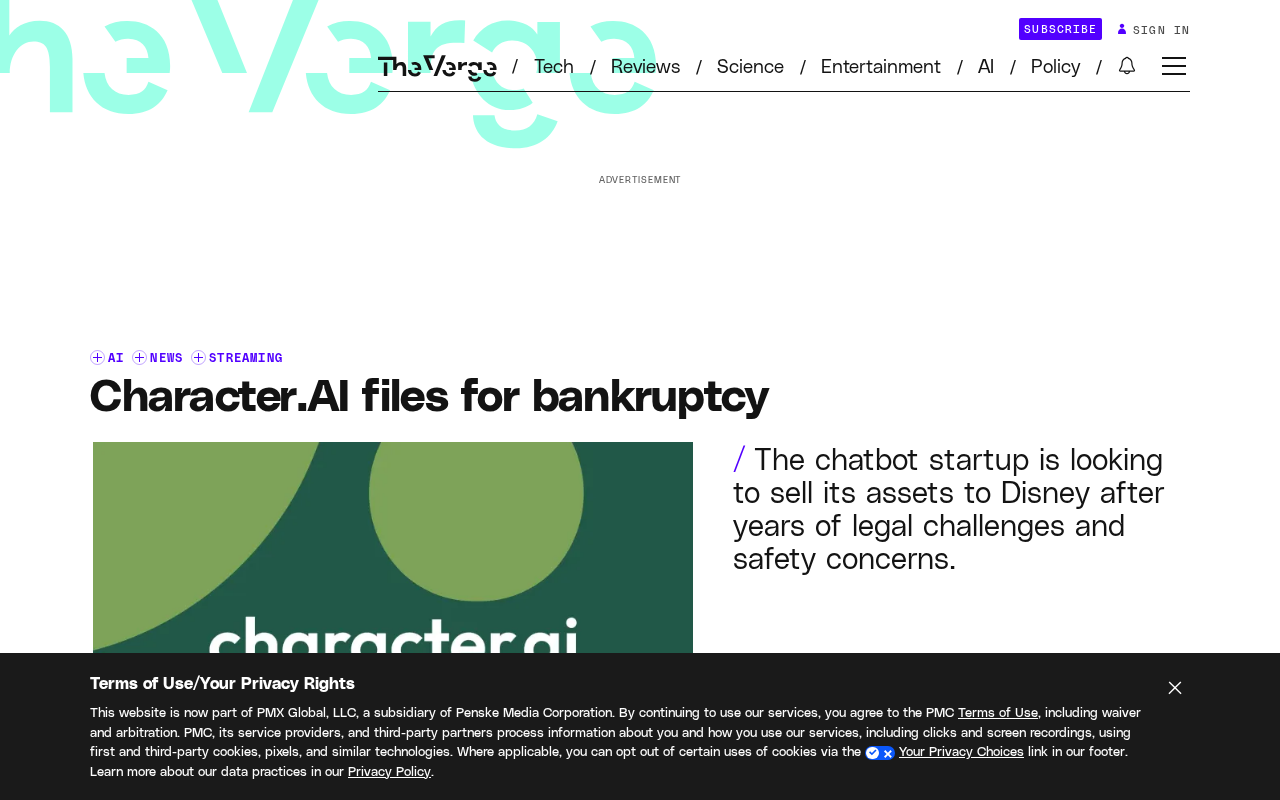
Once regarded as one of the first breakout startups of the generative AI wave, Character.AI has now reached the brink of bankruptcy. According to the latest reports, the company has officially filed for bankruptcy and plans to sell some of its assets to Disney. The news has sparked widespread discussion in the AI community and marks a major setback for the once-booming AI role-play sector.
From Star to Bankruptcy: The Rise and Fall of Character.AI
Character.AI was founded in the early days of the generative AI explosion and quickly gained popularity with its positioning around "conversations with virtual characters." Users could create or chat with various online bots and engage in role-play, an innovative interaction format that attracted a large number of young users. The company was once seen as a benchmark for consumer AI applications, with financing and valuation among the top in the industry.
Yet beneath its rapid growth lay a deep crisis. The company faced long-running scrutiny and lawsuits over chatbot safety, especially issues involving the protection of minors and the generation of harmful content. Although Character.AI kept releasing new features and trying to improve its safety mechanisms, the controversy never subsided. These legal and public-opinion pressures may ultimately have been the key factor that crushed the company.
Character.AI's technical foundation: The reason Character.AI was able to rise so quickly in its early days is closely tied to its self-developed large language model. The company was founded by former Google engineers Noam Shazeer and Daniel De Freitas, both of whom had participated in research on Google's LaMDA dialogue model. Character.AI's core technology lay in fine-tuning dialogue models for character embodiment, enabling them to maintain a specific persona, tone, and memory over long periods, thereby supporting immersive role-play. This capability was uncommon in general-purpose chatbots at the time and became the key to its differentiated competition. However, character-based models consume enormous computing power, and as the user base expanded, inference costs surged rapidly. For a company that had not yet established a stable paid model, this cost structure itself planted financial risks and laid the groundwork for later crises.
Safety Controversies and Legal Battles: An Unavoidable Cost
Character.AI's core product lets users freely converse with AI characters, and this openness creates enormous content safety challenges. Multiple lawsuits alleged that its chatbots had negative effects on users, even involving sensitive topics such as self-harm and violence. Regulators and the public have increasingly scrutinized AI companion applications, demanding that platforms take on more responsibility.
The company tried to respond through content filtering, age verification, and model adjustments, but the results were limited. Every new lawsuit or negative report further eroded its brand credibility and investor confidence. Against the backdrop of AI safety becoming a global regulatory focus, Character.AI's predicament is not unique, but it is indeed one of the first leading players to pay a heavy price.
Content safety challenges for AI companion apps: The root of the content safety problem for AI role-play platforms lies in the product form itself. Unlike customer-service bots or writing assistants, companion apps encourage open-ended, emotional, long-term conversations. The model must maintain character consistency while avoiding harmful content, and these two goals often conflict. For example, if a character is designed as a "rebellious teenager," strictly filtering all negative expressions would strip away realism; loosening restrictions could lead to dangerous output such as self-harm or violence. In addition, minors can easily develop emotional dependence on AI characters, further amplifying the risk. The content filtering, age verification, and human review methods commonly used in the industry today struggle to balance cost, accuracy, and user experience, which is one reason regulators continue to apply pressure.
Selling Assets to Disney: A Strategic Pivot or a Last Resort?
According to disclosed information, Character.AI will sell some of its assets to Disney. The deal invites speculation: Disney owns a vast IP empire and character library, while Character.AI's technology and user base might complement Disney's entertainment ecosystem.
However, an asset sale usually means the company cannot survive independently and can only repay debts or satisfy creditors by selling off core assets. For an AI unicorn once valued at billions of dollars, this is undoubtedly a lamentable outcome. Whether Disney's takeover can preserve Character.AI's technological value remains unknown.
The difference between an asset sale and bankruptcy proceedings: The phrase "filing for bankruptcy and selling assets" mentioned in the article usually involves Chapter 11 or Chapter 7 proceedings under U.S. bankruptcy law. Chapter 11 allows a company to reorganize debt under court supervision, continue operating, and seek asset sales or financing; Chapter 7 is direct liquidation. Selling some assets to Disney may be part of the asset-disposal process in bankruptcy proceedings, used to repay creditors. For the acquirer, this approach often makes it possible to obtain technical patents, user data, or teams at below-market prices. But an asset sale does not equal business continuity. Whether the brand and product are retained depends on the acquirer's strategic intent. If Disney values the character dialogue technology, it may integrate it into its own IP interaction experiences rather than maintaining the original platform as an independent operation.
Lessons for the AI Role-Play Sector
Character.AI's bankruptcy sounds a warning bell for the entire AI companion and role-play field. Technical capability matters, but content safety, legal compliance, and a sustainable business model are equally indispensable. Many similar products are still exploring how to balance user experience and risk control, and Character.AI's experience offers valuable lessons.
For developers and entrepreneurs, the boundaries of AI applications are determined not only by technology but also by social norms and regulatory frameworks. Whether they can find a balance between innovation and responsibility will determine how far the next star product can go.
Conclusion
Character.AI's bankruptcy is a landmark event for the generative AI industry. It reminds us that while pursuing technological breakthroughs, we cannot ignore safety, law, and commercial reality. Disney's acquisition may give some technologies a new home, but the role-play platform that once immersed countless users has now come to a full stop.
One-line Summary
Character.AI files for bankruptcy and sells some assets to Disney, sounding a warning for safety and compliance in the AI role-play sector.
Paragraph Summary
Character.AI, once seen as a star startup in generative AI, has officially filed for bankruptcy and plans to sell some assets to Disney. The company rose rapidly by positioning itself around conversations with virtual characters, but faced long-running lawsuits and scrutiny over chatbot safety, including issues involving the protection of minors and the generation of harmful content. Despite attempts at content filtering and age verification, the controversy never subsided, ultimately damaging brand credibility and investor confidence. Although the asset sale to Disney may give its technology a new home, it means the company cannot survive independently. The event is a warning for the AI companion and role-play field: beyond technical capability, content safety, legal compliance, and a sustainable business model are equally indispensable.
Related articles

AI Simulates Thousands of Typhoon Seasons, Reshaping Tropical Cyclone Risk Assessment
AXA and NVIDIA Earth-2 use AI to generate over a thousand simulated cyclone seasons, overcoming the sparsity of 46 years of historical data and providing a richer probabilistic view for tropical cyclone risk assessment and insurance pricing.

JetBrains Incubates ThinkRail: A Pi-Based Agentic IDE with a New Spec-Driven Development Experience
JetBrains Innovation Hub's open-source agentic IDE ThinkRail, built on Pi, offers spec-driven development, Git worktree parallel workspaces, and Monaco editor interaction—completely free. This article details installation, workflow, and ecosystem integration.

Beyond the Mainstream World: Security and Privacy Struggles in Overlooked Regions
Human-centered security research has long focused on the West, causing security solutions to fail in the mainstream world. Researcher Collins Minando draws on Kenyan mobile loan apps, internet café authentication dilemmas, and local expert studies across nine countries to reveal how socioeconomic constraints reshape privacy practices, and proposes mobile money privacy redesign and PETs deployment pathways.