ChatGPT Advice to Reduce Medication Led to Former Amazon Employee's Death? Behind the Reddit Controversy

A former Amazon employee allegedly died after following ChatGPT's advice to reduce medication, sparking debate on AI medical advice boundaries.
A Reddit post claimed a former Amazon employee died after following ChatGPT's advice to reduce epilepsy medication. Comments clarified she held a work visa needing employer sponsorship; Amazon layoffs cost her health insurance and legal status. Facing cognitive side effects before interviews, she sought AI advice under pressure. Discussion focused on systemic issues—employment-linked healthcare and visa fragility—and warned that chatbots need clearer boundaries in medical consultations.
Event Overview: A Tragedy and the Boundaries of AI Advice
Recently, a post on Reddit sparked widespread discussion: a former Amazon employee allegedly died after following ChatGPT's advice to reduce her medication dosage. The post title directly states "Ex-Amazon employee dies after ChatGPT allegedly tells her to reduce medication dosage," but the comments quickly raised a key question: What does the "former Amazon employee" identity have to do with the incident?
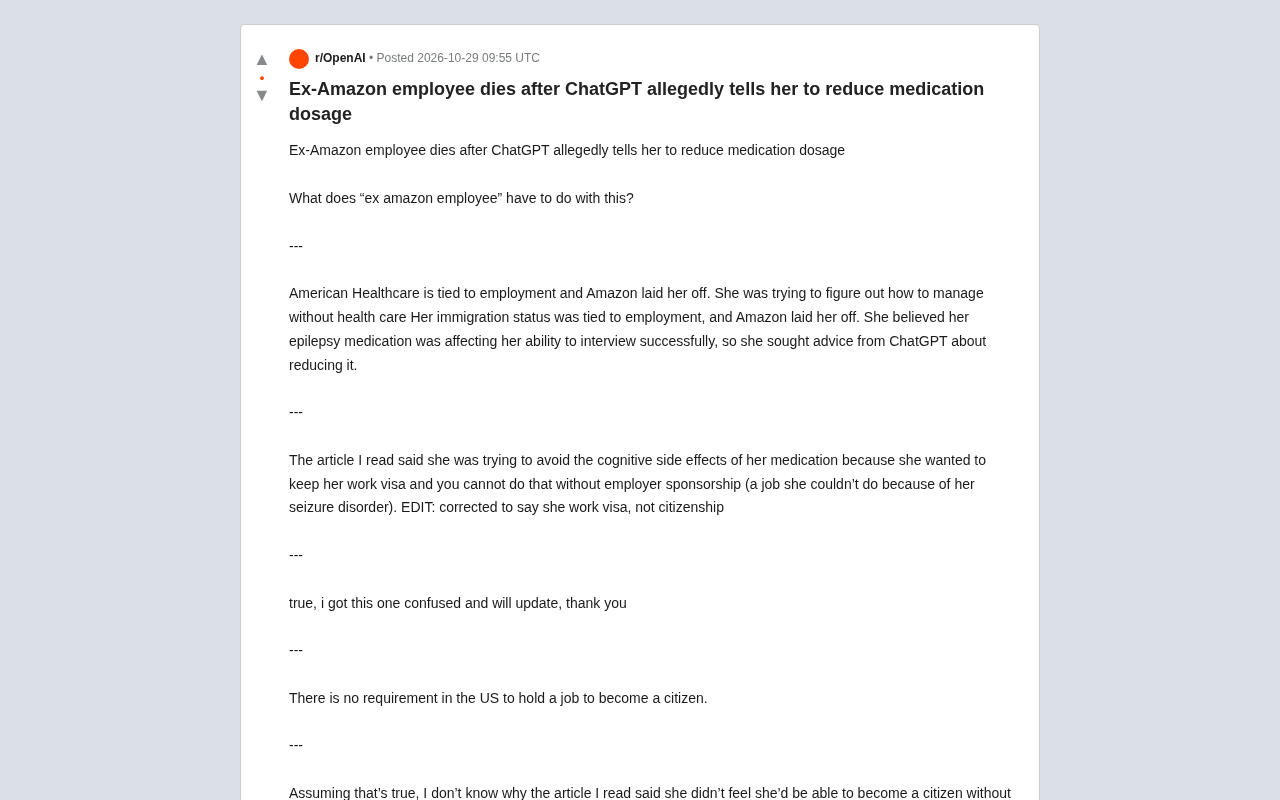
As the discussion deepened, a more complex background emerged. According to multiple Reddit users citing relevant reports, the woman had epilepsy and was worried that the cognitive side effects of her medication would affect her interview performance, so she consulted ChatGPT about how to reduce her dosage. Her urgency to keep her job was closely tied to the reality that the U.S. healthcare system is deeply linked to employment—losing her job meant losing health insurance, and her work visa also required employer sponsorship to maintain legal status.
The Multiple Pressures Behind the Incident: Healthcare, Visa, and Employment
The Employment Link in the U.S. Healthcare System
During the discussion, one user explicitly pointed out: "U.S. healthcare is tied to employment, and Amazon laid her off." This means that losing a job not only means interrupted income but also directly leads to the loss of health insurance. For patients who need to take epilepsy medication long-term, this creates enormous economic and health pressure.
The Fragility of Work Visas
Regarding her immigration status, information in the comments was corrected. Initially, some claimed she was worried about not being able to become a citizen, but later a user clarified: "She held a work visa, and maintaining a work visa requires employer sponsorship." This detail is crucial—without an employer, she not only loses health insurance but may also face the prospect of being forced to leave the country.
Common U.S. work visas such as H-1B are deeply tied to the employer: once the holder loses their job, they typically have only a 60-day grace period to find a new employer and complete a visa transfer, otherwise they lose legal status. This institutional design means that visa holders facing layoffs endure not only economic pressure but also the urgency of their status potentially expiring at any moment. During the wave of layoffs at Silicon Valley tech companies, many foreign employees find themselves in this fragile state of "losing your job means losing your status," which provides key context for understanding why the individual was so eager to secure an interview opportunity by adjusting her medication.
Epilepsy and the Burden of Cognitive Side Effects
According to reports cited in the discussion, she believed that her epilepsy medication affected her cognitive abilities, which in turn hindered her interview performance. Under the dual pressure of losing her job and the visa countdown, she turned to ChatGPT for advice, hoping to improve her interview condition by adjusting her medication. This choice was ultimately alleged to be connected to her death.
Common cognitive side effects of antiepileptic drugs (AEDs) include decreased attention, memory impairment, slowed reactions, and mental fog, with some drugs such as topiramate and benzodiazepines being particularly notable. These side effects may be amplified in high-intensity cognitive situations (such as technical interviews), but self-adjusting dosage carries clear risks: sudden reduction or discontinuation may trigger seizures, and even life-threatening status epilepticus. The standard approach is gradual adjustment under the guidance of a neurologist, not based on advice from a general-purpose chatbot.
Divergences and Clarifications in the Discussion
Citizenship vs. Work Visa
A factual correction appeared in the comments. One user pointed out: "Becoming a U.S. citizen does not require holding a job." Subsequently, the user who initially mentioned "citizenship" corrected their statement, acknowledging that it should be "work visa" rather than "citizenship." This clarification avoided the misreading of simplifying the incident into "working in order to naturalize" and restored the true constraints of the work visa sponsorship system.
The Significance of the "Former Amazon Employee" Label
Regarding the "former Amazon employee" phrasing in the title, some users questioned its relevance. But a highly upvoted reply explained the necessity of this label: it connects the three threads of healthcare, visa, and employment. Amazon's layoff was the starting point that triggered the chain reaction, not mere background noise.
A Deeper Question: The Boundaries of Responsibility for AI Advice
This incident brings a sharp question to the fore: when users consult general-purpose AI assistants like ChatGPT for medical advice, who should be responsible for the consequences?
From the Reddit discussion, most users did not simply blame the AI but focused on systemic pressures—the employment-linked healthcare system, the fragile visa regime, and the reality of patients seeking shortcuts in desperation. One user commented: "It's really not (Amazon's fault), some employers have company insurance plans, which are not fundamentally different from marketplace insurance plans." The implication is that the problem is not any single employer but the entire institutional design.
For AI developers, this incident sounds another warning bell: general-purpose chatbots need clearer boundary warnings and referral mechanisms when faced with medical consultations. Although models like ChatGPT usually attach disclaimers such as "please consult a professional doctor" in their responses, whether such warnings are sufficiently effective when users are under high stress deserves deep reflection.
Large language models are essentially systems that generate text probabilistically; they do not possess medical diagnostic capabilities and cannot know a user's complete medical history, drug interactions, and individual differences. Medication information in their training data may be outdated or out of context, and the models tend to give answers that "look reasonable" rather than "clinically validated" advice. Therefore, in medical consultation scenarios, the industry generally advocates mandatory referral mechanisms and risk-tiered warnings, but disclaimers are often overlooked when users are anxious and time-pressed—this is precisely the warning of such incidents.
Conclusion: Systemic Dilemmas Beyond Technology
The core of this tragedy is not a simple story of "AI saying the wrong thing." It reflects multiple systemic problems: healthcare rights tied to employment, the fragility of immigration status, and the lack of mental health support. ChatGPT played the role of advice provider, but attributing responsibility entirely to AI may cause us to overlook those more fundamental and urgently needed structural contradictions.
For the tech industry, this incident reminds us that the design of AI products must consider not only technical capabilities but also the real circumstances users are in. In scenarios related to life and health, caution and restraint should be the default setting.
One-line Summary
A former Amazon employee lost health insurance and visa sponsorship due to layoffs, consulted ChatGPT about reducing medication, and died, prompting reflection on the boundaries of AI medical advice.
Paragraph Summary
A Reddit post claimed that a former Amazon employee died after following ChatGPT's advice to reduce her epilepsy medication dosage, sparking widespread discussion. The comments clarified that the individual held a work visa requiring employer sponsorship, and Amazon's layoff caused her to lose both health insurance and legal status protection. Worried that cognitive side effects of the medication would affect her interview, she sought medication advice from a general-purpose AI assistant under multiple pressures. The discussion did not stop at AI responsibility but turned to systemic dilemmas such as the U.S. employment-linked healthcare system and visa fragility, while also reminding that general-purpose chatbots need clearer boundaries and referral mechanisms in medical consultation scenarios.
Related articles

The Truth Behind Titanic's Sinking: Key Decisions and Communication Failures in the National Geographic Documentary
National Geographic's The Unsinkable Ship uses survivor testimony to reconstruct Titanic's fatal decisions—from the missing MSG telegram prefix and the broken boiler-room-to-bridge link to how 'unsinkable' thinking delayed damage control and evacuation.

74M-Parameter Open-Source Model Partially Outperforms Jev AI in Testing
Fastino AI's Glider 2.5 models, with just 74M–300M parameters, reportedly outperform Jev AI in some guardrail benchmarks per YouTube testing, run on consumer hardware, and even play Doom. We analyze small models' competitiveness and deployment value on specific tasks.

Gemini 4 Argon Hands-On: Aggressive Pricing, 3D Capabilities Need Coaching
Gemini 4 Argon hands-on: limited-time $2/$10 pricing, million-token output, strong 3D and reverse-engineering work, but weak front-end aesthetics and zero-shot ability need coaching.