ChatGPT Image Generation Explodes in India: Over 1 Billion Images Created

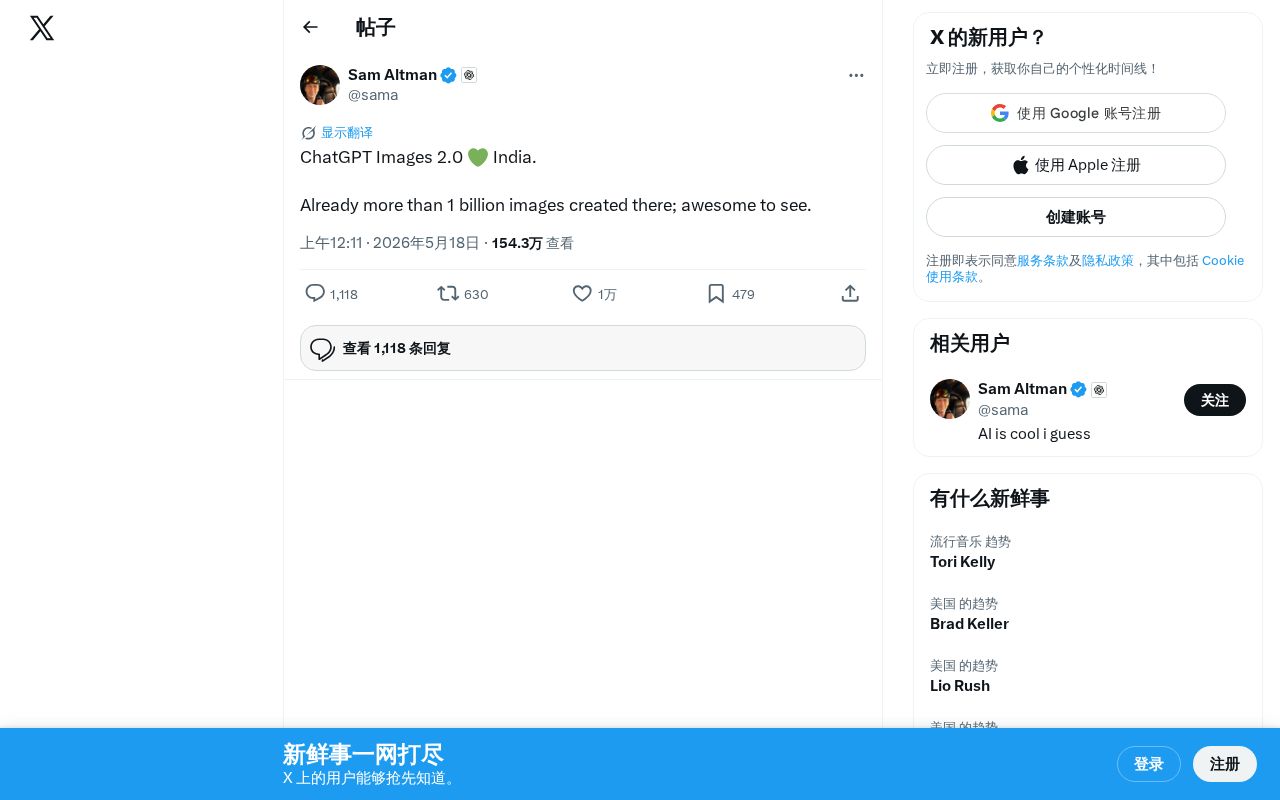
ChatGPT Images 2.0 surpasses 1 billion images generated in India, highlighting explosive AI adoption.
OpenAI CEO Sam Altman revealed that ChatGPT Images 2.0 has generated over 1 billion images in India, making it one of the platform's most active markets globally. Fueled by India's massive young internet population and ultra-low data costs, GPT-4o's native multimodal image generation has been thoroughly validated at scale. The surge also underscores how emerging markets are reshaping the global AI landscape while posing significant infrastructure challenges for OpenAI.
India Becomes One of the Largest Markets for ChatGPT Image Generation
OpenAI CEO Sam Altman recently shared a staggering figure on social media: ChatGPT Images 2.0 has generated over 1 billion images in the Indian market. This milestone number makes India one of the most active markets globally for ChatGPT's image generation feature.
Key Trends Behind 1 Billion AI-Generated Images
One billion images is an extraordinarily massive number, reflecting several noteworthy trends:
India's Fervent Demand for AI Image Generation
India boasts a massive young internet user base with extremely high receptivity to new technologies. With over 800 million internet users, India is the world's second-largest internet market after China, with a significant portion of users under the age of 30. Thanks to continuously rising smartphone penetration and the world's lowest mobile data rates (as low as $0.17 per GB), the barrier for Indian users to try emerging digital tools is remarkably low. ChatGPT's image generation feature has clearly struck a chord with user demand — whether for social media content creation, commercial design, or personal entertainment, AI image generation is becoming an everyday tool for Indian users.
GPT-4o's Native Image Capabilities Validated by the Market
ChatGPT Images 2.0 is built on GPT-4o's native image generation capabilities, representing a quantum leap compared to the previous DALL-E. Unlike DALL-E, which functioned as a standalone image generation module called upon separately, GPT-4o employs a native multimodal architecture that unifies text understanding and image generation within a single model. This end-to-end architectural design enables the model to more precisely understand the mapping between user intent and visual output, achieving significant breakthroughs particularly in text rendering accuracy, spatial layout coherence, and style consistency. Accurate text rendering, diverse styles, and fast response times — these advantages have been thoroughly validated across the dataset of over 1 billion user-generated images.
Emerging Markets Are Reshaping the Global AI Application Landscape
India's explosive growth is not an isolated case. As AI tools become more widespread, emerging markets are becoming critical growth engines for AI adoption. OpenAI's attention to the Indian market — with Altman specifically posting to celebrate this milestone — also hints at the strategic priorities of its globalization efforts.
This data also places enormous pressure on infrastructure. ChatGPT's image generation feature had previously been rate-limited due to server overload, and India's massive demand is undoubtedly one of the key contributing factors. AI image generation consumes far more GPU compute than pure text conversations — the inference cost per image involves substantial floating-point operations and GPU memory usage. When request volumes reach the billions, it poses an immense challenge for data center compute scheduling and network bandwidth alike. For OpenAI, how to maintain service stability while meeting explosive growth will be a core challenge going forward.
Key Takeaways
Related articles

AI+UE in Practice: A Full Record of MCP Connections and Packaging Troubleshooting
Bilibili creator Yongzhou's AI+UE course: connecting MCP plugins to Unreal Engine, the time and pitfalls of AI-created blueprint subclasses, linking project files in VS Code, and using AI to read logs and locate plugin conflicts when packaging fails.

Python for Absolute Beginners: A Must-Learn in the AI Era of 2026
A 2026 Python beginner tutorial covering core basics to hands-on projects, including variables, functions, OOP, web scraping, and data analysis. Learn why Python is a must-learn in the AI era and how it compares with Java in the job market.

Python + AI Agent in Practice: A Course from Syntax to Agent Development
A hands-on Python + AI Agent course for developers, covering environment setup, syntax basics, third-party ecosystem, FastAPI, and frontend-backend layered practice—helping frontend and full-stack developers quickly break into AI agent development.