ChatGPT Launches Verified AI Business Agents, Ushering in a New Era for E-commerce Price Comparison
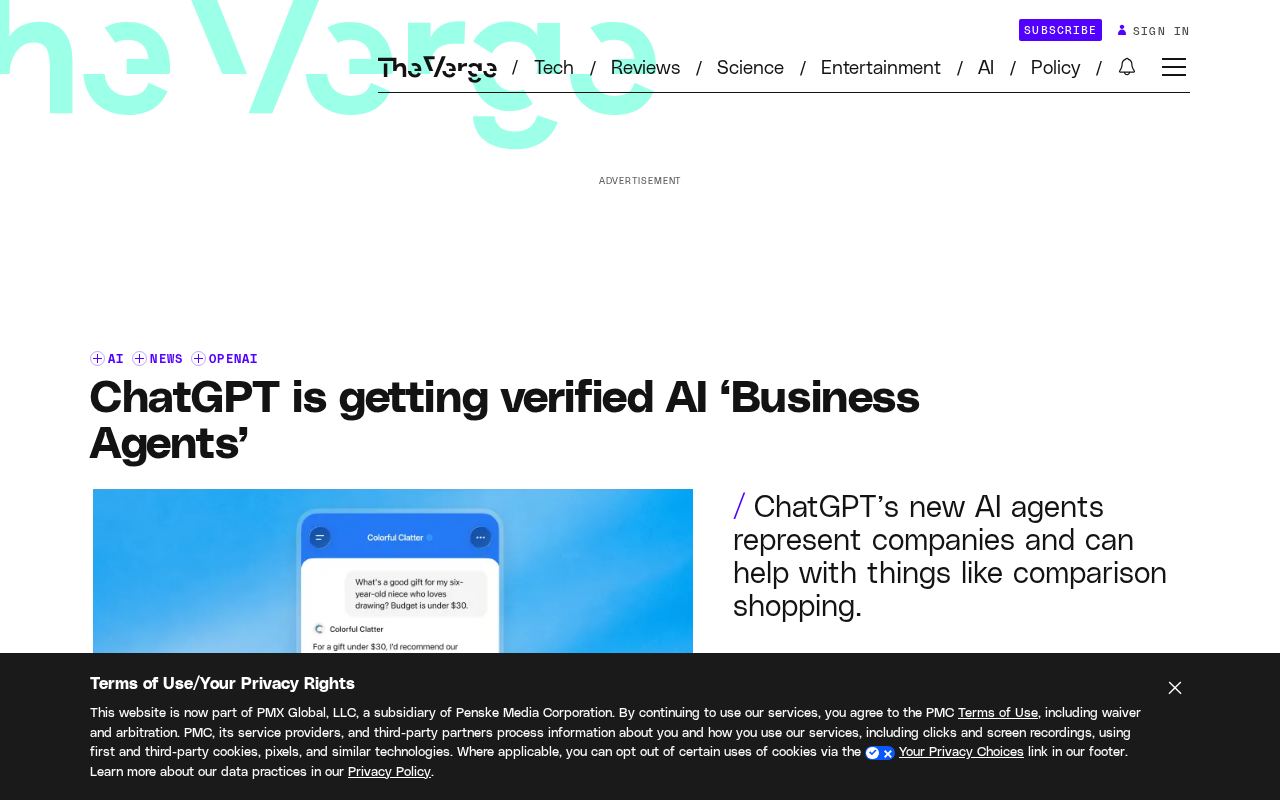
OpenAI will introduce verified business agents to ChatGPT, enabling brands to participate in e-commerce price comparison and service inquiries under official identities.
OpenAI plans to introduce verified "Business Agents" to ChatGPT, allowing brands to interact with users under officially verified identities, initially in beta for eligible U.S. e-commerce and online service companies. Comparison shopping is the core scenario, where multiple brand agents provide official information in the same chat interface. The feature is part of ChatGPT's enterprise suite, signaling its move toward a commercial interaction platform, though verification thresholds, agent governance, and data isolation remain unclear.
Title
ChatGPT Launches Verified AI Business Agents, Ushering in a New Era for E-commerce Price Comparison
Meta Description
OpenAI introduces verified Business Agents to ChatGPT, initially available to eligible U.S. e-commerce and online service companies, enabling brands to participate in price-comparison shopping conversations with official identities and explore a new commercial entry point in the AI chat interface.
Article Content
ChatGPT is extending from a conversational assistant toward commercial infrastructure. According to the latest news, OpenAI will introduce verified "Business Agents" to ChatGPT, allowing brands to interact with users in conversations under an official identity. The first application scenarios target e-commerce price comparison and online service inquiries.
What Are Verified Business Agents?
According to disclosed information, ChatGPT will allow users to converse with "verified business agents" that represent specific brands and help users complete tasks such as comparison shopping. Unlike ordinary chatbots, "verified" means the brand identity has been vetted by the platform — when users interact with an agent, they can confirm that the counterparty genuinely represents a real merchant rather than an impersonating third party.
The feature will initially be available to "eligible" e-commerce and online service companies in the United States, launching in beta alongside a series of enterprise-oriented ChatGPT features. The term "eligible" suggests that OpenAI has set entry requirements, possibly involving corporate qualification reviews and brand verification processes, though specific criteria have not yet been made public.
In AI conversation platforms, an "agent" typically refers to an intelligent entity capable of autonomously executing tasks, invoking tools, and completing multi-turn interactions on behalf of one party, with its capability boundaries determined jointly by the underlying model and external interfaces. Compared with early chatbots that could only respond passively, agents are goal-oriented: they can proactively collect user constraints, call product databases or inventory interfaces, and continuously maintain context throughout the conversation. ChatGPT's business agents can thus be understood as "intelligent agents deployed on the platform by brands," where brands provide product information and response strategies while the platform handles identity verification and behavioral constraints. This model resembles third-party plugins or applications on open platforms, but verified agents place greater emphasis on the certainty of identity attribution and the official nature of response content, thereby imposing higher requirements on the platform's review and governance capabilities.
Why the Price Comparison Scenario Deserves Attention
Comparison shopping is one of the most time-consuming steps in the consumer decision chain. In the traditional model, users must switch between multiple e-commerce platforms, manually compare specifications and prices, or rely on third-party price comparison tools — which often suffer from lagging information and mixed advertising. If brands can enter ChatGPT conversations directly as verified agents, users could theoretically describe their needs in natural language, have agents from multiple brands each provide official information, and complete a side-by-side comparison within the same conversational interface.
For consumers, this means a shorter decision path; for brands, it means a brand-new touchpoint close to user intent. When a user proactively asks "which laptop is suitable for programming," the brand agent's response is no longer a search ad slot but a direct participant in the conversation.
The core mechanism behind comparison shopping is "information aggregation and side-by-side comparison," whose effectiveness depends heavily on the real-time nature and structured quality of data. Traditional price comparison tools typically obtain prices and specifications through web crawling or merchant feeds, then present them in list form; users must judge information timeliness and credibility themselves. If verified agents from multiple brands enter the same conversation simultaneously, the platform effectively assumes the role of information orchestrator: it must decide the order in which agents are invoked, the display format, and how conflicting information is handled. This is logically similar to search engines' price comparison channels or e-commerce platforms' "same-item comparison" features, but the interaction form shifts from page navigation to natural language negotiation. Whether information consistency and traceability can be maintained in conversation is the technical prerequisite for this scenario to work.
Potential Impact on the E-commerce Ecosystem
The emergence of verified business agents may change how brands compete in the AI conversation interface. In the past, e-commerce traffic was highly concentrated in platform search and recommendation systems; now, ChatGPT is attempting to become a new entry layer. Brands need to think not only about keyword rankings but also about how to make their agents deliver persuasive information in conversations.
On the other hand, the verification mechanism itself is a threshold. Can small and medium-sized merchants obtain verification at a reasonable cost? Will verified agents' answers be constrained by platform rules (for example, whether agents are allowed to disparage competitors)? How will user data be isolated between agents of different brands? These questions remain unanswered. OpenAI has only disclosed that the feature is in testing, with more details to be announced later.
"Verification" on internet platforms typically refers to a set of identity verification and continuous oversight mechanisms, commonly seen in search engines' official account verification, social platforms' blue-V verification, and e-commerce platforms' brand flagship store authorization. Their common feature is that the platform grants a trusted identifier to a subject through qualification review and retains the power to revoke it in case of violations. ChatGPT's verified business agents follow this logic but face greater difficulty — agent response content is generated by models, and the platform must draw boundaries between "brand self-expression" and "preventing misleading statements." This means verification is not just a one-time admission review but also requires accompanying continuous monitoring, complaint response, and accountability mechanisms; otherwise, the credibility of the verification badge itself will be diluted by the misconduct of individual agents.
The Overall Signal of the Enterprise Feature Suite
Business agents are not an isolated feature but part of ChatGPT's enterprise feature matrix. From the series of B2B updates, it is clear that OpenAI is pushing ChatGPT from a "personal productivity tool" toward a "commercial interaction platform." The approach of verified agents resembles search engines' previous official account verification and e-commerce platforms' brand flagship stores — the core is building trust through identity verification, except that the interaction form shifts from page browsing to conversation.
Whether this direction can succeed depends on three variables: brands' willingness to participate, users' trust in AI agent recommendations, and the platform's ability to govern agent behavior. The beta's performance will determine whether verified business agents become a standard e-commerce feature or remain at the experimental stage.
One-line Summary
OpenAI will introduce verified business agents to ChatGPT, enabling brands to participate in e-commerce price comparison and service inquiries in conversations under official identities.
Paragraph Summary
OpenAI plans to introduce verified "Business Agents" to ChatGPT, allowing brands to interact with users in conversations under officially verified identities. The feature will initially launch in beta for eligible U.S. e-commerce and online service companies. Comparison shopping is the core scenario: users can describe their needs in natural language, and multiple brand agents provide official information and complete side-by-side comparisons within the same conversational interface, shortening the decision path and offering brands a new touchpoint close to user intent. The feature is part of ChatGPT's enterprise feature suite, signaling its extension from a personal productivity tool toward a commercial interaction platform. However, verification thresholds, agent behavior governance, and data isolation remain unclear, and whether the feature becomes a standard e-commerce offering still depends on brands' willingness to participate and users' trust.
Related articles

Microsoft WebIQ: Verifiable Real-Time Web Grounding for AI Agents
Microsoft WebIQ gives AI Agents real-time, citable web grounding across web, news, images, videos, and Places—164ms P95 latency, 50% fewer tokens, Scopes source control, and MCP integration.
Augmentable Gaussian Splatting: Building Photorealistic Simulation Environments for Robot Training
Team combines Gaussian Splatting with meshes to build photorealistic robot simulation environments, integrating MuJoCo Warp physics and Franka Panda for augmentable, relightable real-site simulation.
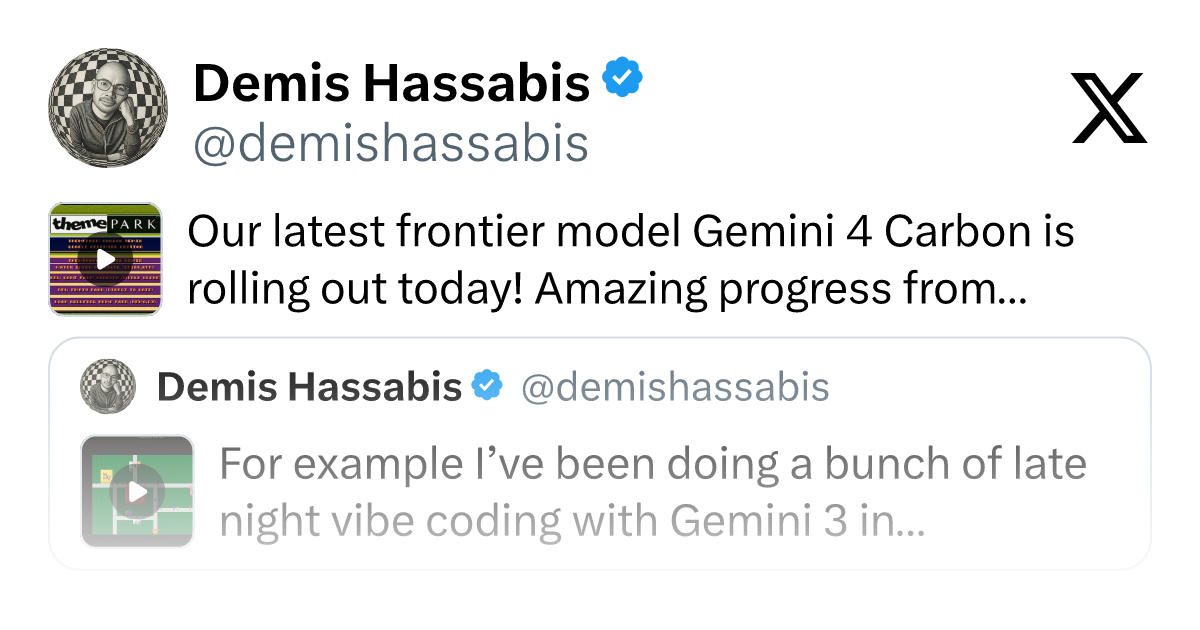
Gemini 4 Carbon Released: The Leap from Gemini 3 to Gemini 4 in Under a Year
Google releases Gemini 4 Carbon, less than a year after Gemini 3. In the official demo, Carbon reverse-engineered the Theme Park binary, added a new DeepMind-themed ride, and ported it to the web in one shot.