ChatGPT Plus/Pro Plans: A Complete Comparison of Features and Payment Methods

Compare ChatGPT Plus and Pro plans, payment methods, and third-party top-up risks.
This article breaks down the pricing and feature differences between ChatGPT Plus and Pro, compares three mainstream payment methods (credit card, US Apple ID gift cards, and Google Play), and honestly assesses the security and compliance risks of third-party top-up services to help users choose the right plan.
Why Is Subscribing to ChatGPT So Complicated
For users in mainland China, getting smooth access to ChatGPT's paid features often means running into a whole series of obstacles: blocked overseas card nodes, low payment success rates, cumbersome registration processes, and more. Many people end up failing after all the hassle.
The cross-border payment barriers around ChatGPT are no accident—they result from the combined effect of OpenAI's risk-control system and international payment infrastructure. OpenAI identifies and filters subscription requests from restricted regions through multiple dimensions, including IP geolocation detection, verification of the issuing bank's country for payment cards, and device fingerprinting.
The technical depth of this risk-control system exceeds many users' expectations. IP geolocation detection relies on commercial IP databases like MaxMind, which can accurately identify a visitor's country and region. Device fingerprinting builds a nearly unique device identifier by collecting dozens of dimensions, such as browser Canvas rendering characteristics, WebGL information, font lists, and screen resolution. The most critical factor is distinguishing residential IPs from data center IPs—residential IPs are assigned by ISPs (Internet Service Providers) to ordinary household users and carry high reputation, whereas most VPNs or proxy servers use data center IPs, which have been widely flagged and blocked by mainstream risk-control systems. Even if a user connects through a proxy node, payment may still fail if the node's IP is flagged as a data center IP (rather than a residential IP)—the node quality and the credit card's country of origin must be highly aligned for a subscription to go through smoothly.
This article sorts out the pricing differences among ChatGPT's various plans, the feature distinctions between Plus and Pro, and a comparison of the several common payment methods currently available, to help users with genuine needs make rational choices about the plan that suits them best.
Important Notice: This article is intended solely for informational and educational purposes. Third-party top-up services carry multiple risks related to account security, funds, and compliance. Readers should exercise careful judgment and prioritize official channels.
ChatGPT Plan Pricing and Feature Comparison
Official Pricing Overview
OpenAI's official pricing for each plan is as follows:
- ChatGPT Plus: $20/month
- ChatGPT Pro (Pro 5): $100/month
- ChatGPT Pro (Pro 20): $200/month
OpenAI's tiered plan strategy reflects the ongoing evolution of its business model. ChatGPT Plus officially launched in February 2023, and its $20/month price was seen at the time as a landmark event in the commercialization of AI services. As reasoning models like o1 and o3 came online, along with the deep integration of DALL·E image generation capabilities, OpenAI further introduced the Pro tier in 2025, institutionalizing a differentiated service system for heavy-usage users. The Pro 20 plan's $200/month pricing actually targets professional creators, enterprise users, and power users who rely heavily on AI, rather than mass consumers—which explains why its price is 10 times that of Plus, with its core selling points being usage quotas and the full unlocking of image generation capabilities.
One point to note in particular: the free tier (the Go version) does not support the Codex coding feature. For developers with programming needs, the Plus and Pro plans are the necessary choice—only these two paid tiers open up Codex services.
Codex is a model series OpenAI trained specifically for code understanding and generation tasks. Its capabilities are built on the GPT architecture and formed through dedicated fine-tuning on billions of lines of open-source code from platforms like GitHub. Codex supports dozens of programming languages, including Python, JavaScript, TypeScript, Go, and Ruby, and can automatically complete function bodies based on natural-language comments, identify the root causes of bugs, generate unit tests, and explain complex code logic. As the underlying engine behind GitHub Copilot, it is deeply integrated into mainstream development environments like VS Code and JetBrains, and has become the de facto standard in AI-assisted programming. The fact that the free tier does not grant Codex access means free users face noticeable limitations in AI-assisted programming, which is one of the core drivers pushing developers toward paid plans.
Core Differences Between Plus and Pro 20
Compared to Plus, Pro 20 mainly stands out in the following three areas:
- 20x usage quota: Substantially higher usage limits
- Priority access to frontier models: Enjoy the latest Pro-level models
- Unlimited image generation: Faster generation speed, without stalling when quotas run out
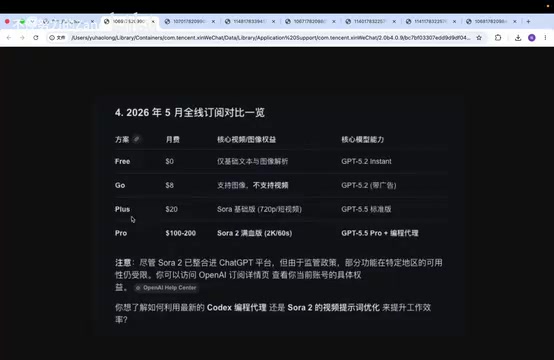
These differences carry clear significance for specific user groups. Take e-commerce users as an example: they routinely need to generate large volumes of product images quickly, but the Plus plan imposes limits on image generation. The Pro plan's unlimited image generation capability is precisely suited to such high-frequency image needs.
Comparison of the Three Mainstream Payment Methods
There are currently three main ways to subscribe to ChatGPT membership, each with its own pros and cons. It's advisable to choose based on your own circumstances.
1. Direct Credit Card Payment
Widely recognized as the most stable payment method, with high account security and relatively smooth renewals. But the core pain point is: domestic Chinese credit cards cannot be used—you must hold an overseas bank card. Obtaining an overseas credit card involves high barriers and cumbersome procedures, making it unfriendly for ordinary users.
Best suited for: Users who already hold an overseas bank card, or are willing to spend the time to obtain one.
2. US Apple ID + Gift Card Top-Up
This method is iOS-only. You need a US Apple ID and must purchase gift cards to top up. The total cost is roughly $20 to $25, slightly higher than official pricing, and its stability doesn't match direct credit card payment.
Apple's App Store employs strict regionalized content and payment management mechanisms, where Apple IDs from different regions correspond to different store shelves and billing systems. The key to understanding this approach lies in Apple's IAP (In-App Purchase) system: IAP requires all in-app purchases to go through Apple's payment channel, with Apple acting as the intermediary that first collects payment from the user, then settles with the developer monthly while taking a platform commission of 15% to 30%. This mechanism means OpenAI cannot directly reject subscription requests initiated through the App Store—part of the risk-control decision-making power shifts to Apple's side. A US Apple ID corresponds to the US App Store shelf, is billed in US dollars, and gift card balances can directly offset IAP consumption. The entire fund flow requires no bank card information from the user, thereby circumventing OpenAI's verification of the payment card's country of origin. This is the underlying reason the iOS gift card top-up method can bypass OpenAI's direct payment restrictions. However, Apple's platform commission is ultimately passed on to users, resulting in a total price slightly higher than the official direct payment price.
For Apple users who already have a US ID, this can serve as an alternative option.
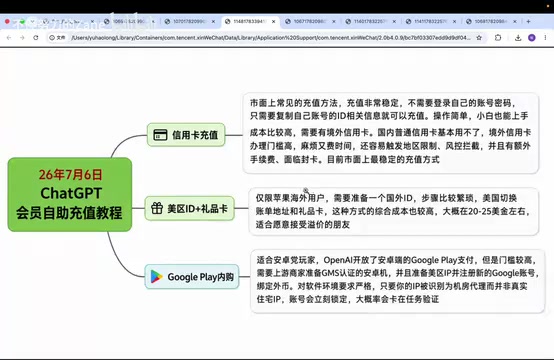
Best suited for: iOS users who already have a US Apple ID.
3. Google Play Gift Card Top-Up
The top-up route for Android users, requiring a GM card (Google Play gift card) to operate. This method has extremely strict requirements for the operating environment—if the environment doesn't meet the standard, the account can be locked immediately, making it the highest-risk option.
The reason Google Play top-ups carry the highest risk is closely tied to the account risk-control mechanisms of both Google and OpenAI. Google enforces strict regional consistency requirements for Google Play accounts. If there's an obvious contradiction among the account's registration region, the payment method's country of origin, and the current access IP, the account is very likely to trigger anomaly detection. Device fingerprint information on Android devices (including device model, Android ID, system language, time zone, installed app lists, etc.) is more easily collected by third-party SDKs than on iOS, allowing risk-control models to more accurately identify environmental anomalies. In addition, Google's Play Integrity API performs integrity verification on devices, and rooted or uncertified devices may be rejected outright when subscribing. Once an account is locked or a subscription is revoked on Google's side, the membership benefits on OpenAI's side become invalid as well. This double layer of risk control makes this method significantly more difficult to operate and far more prone to failure than the other options.
Best suited for: Android users who can ensure their network environment meets the requirements.
A Rational Look at Third-Party Top-Up Services
The Current State of the Top-Up Market
On second-hand marketplaces like Xianyu, there are quite a few shops offering ChatGPT top-up services. Common product formats include:
- Official direct Plus top-up: around ¥158 (via the credit card channel, relatively stable)
- Dedicated ready-made Plus account: around ¥59, with a short-term warranty
- Direct Pro 5 top-up: around ¥730 to ¥750
- Direct Pro 20 top-up: around ¥1,228
- Dedicated web-only access: around ¥750 (suited for users who only use the web version, mainly for image generation)
This type of service is essentially a form of information-asymmetry arbitrage: sellers who possess overseas payment tools or bulk account resources provide subscription services to domestic users at a markup. Specifically, sellers typically obtain subscription capabilities through several methods: holding genuine bank card accounts in the US, Hong Kong, and other regions; using virtual credit card services like Depay and Wise; or purchasing ready-made accounts that already have active memberships in bulk. Their pricing logic layers exchange rate fluctuation buffers, operating costs, and risk premiums on top of the official USD price, ultimately selling to domestic users in RMB.


Risk Warnings
Third-party top-up prices may seem affordable, but the following risks cannot be ignored:
- Account security risk: Topped-up accounts may be banned by OpenAI's risk control, wasting your payment
- Financial security risk: After prepaying, you may face reduced service or even a runaway seller
- Data privacy risk: Both shared and dedicated accounts may involve the exposure of personal conversation data
- Compliance risk: Some top-up methods may violate OpenAI's terms of service
OpenAI's terms of service explicitly prohibit account transfers and proxy subscriptions. Once anomalies are detected, an account may be unilaterally banned without a refund. So-called "warranty" promises are almost impossible to fulfill in practice, because sellers can neither control OpenAI's risk-control decisions nor be effectively held accountable at the platform level. As for data privacy, a shared account means conversation records may be viewed by the account holder (i.e., the seller), a risk that is especially pronounced when sensitive business information is involved—OpenAI's conversation history is stored at the account level by default, meaning anyone who can log into the account can access the complete conversation records.
The seller's so-called "warranty" is merely a verbal promise and does nothing to fundamentally eliminate the risks above. Users with the means are advised to prioritize official channels, including obtaining legitimate overseas payment tools or using OpenAI-approved compliant payment methods.
Conclusion: How to Choose What's Best?
ChatGPT's paid barrier essentially stems from the complexity of cross-border payments. Making choices from the standpoint of your actual needs leads to clearer thinking:
- Ordinary users: The Plus plan is basically sufficient, and $20/month offers reasonable value
- Developers/programming needs: Either Plus or Pro works—the key is that you must subscribe to a paid version to use Codex
- E-commerce/high-frequency image generation users: Pro 20's unlimited image generation capability is worth considering
As for payment methods, direct credit card payment is the most stable but has the highest barrier; gift card options each come with platform restrictions; and the Google Play method carries the greatest risk. As for third-party top-ups, convenient though they are, the security and compliance risks must not be overlooked—the price of a bargain can sometimes be far higher than imagined.
Key Takeaways
Key Takeaways
Related articles

Gaussian Process Bandit Optimization: Exploration Strategies and Inference Regret Guarantees
Cumulative regret guarantees in Bayesian optimization fail to reflect final recommendation quality. This article examines a new study that provides inference regret guarantees for Gaussian process bandit optimization through exploration query strategies and fill distance analysis, validated on hyperparameter optimization and control tasks.

The Most Detailed Codex Guide on Bilibili: From Installation to Real-World Practice
The most detailed Codex guide on Bilibili: from app store installation to daily work mode configuration, with a real coffee shop project demonstrating file organization, data extraction, dashboard creation, and other practical tasks. Learn to use Plan Mode and desktop pets to leverage Codex efficiently.

Appearance Compensation in Volume Rendering: Why RGB Accuracy Cannot Guarantee Density Correctness
Volume rendering research reveals that volumetric data perfectly reproducing external RGB views may still contain density errors: appearance compensation can double central density and keep external rays unchanged even when L2 error exceeds 14.52%. Density recovery depends on appearance capacity, spatial resolution, and measurement design.