ChatGPT Plus vs Claude Pro: How Developers Should Choose

At $20/month, ChatGPT Plus and Claude Pro follow two product philosophies on code tool metering and model availability.
ChatGPT Plus and Claude Pro both cost $20/month, but developers don't get the same thing. The core divergence is billing structure: ChatGPT Plus meters Codex separately from regular chat, so they don't crowd each other out; Claude Pro has Claude Code and daily conversation share the same quota pool, so heavy use of coding tools directly squeezes chat capacity. On models, a major selling point of ChatGPT Plus is access to GPT-6 Astra, while the original material is vague about Claude Pro's specific model versions. The article offers three decision dimensions: coding tool usage intensity, dependence on specific models, and overall ecosystem integration.
A $20 Subscription Battle
For developers, a $20/month AI subscription has become as basic an expense as cloud servers and domain names. But when both OpenAI and Anthropic anchor their pricing at the same number, choosing between them becomes a real decision.
According to the original source's analysis, ChatGPT Plus and Claude Pro are priced identically, but there are key differences in the billing and feature structures that developers care about most. These differences directly determine what you actually get for your $20 a month.
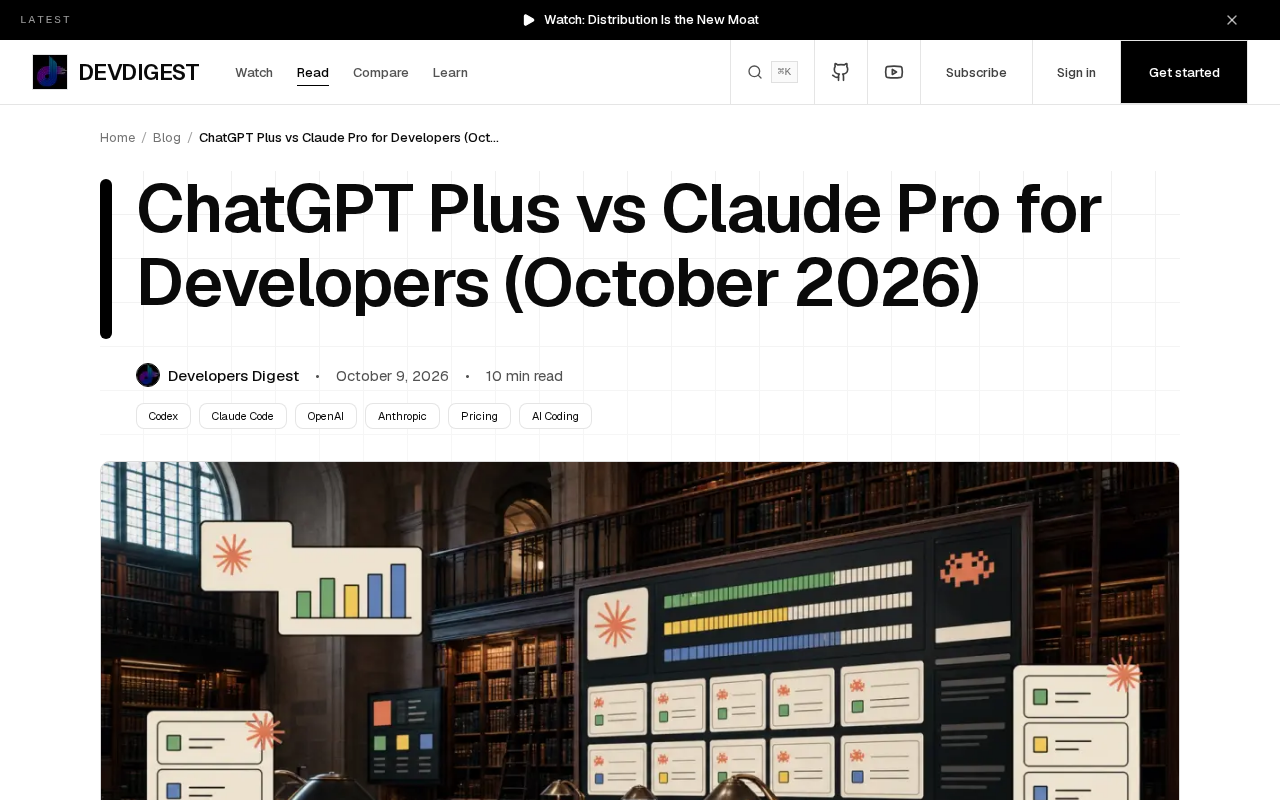
Core Difference: Codex Metered Separately, Claude Code Shares Quota
The most fundamental divergence between the two lies in how their coding tools are used.
ChatGPT Plus meters Codex separately from regular chat — meaning your Codex usage won't eat into your daily conversation quota, with each tracked independently. For developers who frequently switch between code generation and everyday Q&A, this isolation design reduces interference between the two.
Claude Pro takes a different approach: Claude Code and regular chat share the same usage pool. According to the original source, this design means heavy use of Claude Code directly consumes the quota available for regular conversations.
Each model has its advocates. The benefit of separate metering is that each resource pool is dedicated to its purpose; the downside is that one side's quota may sit idle while the other runs tight. The benefit of a shared pool is greater flexibility; the downside is the tendency for "one scenario to drain the entire quota."
What Are Codex and Claude Code?
Codex was originally a series of code-generation models released by OpenAI early on, and has now evolved in the ChatGPT product line into a developer-facing programming assistant entry point, supporting tasks like code completion, debugging, refactoring, and cross-file understanding. Its positioning is "taking coding as a separate task and going deep on it," which is why OpenAI tends to give it an independent usage quota to avoid crowding out general chat.
Claude Code, meanwhile, is a command-line/terminal-form programming agent from Anthropic that can directly read and write files in a local repository, run tests, and execute multi-step tasks. Its design philosophy is to embed Claude's reasoning capabilities into the developer's actual engineering workflow, rather than staying in a web chat box. Although both products are "AI writing code," their product forms (integrated assistant vs. terminal agent) inherently determine different rhythms of quota consumption — this is also the technical background behind the two companies' different metering strategies.
Model Capabilities: GPT-6 Astra vs. Claude's Current Lineup
A major selling point of ChatGPT Plus is its inclusion of GPT-6 Astra. The original source cites this as one of the Plus subscription's core attractions.
For developers, the generation of the underlying model directly affects code generation quality, long-context understanding, and tool-calling capabilities. The addition of GPT-6 Astra means Plus users can access OpenAI's current latest model capabilities without paying extra to upgrade.
On the Claude Pro side, the original material doesn't provide equally specific model version information, but from its product positioning, Claude Pro likewise offers access to Anthropic's current flagship models.
The practical impact of model choice varies by task. Feedback from some developer communities suggests that Claude's output is preferred on certain refactoring tasks, while GPT series often performs more directly when rapid generation of multiple options is needed. However, these are differences at the level of user perception, and the original source does not provide benchmark data to support them.
On the Matter of "Model Generation"
In large-model subscription products, "which model you can access" often affects actual experience more than "how many tokens you can use." Model generations typically manifest across several dimensions: context window length (determining how much code you can fit in at once), stability of tool calling and function calling (determining whether Agent-type tasks can run successfully), and depth of reasoning chains (determining the success rate of complex refactoring or multi-step planning).
Vendors often use the approach of "latest models only in paid tiers" to create subscription tiers, so whether the $20 entry tier can get the flagship model is a key metric for evaluating value for money. It should be noted that model versions iterate very frequently, and the specific models mentioned in this article may be replaced by newer versions within a few months. Readers should base decisions on the currently available models listed on official pricing pages.
How to Choose: Three Decision Dimensions
Look at your intensity of use of coding tools. If you use Codex or Claude Code heavily every day, the billing structure's impact is amplified. Separate metering suits developers with clear usage patterns; a shared pool suits those who need to flexibly allocate quota across different tasks.
Look at your dependence on specific models. If GPT-6 Astra is an irreplaceable part of your workflow, ChatGPT Plus is the more direct choice. If you value the Claude series' performance on specific tasks more, Claude Pro is more suitable.
Look at overall ecosystem integration. Subscription decisions often aren't just about a single tool — they also involve the IDE plugins, API workflows, and team collaboration tools you already use. The two platforms have different directions in their developer ecosystem layouts, which affects long-term experience.
The Practical Difference Between "Shared Pools" and "Independent Pools"
Quota pool design is essentially a resource allocation problem. An independent pool is like earmarking funds for each type of task; the benefit is predictable budgeting — you won't find yourself with no quota to ask questions the day after a coding spree; the cost is that after splitting the total, idle capacity on one side creates waste. A shared pool is the opposite: it merges all quota into one big pool, charged by usage, flexible but unpredictable — especially when running tasks like Claude Code that execute many rounds in succession, quota consumption can far exceed chat scenarios.
For individual developers, a practical way to judge is to look back at your usage logs over the past month: if code-type requests and Q&A-type requests are of similar magnitude, an independent pool is safer; if one category clearly dominates, a shared pool can actually let you put idle quota to use.
Summary
At the $20 price point, ChatGPT Plus and Claude Pro offer two different product philosophies: the former tends to separate coding tools from general chat and meter them independently, while emphasizing access to the latest models; the latter incorporates coding capabilities into a unified quota system, emphasizing continuity of use.
There is no absolute winner. The choice depends on the distribution of your usage intensity, your dependence on specific models, and which quota-management logic you agree with more. The question raised by the original source — "which to choose" — is essentially asking: are you more willing to pay for certainty, or for flexibility?
It should be noted that this article's judgments are based on limited original material, lacking benchmarks and long-term usage data, and actual experience may differ significantly depending on individual workflows.
Related articles

Random Pruning of the DPO Computation Graph: 1.4x Training Speedup and Lower Peak Memory
DPO training too slow and memory-hungry? This paper proposes a random pruning framework for the DPO computation graph, sampling independently across position, sequence, and branch dimensions; branch pruning achieves a 1.426x step-time speedup and cuts training time by about 30%, with in-depth attribution of memory and time gains.

Why Does JEPA Underperform MLM in Longitudinal EHR Representation Learning?
New study compares JEPA and MLM for longitudinal EHR representation learning on MIMIC-IV: three JEPA variants train stably without collapse but underperform MLM; target size, not heterogeneity, drives prediction error.

Transfer Learning + Visible Light Communication: A New Approach to Energy-Efficient Indoor Positioning
A study proposes a transfer learning-based visible light communication indoor positioning method, achieving 47% accuracy improvement on the BOSCH factory dataset, 67.5% model efficiency under high noise, and introducing the ME composite metric for energy-efficient positioning in energy-constrained industrial IoT scenarios.