ChatGPT Pro and Business Subscriptions Now Include API Credits, Enabling Direct Development in Codex

ChatGPT Pro and Business subscriptions now include monthly API credits, with integrations buildable directly in Codex.
OpenAI announced that ChatGPT Pro and Business subscribers automatically receive monthly API credits usable across the OpenAI platform, with amounts scaling by subscription tier. Users simply link an API organization in the Building section of the ChatGPT app, with no extra account migration. Combined with the OpenAI Developers plugin in Codex, users can complete endpoint selection, key creation, and code integration via natural language. The demo case is a Mac writing assistant app that integrates writing quality assessment and revision suggestion endpoints, with no hand-written API calling code. These credits are positioned for prototype validation and experimentation, while production usage still requires separate planning.
ChatGPT Pro and Business Subscriptions Now Include API Credits, Enabling Direct Development in Codex
OpenAI has lowered the barrier to API development yet again. According to an official demo video, ChatGPT Pro and ChatGPT Business subscribers now automatically receive a monthly allotment of API credits usable across the entire OpenAI platform. More importantly, these credits can be spent directly within Codex—no need to separately register a developer account, configure billing, or switch toolchains.
Subscriptions Now Include API Credits, Moving the Development Entry Point into ChatGPT
Previously, developing on the OpenAI platform followed a relatively fragmented path: ChatGPT was a consumer product, the API was a developer platform, and the two had separate account systems and billing logic. This change connects the two.
According to the demo, Pro and Business users receive monthly API credits, with the amount scaling by subscription tier—higher tiers correspond to larger monthly credit amounts. OpenAI's stated intent is to "give you room to experiment and build your own tools." For teams already paying for ChatGPT subscriptions, these credits effectively convert part of the subscription cost into a programmable experimentation budget, eliminating the need for a separate procurement approval process.
Enabling it is simple: go to the Building section in the ChatGPT app and link your API organization. No additional account migration is required.
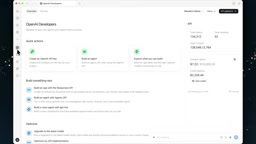
API organization is a management unit in the OpenAI developer platform used to isolate API resources, member permissions, and billing for different projects or teams. Each API organization has its own API keys, usage statistics, and quota settings. After linking a ChatGPT subscription account to an API organization, the subscription's included API credits are injected into that organization to offset costs when its projects call models. This design preserves the independence of the consumer product and developer platform account systems while bridging their billing logic through credits, allowing subscribers to start API experimentation without separately topping up a balance.
The OpenAI Developers Plugin in Codex
What really makes these credits useful is the OpenAI Developers plugin in Codex. The demonstrator's assessment was that the plugin makes "getting started very easy"—you can rapidly prototype on the API and also add AI capabilities to existing projects.
The demo case is a small Mac app that helps improve email and message writing. The app itself was already built; what was missing was the integration with the OpenAI API. Through the plugin, the demonstrator verbally described the requirement: at the end of input, quickly check writing quality, determine whether the content is ready to send, needs minor adjustments, or needs substantial rewriting, and provide revision suggestions.
Codex first asks which API organization to use, then helps create an API key dedicated to that app. The significance of this step is permission isolation—issuing a separate key for a single app rather than reusing the main account credentials.

From Verbal Requirements to a Working Integration
Next, Codex begins building the integration, first connecting the endpoint for assessing writing quality, then the editing endpoint responsible for generating revision suggestions. The demo mentioned that the editing step uses a model that is "good at writing and cost-efficient," on the grounds that it is best suited to this task scenario.
Note: The specific APIs and model names shown in the demo cannot be verified in public sources, and this article does not cite them as fact. What can be confirmed is the workflow itself—Codex can select endpoints, create credentials, and complete code integration based on natural language descriptions.
Once the app is running, you input a piece of text, and the assessment endpoint returns a result in a very short time: this message could be clearer. The editing endpoint then offers rewrite suggestions, and a keyboard shortcut can bring the suggestion directly into the context app. The entire flow consumes exactly the API credits newly included with the subscription.

API key is the credential string used to authenticate calls to the OpenAI API. Creating a separate key for a single app rather than reusing the main account credentials is a least-privilege practice: if a key leaks, it can be revoked independently without affecting other services, and it also makes it easier to track usage and cost per app. In the demonstrated workflow, the dedicated key created with Codex's help is bound only to that Mac writing assistant app, and its usage is deducted from the API credits included with the subscription. This isolation design is especially important in enterprise environments, preventing a key leak from a prototype project from affecting production systems.
What This Means for Developers
The practical impact of this change has two layers.
The first layer is lower decision cost. Previously, when a team wanted to validate an API idea, they had to confirm billing settings, estimate call costs, and go through internal processes. Now the credits are already in the account, and the question "should we try it?" no longer requires a meeting. For teams on Business subscriptions, this means product managers and designers can also build prototypes directly without waiting in line for engineering resources.
The second layer is the migration of the development interface. Codex has gone from a code completion tool to an integration entry point: selecting an organization, creating a key, writing calling code, and verifying it works—this chain has been compressed into a single conversational interface. In the demo, the demonstrator described requirements verbally throughout and did not hand-write a single line of API calling code.

It's worth noting that the credits are issued monthly and cover the entire platform, making them suitable for prototype validation and small-scale experiments, but usage planning for production environments still needs separate evaluation. The demo itself positions them as room for "experimentation and building your own tools," rather than a replacement for formal API billing.
If you have a small tool you've always wanted to try, the startup friction is indeed much lower than before.
Background
Codex was originally a series of code generation models launched by OpenAI, later evolving into a programming assistant interface integrated into ChatGPT that supports code completion, debugging, and project-level conversations. In this article, Codex's role is further expanded to "integration entry point": by installing the OpenAI Developers plugin, users can directly invoke API management functions (such as selecting an organization and creating keys) within a conversation and generate calling code. The plugin mechanism transforms Codex from a pure code assistance tool into a console that can operate OpenAI platform resources, reducing the friction of switching between the IDE, terminal, and web backend.
One-line Summary
ChatGPT Pro and Business subscriptions now include monthly API credits, with integrations buildable directly in Codex.
Paragraph Summary
OpenAI announced that ChatGPT Pro and Business subscribers automatically receive monthly API credits usable across the entire OpenAI platform, with amounts scaling by subscription tier. Users simply link an API organization in the Building section of the ChatGPT app—no additional account migration needed. Combined with the OpenAI Developers plugin in Codex, users can complete endpoint selection, key creation, and code integration through natural language. The demo case is a Mac writing assistant app that integrates writing quality assessment and revision suggestion endpoints, with no hand-written API calling code throughout. These credits are positioned for prototype validation and experimentation, while production usage still requires separate planning.
Related articles

Vaani Developer Platform: Build Human-Like Voice AI Agents with Zero Code
Vaani Developer Platform tops Product Hunt with 175 upvotes, offering zero-code construction of human-like voice AI agents with flow design, tool and knowledge base connections, real phone deployment, and structured call data output.

Knocket AI: A Lightweight Tool That Lets Visitors Chat with Zero Friction
Knocket AI is a lightweight tool that lets visitors start real-time chats via a website or link without registering, targeting founders, creators, and small teams.

XWiki Launches Open-Source MCP Server: Let AI Read Your Wiki
XWiki's open-source MCP Server extension connects your Wiki knowledge base to AI agents like Claude Code and GitHub Copilot, supporting Q&A, page editing, and structured data—self-hosted to keep data control.