ChatGPT's Innovator's Dilemma: Why Dots Isn't a Standalone App
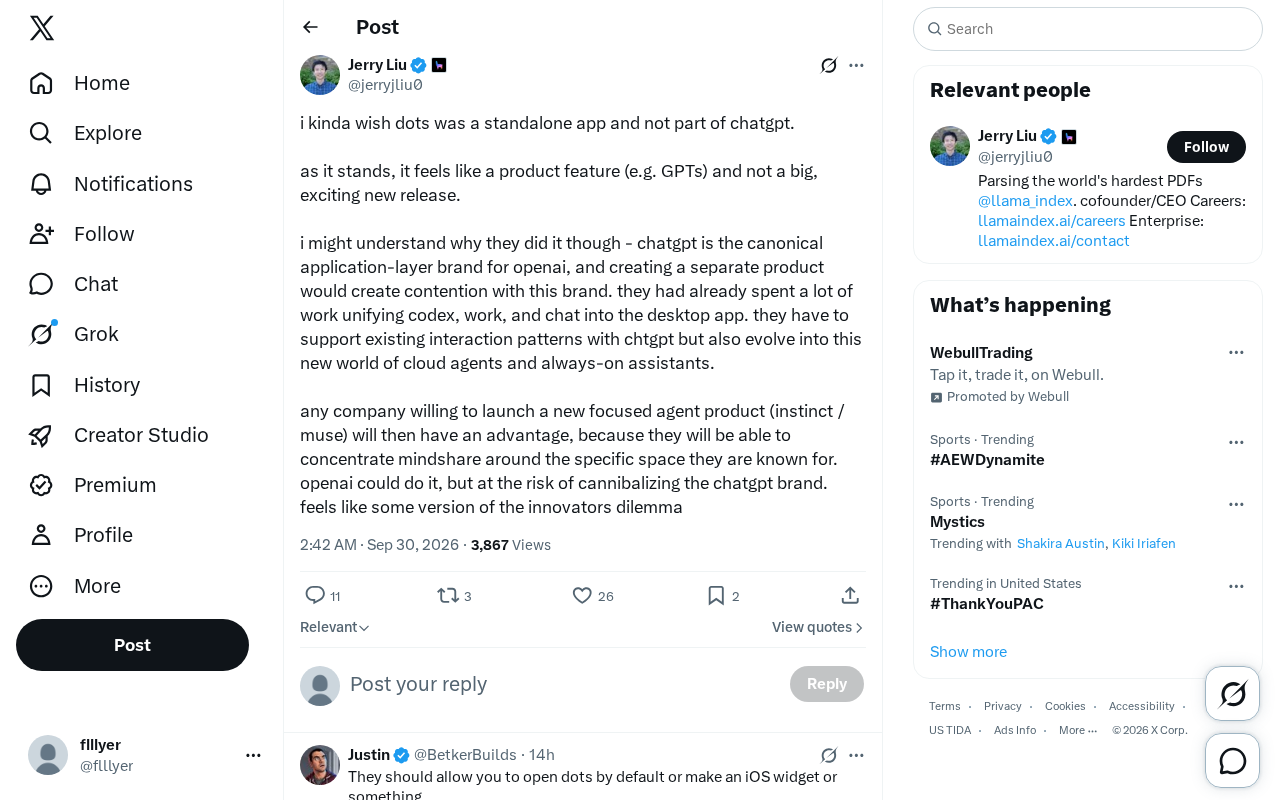
OpenAI folding Dots into ChatGPT instead of launching it standalone reflects a classic Innovator's Dilemma in the agent era.
This article examines a social media observation: by folding Dots into ChatGPT rather than launching it as a standalone product, OpenAI made it feel like a minor feature rather than a major release. The gravitational pull of the ChatGPT brand — and OpenAI's broader convergence strategy — explains the decision, but it creates a real tension: conversational AI and agent/always-on paradigms are fundamentally different, and forcing the new into the old container dilutes its value. This opens a window for focused agent startups to capture mindshare in specific domains, while OpenAI's brand-protection instincts constrain its boldness. The piece closes by framing this as a classic Innovator's Dilemma — ChatGPT may be OpenAI's biggest asset and its biggest liability at the same time.
The Product Strategy Behind a Single Tweet
A tech observer recently posted a thought-provoking take on social media: OpenAI's Dots feature should have launched as a standalone app, not been folded into ChatGPT's existing product ecosystem.
In their view, Dots currently feels more like a "product feature" (similar to the earlier GPTs rollout) than an exciting, high-impact launch. This sense of anticlimax reveals a deeper tension that large AI companies face when making brand and product architecture decisions.
The "Gravitational Pull" of the ChatGPT Brand
Why did OpenAI fold Dots into ChatGPT instead of spinning it out independently? The observer offers a fairly compelling explanation.
ChatGPT has become OpenAI's most recognizable brand identity at the application layer — it's essentially synonymous with the "consumer AI" category itself. In that context, launching a separate standalone product would inevitably create internal competition (contention) with this core brand asset.
More critically, OpenAI has already invested heavily in unifying Codex (coding), Work (workplace scenarios), and Chat (conversation) under a single desktop application. This reflects a clear "convergence" strategy: aggregating disparate capabilities under one entry point to deliver a unified user experience. Within that integration logic, spinning Dots out as a separate product would run directly against the grain.
Supporting the Old World While Embracing the New
A subtle tension exists here. OpenAI must both maintain the ChatGPT interaction model that users are already accustomed to, while also evolving toward an entirely new paradigm: cloud agents and always-on assistants.
These two demands don't always coexist harmoniously. Traditional conversational interaction emphasizes the immediacy of the "question-answer" loop, whereas agents and always-on assistants imply a new paradigm of background execution and proactive task completion. Cramming new capabilities into a container designed for an older paradigm tends to make those capabilities feel diminished — robbed of the presence and impact they deserve.
This may be precisely why Dots reads as a "product feature" rather than a "major launch" — it gets diluted by the framework of an older brand.
"Cloud agents" and "always-on assistants" represent a fundamentally different product philosophy from traditional chatbots. Traditional conversational AI treats the "request-response" cycle as its basic unit: the user initiates a query, the model returns a result, and no execution state persists after the session ends. The agent paradigm introduces persistent memory, task planning, tool calling, and asynchronous execution — the model can decompose goals, call external APIs, manage multi-step workflows, and proactively notify users upon completion, all without real-time human supervision.
This paradigm shift has radical implications for product design: the entry point shifts from a "chat box" to a "task dashboard" or "background process manager," and the user's mental model shifts from "tool" to "delegate." Embedding these capabilities inside an application whose core metaphor is a chat box makes it very difficult for users to develop the right expectations — and the value of the new capabilities gets substantially discounted as a result.
The Opportunity Window for Focused Competitors
The most valuable insight in this analysis is its identification of a potential shift in competitive dynamics.
Any company willing to launch a focused, purpose-built agent product (the tweet mentions positioning plays like Instinct or Muse) stands to gain a structural advantage: the ability to concentrate user mindshare on a specific domain where they excel, and build clear brand recognition around it.
OpenAI is certainly capable of doing the same — but the cost would be potentially cannibalizing the ChatGPT brand, its most valuable asset. A unified, all-encompassing brand gains scale, but loses the flexibility to go deep and focused on any particular use case.
This Is the Classic Innovator's Dilemma
The observer closes with a precise framing: this feels like some version of the Innovator's Dilemma.
This classic theory, articulated by Clayton Christensen, holds that successful large companies often hesitate in the face of disruptive innovation because they are too focused on protecting their existing core business and brand assets — and ultimately get overtaken by more agile newcomers.
OpenAI's situation maps neatly onto this. ChatGPT is simultaneously its greatest asset and potentially its greatest liability in the transition to the agent era. The instinct to protect the brand and the need to open up new frontiers are in irreconcilable tension. For any startup trying to carve out a position in the agent space against an incumbent, this may be exactly the right moment to strike.
The Innovator's Dilemma was systematically articulated by Harvard Business School professor Clayton Christensen in his 1997 book of the same name. Its core logic: market leaders excel at serving their existing mainstream customers, and that very success makes it difficult for them to invest in "disruptive innovations" — new technologies that initially underperform on key metrics and target niche markets. The reason is that disruptive innovations offer low early-stage margins and small initial market sizes, making them unable to pass the financial scrutiny applied inside large organizations. By the time the technology matures and begins eroding the mainstream market, the leader is often too entrenched to respond effectively.
Classic examples include: large-format hard drive manufacturers being disrupted by smaller form factors; Kodak inventing the digital camera but failing to lead the digital era because of its film business; Nokia's dominance in feature phones slowing its pivot to smartphones. OpenAI's situation is structurally analogous — the brand inertia and user scale of ChatGPT are quietly becoming a hidden drag on its ability to innovate boldly in the agent paradigm.
Conclusion
What looks like a casual tweet actually cuts to the heart of a central question in AI product evolution: as conversational AI migrates into the agent era, does an established powerhouse brand serve as a moat — or a set of shackles? The choice to ship Dots as a feature rather than a standalone app may be the result of careful deliberation at OpenAI, or it may have planted the seeds of being surpassed by more focused competitors. The market will likely have the final word.
Note: This article is based on a single social media perspective. The analysis represents speculation and has not been officially confirmed by OpenAI. It is intended for reference and discussion purposes only.
Related articles

New in Notion 3.8: Your ChatGPT Subscription Now Works Directly in Notion Agent
Notion 3.8 lets Business/Enterprise workspaces connect ChatGPT Plus, Pro, or Go subscriptions to power Notion Agent, replacing Notion credits. Eligibility, setup, MCP risks, and team implications explained.

ChatGPT Agent Mode Quick Start: A Multi-Step Task Automation Tutorial
How to use ChatGPT Agent mode? This guide breaks down the enabling steps: open the Tools dropdown from the Composer, select Agent Mode, and clearly describe multi-step goals, plus browser interaction in the VM, data analysis, file generation, and real-time interrupt controls.

Premiere Pro Meets AI Assistants: Automation Agent Brings Editing Automation
Automation Agent connects ChatGPT and Claude Code to Adobe Premiere Pro, enabling speech-based rough cutting, face pixelation, and more, with built-in FFmpeg and Python local tools and a one-time purchase, no subscription.