New in Notion 3.8: Your ChatGPT Subscription Now Works Directly in Notion Agent

Notion 3.8 lets Enterprise workspaces connect ChatGPT Plus/Pro/Go subscriptions, replacing Notion credits with subscription quota.
Notion 3.8 bridges ChatGPT subscriptions and Notion Agent quotas: Business and Enterprise workspace users who connect a ChatGPT Plus, Pro, or Go account via Settings → Notion AI → Usage → Connected Subscriptions will have Agent calls to GPT models draw from their ChatGPT plan quota instead of Notion credits, reducing duplicate subscription costs. The feature applies only to standard Agents—custom Agents and Guest users are excluded. The same release notes that Agents like Claude and ChatGPT can operate on pages with full user permissions via MCP, with Notion advising careful connection and enterprises needing to address data governance and permission boundaries.
If you already subscribe to ChatGPT Plus, Pro, or Go, you can now use that subscription quota directly in Notion Agent instead of consuming Notion credits. This is a practical update introduced in Notion 3.8, aimed at Business and Enterprise workspace users. This article breaks down the eligibility requirements, setup process, and limitations you should be aware of.
Core Feature: Replacing Notion Credits with Your ChatGPT Subscription
According to the YouTube channel "Money-Making AI Hub," Notion released version 3.8 on October 13. The key aspect of the new feature is that it bridges the quota systems between ChatGPT subscriptions and Notion Agent: when you select a GPT model in Notion Agent, the system prioritizes your linked ChatGPT plan rather than deducting Notion Credits.
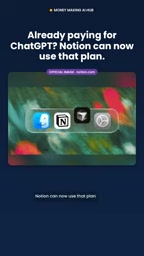
For users who hold both a ChatGPT subscription and a paid Notion workspace, this means the cost of double-paying can be put to better use. Previously, calling GPT models within Notion required consuming Notion's own AI credits; now this path can directly reuse an external subscription.
Who Can Use It? Eligibility Requirements and Limitations
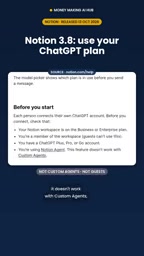
This feature is not available to all Notion users. According to the source material, the following conditions must be met:
- Workspace plan: Must be a Business or Enterprise plan workspace; Personal and Team plans are not currently supported.
- ChatGPT subscription type: Supports ChatGPT Plus, Pro, and Go accounts.
- Agent type: Only applies to standard Agents; custom agents cannot use this quota channel.
- Guest status: Guest users cannot use this feature.
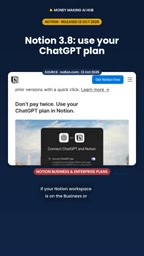
These restrictions indicate that the feature currently leans toward standardized integration in enterprise scenarios rather than being a universal capability for all users. The exclusion of custom Agents in particular means that teams relying on customized Agent workflows will still need to consume Notion credits in the original way.
Setup Process: Three Steps to Connect
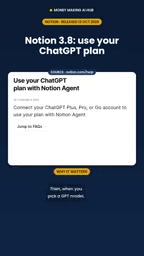
The setup process is relatively straightforward. Go to Notion's Settings, navigate to Notion AI, then Usage, and click Connect ChatGPT under Connected Subscriptions to complete the linking.
Once connected, when you select a GPT model in Agent, Notion will automatically use the ChatGPT subscription quota. Users don't need to manually switch each time, but should be aware of the change in where usage is billed—what was previously deducted from Notion credits is now drawn from the ChatGPT plan's usage.
MCP Permissions: Security Considerations Behind the Convenience
In the same version, Notion also mentions that Agents such as Claude and ChatGPT can work within user pages via MCP (Model Context Protocol) and have full user permissions.
This point deserves separate discussion. Full permissions mean the Agent can read, modify, and even delete page content, with permission boundaries identical to the user themselves. Notion officially advises to "connect carefully"—when connecting external Agents, you need to be clear about what scope of access will be granted. For enterprise workspaces, this is not just a matter of convenience but also involves practical risks around data governance and permission management. It's recommended to confirm the Agent's purpose before connecting and to clarify at the team level which pages are allowed to be accessed by external Agents.
MCP (Model Context Protocol) is a protocol proposed and open-sourced by Anthropic in late 2024, designed to establish a standardized connection method between AI models (clients) and external data sources or tools (servers). It abstracts "what the model can access and what operations it can perform" into capabilities such as resources, tools, and prompts provided by the server, which the client calls as needed—avoiding the need to write a separate plugin for each application. For workspaces like Notion, MCP allows external Agents such as Claude and ChatGPT to read pages and perform operations through a unified interface; "full permissions" means that the MCP server exposes a user-level token, and the authorization the Agent receives is equivalent to the user themselves—the protocol itself does not have built-in fine-grained field-level or page-level isolation. Therefore, permission boundaries need to be controlled at both the connection level (authorization scope) and the usage level (Agent behavior constraints).
What This Update Means
From a product strategy perspective, Notion is advancing AI capabilities from a "self-built credit system" toward "subscription interoperability." For users, the most direct value is reduced duplicate payments; for Notion, this lowers the psychological barrier to using Agents—those who already have a ChatGPT subscription no longer need to pay extra for Notion AI credits, which may increase usage frequency.
However, the current limitations also define clear boundaries: custom Agents and Guests are excluded, indicating that this mechanism is still in a relatively early integration stage. As protocols like MCP become more widespread, interactions between external Agents and workspace data will become increasingly frequent, and permission control and quota billing will become key factors determining whether such integrations can be deployed at scale.
For teams evaluating whether to upgrade to a Business or Enterprise workspace, this feature can serve as a reference factor, but should not be the sole basis for the decision—after all, it depends on users already holding a corresponding ChatGPT subscription.
Additional Context
ChatGPT Go is a low-cost subscription tier offered by OpenAI in select markets (approximately $8/month, initially available in India, Indonesia, and other regions), positioned between the free tier and Plus, offering higher usage limits and partial model access. It is neither a fully featured, no-difference coverage like Plus/Pro nor a free account, so whether it can be recognized in third-party integrations and how quotas are converted often depends on the integration partner's (here, Notion's) list of supported plan types. The article lists it alongside Plus and Pro, indicating that Notion maps quotas by subscription tier rather than specific feature granularity. If users are unsure whether their tier is fully supported, they should refer to the actual prompt displayed after connecting on the Notion settings page.
One-line Summary
Notion 3.8 allows Enterprise workspaces to connect ChatGPT Plus/Pro/Go subscriptions, replacing Notion credits with subscription quota.
Paragraph Summary
Notion 3.8 bridges the quota systems between ChatGPT subscriptions and Notion Agent: after Business and Enterprise workspace users connect a ChatGPT Plus, Pro, or Go account in Settings → Notion AI → Usage → Connected Subscriptions, Agent calls to GPT models will prioritize consuming ChatGPT plan quota rather than deducting Notion credits, thereby alleviating the duplicate cost of paying for both ChatGPT and Notion AI. The feature applies to standard Agents; custom Agents and Guest users are excluded. The same version also mentions that Agents such as Claude and ChatGPT can operate on pages with full user permissions via MCP, with official guidance to connect carefully and enterprises needing to pay attention to data governance and permission boundaries. Overall, this marks Notion's AI capabilities evolving from a self-built credit system toward subscription interoperability, though it remains in an early integration stage.
Related articles

LLaMA-Factory in Practice: A Complete No-Code Guide to Fine-Tuning Large Models
An introduction to LLaMA-Factory, the open-source fine-tuning tool: its 60.1K-star background, supported models and algorithms, local vs. cloud deployment, and CUDA setup steps.

Zeng Ming's Deep Retrospective: Why OpenAI May Not Be the Ultimate Winner — and Why the Corporate System Will Disappear
Zeng Ming's deep retrospective on the AI endgame: model companies are just infrastructure, OpenAI and Anthropic won't be the final winners; the next battle is the Agent entry point standard; the corporate system will disappear as AI restructures collaboration, and only mission-driven companies can survive the cycle.

OpenHands v1.28.0: OpenCode and PI Added as Built-in Agents, API Keys Requestable In-Conversation
OpenHands ships 5 releases in 21 days: v1.27.0 adds OpenCode and PI as built-in agents, v1.28.0 enables in-chat key requests. ACP integration, credential reuse, model list changes, and upgrade advice.