ChatGPT's Intelligent UI Reverse-Engineered in 24 Hours — Open-Source Version Works with Local Models

ChatGPT's Intelligent UI was reverse-engineered in 24 hours; an open-source version now supports local LLMs.
ChatGPT's new Intelligent UI feature lets LLMs generate interactive interfaces in real time rather than just outputting text. Generative UI exists on a spectrum — from predefined component libraries to fully free code generation — with each approach making different trade-offs between flexibility and reliability. Remarkably, a team reverse-engineered the feature purely from ChatGPT's public front-end behavior within 24 hours, then released an open-source alternative called Open Intelligent UI that supports local LLMs via Ollama and LM Studio. The development has sparked debate about the viability of local generative UI, with structured output reliability, inference latency, and small-model capabilities emerging as the key variables.
What Is Generative UI?
ChatGPT's recently launched "Intelligent UI" feature is OpenAI's practical implementation of the generative UI concept. Traditionally, large language model responses have been confined to plain text or Markdown. Generative UI breaks that boundary — models can now dynamically compose truly interactive interface elements in real time.
There's no single path to achieving this capability; it's more of a spectrum. At one end, the model selects and assembles elements from a predefined component library — high control, high reliability. At the other end, the model freely generates interfaces on the fly (essentially writing HTML/React code rendered inside an iframe) — maximum flexibility, but stability and performance become real challenges.
OpenUI, Vercel's json-render, Google's a2ui, and now ChatGPT's Intelligent UI all sit at different points along this spectrum. Each makes its own trade-offs between flexibility, reliability, performance, and how much creative freedom is handed to the model.
Structured output is one of the foundational technologies that makes generative UI work. LLMs default to producing free-form text, but driving UI component rendering requires the model to return results in strict JSON Schema or a specific data format. OpenAI provides a response_format parameter at the API level to constrain output structure, while Vercel's AI SDK includes built-in tools like generateObject to address this. In the component library approach, the model simply selects from a limited set of component types and fills in parameters — the structural constraints are relatively loose. In the free code generation approach, the model must produce syntactically correct, executable HTML or JSX, which dramatically raises the bar for model capability and reliability. This is the fundamental reason why stability differs so dramatically between the two ends of the spectrum.
Reverse-Engineered Within 24 Hours
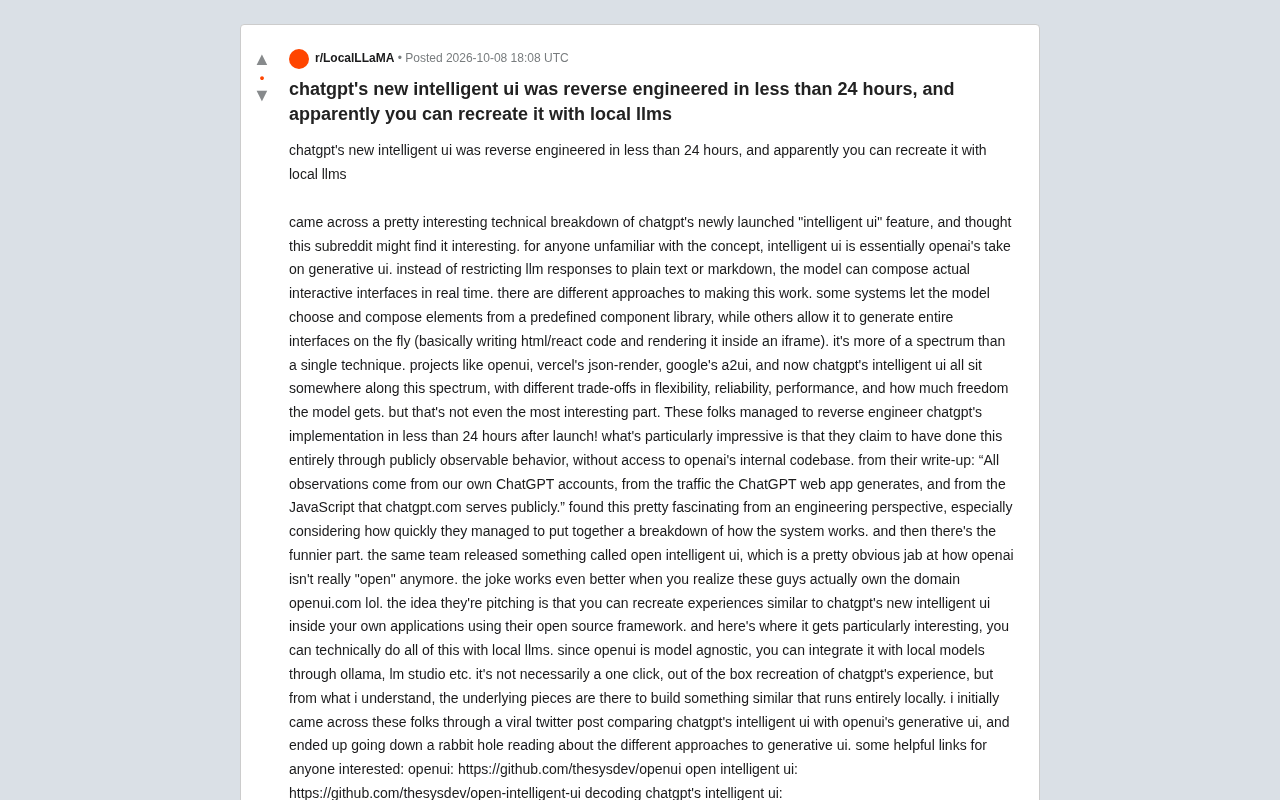
The most surprising part of this Reddit technical discussion isn't the feature itself — it's the speed at which it was cracked. A team completed a reverse-engineering of ChatGPT's Intelligent UI implementation in under 24 hours of its release.
What's even more noteworthy is the methodology. According to the team cited in the original post, they claim the entire process was completed using only publicly observable behavior, with no access to OpenAI's internal codebase:
"All observations were made from our own ChatGPT accounts, traffic generated by the ChatGPT web app, and JavaScript publicly served from chatgpt.com."
From an engineering perspective, this demonstrates both that front-end behavior provides ample material for reverse analysis, and that so-called "black box" products in web environments leave a surprising number of inferable traces. Being able to reconstruct the system's operating logic and publish a comprehensive breakdown in such a short time is itself a testament to serious technical skill.
Open Intelligent UI: A Jab at "No Longer Open"
The same team that completed the reverse engineering subsequently released an open-source project called "Open Intelligent UI" — an obvious dig at the narrative that OpenAI is "no longer Open." The joke lands even harder when you realize this team actually owns the openui.com domain.
Their core claim: developers can use this open-source framework to reproduce a ChatGPT Intelligent UI-like experience within their own applications. This gives developers who want to integrate generative UI capabilities into their own products — without locking into the OpenAI ecosystem — a genuine alternative path.
To be clear, this isn't a one-click, feature-complete replica of the ChatGPT experience. But based on the original poster's understanding, the underlying components needed to build a comparable system are all in place.
Can Local LLMs Power Generative UI?
The most imaginative angle in the entire discussion is the viability of local models. Because OpenUI is model-agnostic, it can integrate with local models via tools like Ollama and LM Studio — theoretically allowing the entire generative UI pipeline to run completely on-device.
This also surfaces the core questions the original post put to the community — worth considering for any developer focused on local inference:
- Is generative UI a genuinely valuable direction for LLM interaction, or just another "impressive in demo, disappointing in production" concept?
- As smaller models continue to improve, will running this kind of experience entirely on-device become practically feasible?
- Or does the added complexity, latency, and structured output overhead simply not justify itself compared to traditional UI?
Structured output places high demands on the model. Whether local small models can reliably generate stable, renderable interface code is the critical variable for real-world deployment. Latency is another hard constraint for local inference — interactive interfaces are far more sensitive to response speed than plain text conversations.
Ollama and LM Studio are the two dominant local LLM runtime solutions today. Ollama is CLI-centric and exposes a local HTTP interface compatible with the OpenAI API format, letting developers swap cloud calls for local inference with minimal code changes. LM Studio offers a graphical interface that lowers the barrier for non-technical users, and similarly supports an OpenAI-compatible local server. Both support downloading quantized GGUF-format models from Hugging Face or other sources, and can run on consumer-grade GPUs or even CPU-only setups. For generative UI specifically, the key constraint is this: mainstream locally runnable small models (7B–13B parameters) exhibit significantly higher error and hallucination rates than GPT-4-class models when following strict JSON Schemas or generating renderable interface code — requiring additional retry logic or output validation layers to ensure usability.
What This Means for Developers
Regardless of whether generative UI ultimately trends toward predefined components or free code generation, this discussion reveals several clear patterns: LLM output is extending from text toward interactive interfaces; the open-source community's ability to catch up with closed-source products is accelerating; and model-agnostic framework design is making local deployment a real option.
For developers focused on shipping AI applications, rather than fixating on ChatGPT's specific implementation, a more productive approach is to start with open-source projects like OpenUI, json-render, and a2ui — understand the trade-offs at different points on the generative UI spectrum, then make technology choices based on your own context (cloud vs. local, control vs. flexibility).
Relevant resources: OpenUI (github.com/thesysdev/openui), Open Intelligent UI (github.com/thesysdev/open-intelligent-ui), Vercel's json-render, and the a2ui project are all solid starting points for diving deeper into this space.
Related articles

Chain of Thought Isn't Just for AI: How Humans Can Use CoT to Improve Thinking Quality
Chain of Thought isn't just a prompt trick for large models. Starting from a Hacker News discussion, this article analyzes why CoT works for human thinking too, breaks down actionable ways to transfer it, and highlights the key differences between human CoT and machine CoT.
Cloudflare Teams Up with OpenAI: Closi…
Cloudflare Teams Up with OpenAI: Closing the Loop from Vulnerability Discovery to Defense with AI
Cloudflare uses OpenAI Daybreak to investigate security vulnerabilities and generate reviewable remediation plans, while developers use Codex to boost coding efficiency and quality.

Orca Multi-Agent Orchestration in Practice: A Guide to Parallel Collaboration with Claude and Codex
Orca is Stable AI's free open-source agent workbench supporting 34 agents like Claude Code and Codex in parallel. Learn its Git worktree isolation, multi-model orchestration, and mobile management.