ChatGPT Switches to Token Billing in December: Chat and Codex Share Quota — Who's Most Affected?

OpenAI merges ChatGPT and Codex quotas starting December, with billing switched to Token-based counting.
OpenAI announced that starting in December, ChatGPT and Codex usage will share the same quota, with billing units changing from message count to Tokens. Heavy Codex users are most affected as programming usage squeezes chat allocation. Everyday simple questions can go to Instant chat, which doesn't deduct quota, leaving shared quota for advanced models and complex tasks. Users can view remaining usage and reset time in settings, and purchase Credits when exhausted.
OpenAI's quota rules are undergoing a key shift. Starting in December, ChatGPT and Codex usage will no longer be billed separately but will share the same quota, and the billing unit will switch from message count to Tokens. This means that casually asking about the weather and having AI compile a full report will no longer consume the same amount of quota.
From "counting calls" to "metering data"
According to Rohan Paul's observation, OpenAI previously had Codex share quota with the Work feature inside ChatGPT, while general chat was metered separately, so heavy coding didn't eat into chat quota. But OpenAI's documentation page explicitly states that starting in December, quota for Plus, Pro, and Business plans will be shared between ChatGPT and Codex, and chat metering will change accordingly.
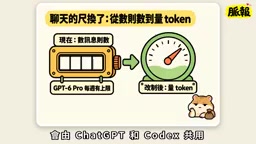
Rohan Paul points out that general chat is currently rate-limited by message count per model — for example, GPT-6 Pro has a weekly cap. After the change, every request will be priced by Token. Think of it like a mobile plan: previously it counted how many calls you made; now it measures how much data you actually use. How much gets deducted depends on the model you choose and the task you assign — more advanced models and more complex tasks typically consume more.
Token is the basic unit of text processed by large language models, roughly understood as a "word piece." In English, one Token corresponds to about 0.75 words, while in Chinese a single character typically takes 1 to 2 Tokens. Each time a model receives input and generates output, workload is calculated by Token count. Token-based billing therefore reflects actual consumption more precisely: short questions consume little; long-document processing and code generation consume more. This is also why, after the change, the same "conversation" can vary in quota consumption by dozens of times depending on the task.
Heavy Codex users should frown the most

The most directly affected after the change are people who ask Codex to write code every day. Previously, no matter how much code ran, it didn't touch chat quota; afterward, both sides compete for the same allocation — the more heavily coding is used, the less is available for chat. OpenAI's documentation page expects that most users won't hit quota resets more frequently than they do now, but this expectation comes without specific numbers, and real-world experience remains to be seen.
Codex is OpenAI's model series for code generation and software engineering tasks, often integrated into developer tools and ChatGPT for writing code, debugging, and explaining repositories. Its tasks often involve large amounts of context code and multiple iterations, so Token consumption is naturally higher than ordinary chat. After quota merging, Codex's high consumption directly occupies the same quota available for chat — which is exactly what heavy programming users need to watch closely.
Everyday simple questions can go to Instant
Fortunately, there's an outlet: OpenAI's documentation page states that Instant chat does not deduct usage quota. Everyday simple questions, looking up a word, tweaking a sentence — all can be thrown to Instant, leaving shared quota for advanced models and genuinely complex tasks. The logic is straightforward — simple questions don't need large models anyway, and spending quota on them is the worst deal.
Quota balance and reset time will be viewable
No more guessing how much quota is left. OpenAI's documentation page says you'll be able to check your merged remaining usage and reset time in settings. If you actually run out, the page lists three paths: wait for reset, upgrade your plan, or purchase Credits to continue using eligible features.

This is a lot like running out of mobile data: you can wait for the next cycle, switch to a bigger plan, or buy add-ons. Getting into the habit of checking settings — knowing how much you have left before hitting zero — is more relaxed than remedying afterward.
Credits are pay-as-you-go points offered by OpenAI, typically used to continue using eligible features after plan quota is exhausted. The difference from a subscription is: subscriptions provide periodic quota, while Credits are extra purchased resources deducted by actual consumption. For users who occasionally exceed quota or need to temporarily handle long tasks, Credits offer a flexible option without immediately upgrading plans.
Work capabilities move into the main experience, same quota
The documentation page mentions "quota merging" and "moving Work capabilities into the main ChatGPT experience" in the same sentence — a detail worth noting. According to Rohan Paul, Work is an Agent launched by OpenAI in July, built on Codex, that does things on its own; OpenAI's own announcement says it can work across your apps and files, and can sit with you for hours on a project if needed.
Putting the two in the same sentence, it's worth viewing them as the same adjustment. Later, calling Work in chat to run for hours will also draw from the same shared Codex quota — this kind of long task is the first thing to watch usage on.
Agent refers to an AI system that can autonomously plan steps, call tools, and execute multi-step tasks, rather than just passively answering questions. Work is described as "an Agent that does things on its own," meaning it can continuously operate across apps and files, potentially taking hours to complete a project. Such long tasks continuously generate Token consumption, and under shared quota their usage impact far exceeds a single Q&A, so users need to monitor balances more proactively.
Old cap numbers are hard to compare directly

Tech media The Decoder compiled current caps: the $200 Pro plan at 200x per week, the $100 Pro plan at 50x per week. But after switching to Token counting, these multipliers are hard to compare directly. What everyone most wants to know is roughly how much shared quota one GPT-6 Pro query eats — and that conversion hasn't been clarified yet. Until it is, saving GPT-6 Pro for questions truly worthy of it is the safer approach.
One wallet, two ways to spend
After reading about this change, the image left in my mind is a wallet: chat and Codex used to deduct separately; afterward they spend from the same wallet — spend on one side, and the other side has less. So the more sensible approach is to prioritize: give simple questions to Instant, and save quota for genuinely complex tasks. After the change, before each request, ask yourself — how much quota is this question worth.
One-line Summary
OpenAI will merge ChatGPT and Codex quotas starting in December, with billing switched to Token-based counting.
Paragraph Summary
OpenAI announced that starting in December, ChatGPT and Codex usage will share the same quota, with billing units changing from message count to Tokens. This means quota consumption across different tasks will vary significantly more, heavy Codex users are most affected, and programming usage will squeeze chat allocation. Everyday simple questions can go to Instant chat, which doesn't deduct quota, leaving shared quota for advanced models and complex tasks. Users can view remaining usage and reset time in settings; when exhausted, they can wait for reset, upgrade plans, or purchase Credits. The old weekly message caps are hard to convert directly into Token consumption, and GPT-6 Pro's actual consumption remains unclear.
Related articles

AI Can Read Neural Network Weights Directly: Do Models Already Exceed Expectations?
A Reddit developer experiment shows language models can directly read neural network weights and infer their function. Astra, Opus 5.5, and Muse Spark 1.3 all passed the test, sparking discussion on model generalization and training sources.

India's Microdrama Market Explodes: EloElo Secures $80M Investment from NBCUniversal
EloElo secures $80M from NBCUniversal to boost StoryTV, its microdrama platform with over 33M monthly active users, as India's microdrama market draws global capital.

Acoustic Detection of Multi-Rotor UAVs: Fusing Handcrafted Features with Pre-Trained Embeddings
Study reveals data leakage from random splits in UAV acoustic detection, proposes source-disjoint protocol with stacked ensemble of handcrafted features and YAMNet embeddings, achieving 95.29% accuracy for low-cost drone detection.