ChatGPT Wallet Arrives: How Can LangChain Agents Spend Money Safely?
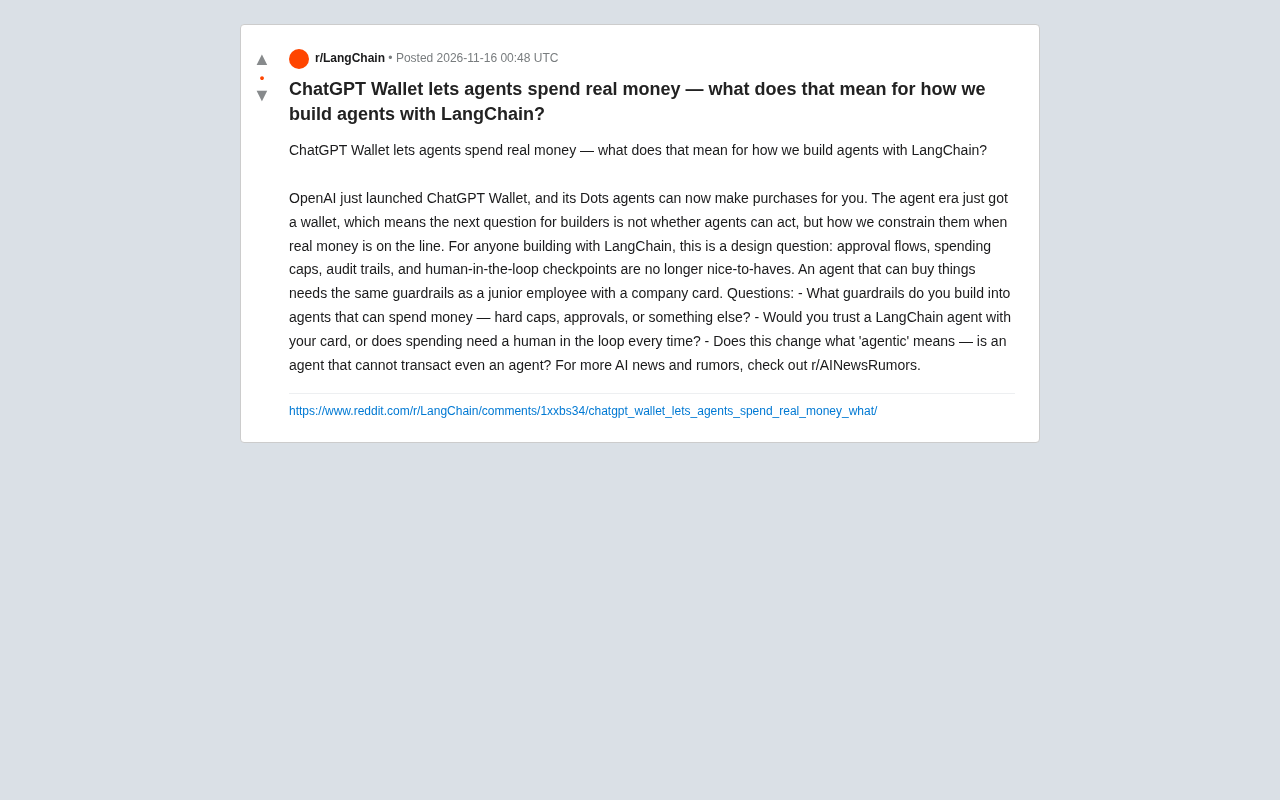
ChatGPT Wallet lets agents make real purchases, so LangChain developers must design guardrails upfront.
After OpenAI launched ChatGPT Wallet, Dots agents can directly complete purchases for users, shifting community discussion from whether agents can act to how to constrain agents when real money is involved. Aimed at LangChain developers, the article explains why financial transaction tools differ fundamentally from ordinary tools—irreversible errors, quantifiable losses, traceable responsibility—so approval flows, spending caps, audit trails, and human-in-the-loop checkpoints should become essential. It outlines four guardrail types, discusses disagreement over trusting agents to spend, and recommends tiered authorization as a compromise.
Title
ChatGPT Wallet Arrives: How Can LangChain Agents Spend Money Safely?
Meta Description
OpenAI launches ChatGPT Wallet, letting Dots agents make purchases directly. Drawing on Reddit community discussion, this article analyzes how LangChain developers should design spending caps, approval flows, audit trails, and human-in-the-loop checkpoints for agents that can spend money.
Article Content
OpenAI has launched ChatGPT Wallet, and its Dots agent can directly complete purchases on behalf of users. The discussion this news sparked on r/AINewsRumors focuses not on "whether agents can act," but on "how we constrain them once real money is involved." For developers building agents with LangChain, this means approval flows, spending caps, audit trails, and human-in-the-loop checkpoints are shifting from nice-to-haves to essential design requirements.
Once agents have wallets, the core questions for builders change
In the past, discussions of agent capabilities usually revolved around tool calling, task planning, and multi-step reasoning. ChatGPT Wallet puts "transaction capability" directly into the agent's hands, and the nature of the problem changes: an agent that can place orders and pay is fundamentally no different from a junior employee holding the company credit card. The original poster's analogy is apt—it needs the same order of magnitude of guardrails.
In the LangChain ecosystem, agents calling tools is already a mature pattern, but financial transaction tools differ fundamentally from search, calculation, and file read/write: errors are irreversible, losses are quantifiable, and responsibility is traceable. This means every step in the chain needs its permission boundaries re-examined, rather than simply adding a purchase tool and shipping it.
LangChain and agent execution graphs
LangChain is an open-source orchestration framework for building large language model applications, and one of its core abstractions is the "Chain" along with the more flexible "Graph." In extensions such as LangGraph, an agent's execution flow is modeled as a directed graph: nodes represent a model call, a tool call, or a conditional judgment, and edges represent state transitions. This structure makes it possible to insert validation, logging, or human pause points between any nodes without rewriting the entire agent logic. For financial transaction tools, the value of the execution graph is that it explicitly separates "intent—decision—execution," allowing developers to intercept transaction intent before the tool call and record results after execution—thus internalizing guardrails as part of the flow rather than relying on external monitoring scripts.
Real-world guardrail options: hard caps, approval flows, and human checkpoints
The original post posed three questions to the community, the first of which is the most pragmatic: what guardrails would you add to an agent that can spend money—hard spending caps, approval processes, or something else?
From an engineering perspective, these mechanisms are not mutually exclusive. A hard cap solves the ceiling problem for single and cumulative spending, has the lowest implementation cost, and is suitable as the first line of defense. An approval flow intercepts high-risk transactions for human confirmation, suitable for large amounts or scenarios where the payee is not on a whitelist. An audit trail records every intent, decision, and actual transaction, providing the basis for post-mortem review and accountability. A human-in-the-loop checkpoint is a combination of the first two: forcibly pausing at key nodes to wait for human release.
For LangChain developers, these mechanisms need to be embedded in the agent's execution graph rather than added as external add-ons. For example, insert validation nodes before and after tool calls, write transaction intent to the audit log first, and then enter approval or release logic.
Engineering differences between human-in-the-loop and hard caps
Human-in-the-loop (HITL) means the agent actively pauses at key steps and waits for human confirmation or modification before continuing. In LangGraph, this is usually implemented through an interrupt mechanism: when the graph reaches a specified node, it saves state and suspends, and after the human resumes, it continues from the breakpoint. A hard cap, by contrast, is a stateless static constraint—simple to implement but lacking contextual judgment, and easily bypassed by strategies such as splitting orders. When combined, the hard cap serves as a fallback defense, while HITL handles high-risk scenarios requiring semantic judgment. The audit trail is a recording layer independent of both, requiring every transaction intent to carry a timestamp, call chain, and decision basis so responsibility can be traced afterward.
The trust question: fully automated spending or human confirmation every time?
The original post's second question is sharper: would you be comfortable binding a LangChain agent to your own bank card, or must every purchase involve human intervention?
There is no unified answer—it depends on the transaction type and risk tolerance. For low-risk, high-frequency transactions such as subscription renewals and purchases from fixed suppliers, a hard cap plus whitelist may be enough; for large payments or transactions with new payees, human confirmation each time is more reasonable. You may not have noticed that the community discussion did not reach a consensus—which itself shows that agent financial permissions are still in an early exploratory stage, and best practices have yet to settle.
One reference approach is tiered authorization: automatically release small transactions and gradually increase approval levels as amounts rise. This is consistent with the logic of corporate internal financial authorization systems and is also easier to explain to non-technical stakeholders.
Does an agent count only if it can transact?
The original post's third question has a philosophical flavor: does this change the definition of "agentic"—is an agent that cannot transact still an agent?
There is no consensus on this question in the community. One view holds that transaction capability is just another form of tool calling, and the core of an agent remains autonomous planning and execution; whether it can spend money should not define it. Another view holds that when agents begin managing real resources, the meaning of autonomy does change, because they bear the consequences.
For builders, the practical significance of this debate is: don't rush to add payment capability to all agents just because ChatGPT Wallet appeared. Transaction capability should be driven by specific scenarios, not by technological trends.
Practical implications for LangChain developers
The launch of ChatGPT Wallet sends a clear signal: interaction between agents and real money is moving from experimentation to product. As an agent orchestration framework, LangChain requires developers to consider permission models, logging standards, and exception-handling paths in advance. The discussion convened by the original post itself shows that the community is looking for reusable patterns, and there is no standard answer yet.
When designing guardrails, it is better to be conservative first and open up later. An agent that cannot spend money can still complete a large number of valuable tasks; but an agent that can spend money without constraints may offset all efficiency gains with a single mistake.
One-line Summary
ChatGPT Wallet lets agents make real purchases, and LangChain developers need to design guardrail mechanisms in advance.
Paragraph Summary
After OpenAI launched ChatGPT Wallet, Dots agents can directly complete purchases for users, and the community discussion has shifted from "whether agents can act" to "how to constrain agents when real money is involved." Aimed at LangChain developers, the article points out the fundamental differences between financial transaction tools and ordinary tools—irreversible errors, quantifiable losses, and traceable responsibility—so approval flows, spending caps, audit trails, and human-in-the-loop checkpoints should move from optional to essential. The article outlines four types of guardrails: hard caps, approval flows, audit trails, and HITL checkpoints; discusses the disagreement over whether to trust agents to spend on a linked card; and recommends tiered authorization as a compromise. On the philosophical debate of "does an agent count only if it can transact," the article argues that transaction capability should be driven by scenarios, not by technological trends.
Related articles

Abnormal Error Rate Spike in Claude Mythos 5.2 and Fable 5.2
Claude Mythos 5.2 and Claude Fable 5.2 show an abnormal spike in request error rates, marked as investigating on the official status page. This article covers the incident overview, practical impact on developers, and recommended responses.

ReAct Runtime Context Trimming: Why Claude Code Acts at 70%
A deep dive into ReAct runtime context trimming: why Claude Code compresses at ~70% usage, why tool calls dominate, why messages must be dropped in pairs, and why codebases don't need RAG.

AI Agent vs LLM: How Cursor and Claude Code Actually Work
An in-depth analysis of the essential difference between AI Agents and LLMs: LLMs generate code suggestions, while Agents modify files and run tests via tool calls. Using a Spring Boot bug fix as an example, it breaks down the workflows, permission control, and verification mechanisms of Cursor and Claude Code.