China Proposes Export Controls on 23 AI Technologies, Open-Source Models Exempted

China proposes adding 23 AI export control technologies, but open-source exemptions and API exceptions leave room for the ecosystem.
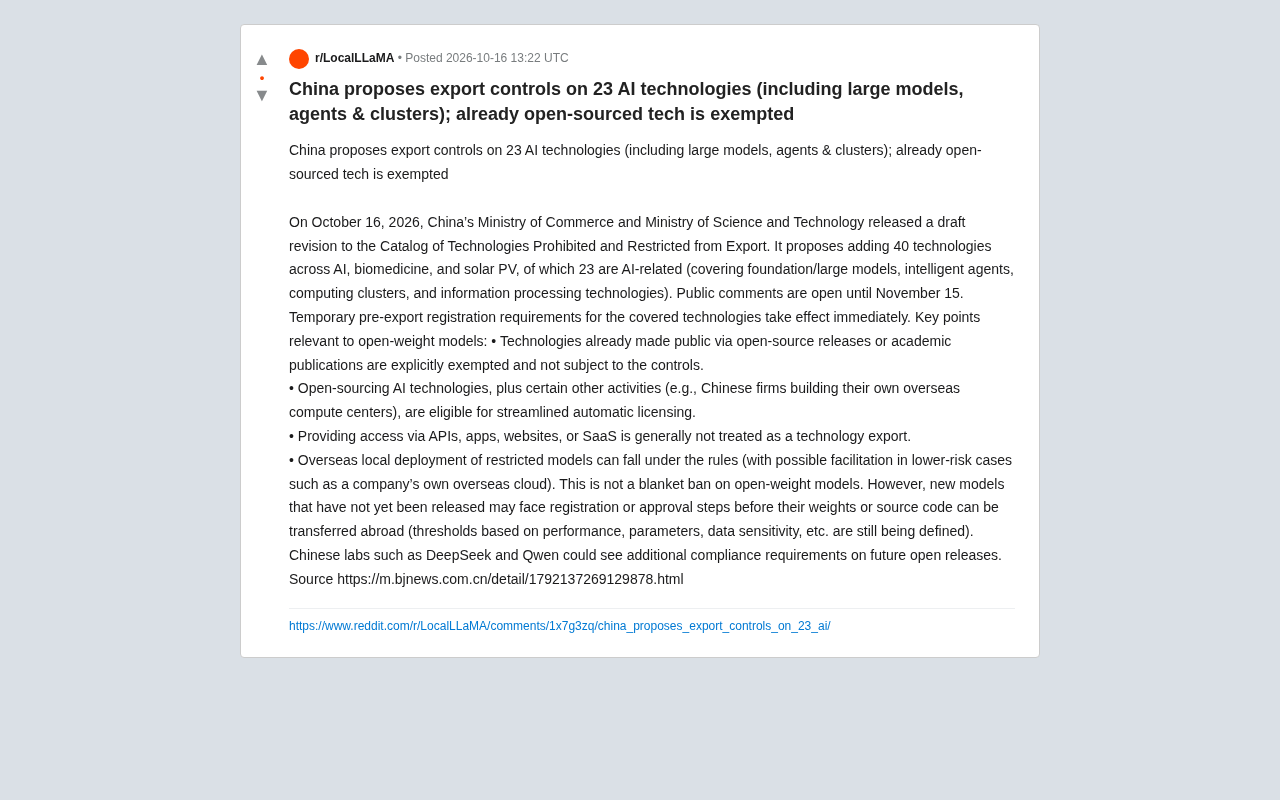
China's Ministry of Commerce and Ministry of Science and Technology jointly released a draft amendment to the Catalogue of Technologies Prohibited or Restricted from Export, proposing to add 40 technologies, 23 of which are directly related to AI, covering large models, agents, and computing clusters. The draft explicitly exempts technologies already made public through open source or academic publication; already open-sourced models like DeepSeek and Qwen are not restricted, but overseas transfers of unreleased new models may require registration or approval. API, SaaS, and other access methods are generally not considered technology exports, preserving a channel for service-based output. Localized overseas deployment of restricted models remains a gray area, while enterprises building their own overseas computing centers may receive simplified automatic licensing. The overall framework seeks a balance between preventing technology outflow and maintaining open-source ecosystem vitality. Specific thresholds for performance, parameters, and data sensitivity remain to be formulated, and implementing rules will determine the actual impact.
Title
China Proposes Export Controls on 23 AI Technologies, Open-Source Models Exempted
Meta Description
China proposes adding 23 AI-related export control technologies, covering large models, agents, and computing clusters. Open-sourced technologies are explicitly exempted, API and SaaS access are not considered technology exports, but overseas transfers of unreleased new models may require approval.
Article Content
The Ministry of Commerce and the Ministry of Science and Technology of China jointly released a draft amendment to the Catalogue of Technologies Prohibited or Restricted from Export, proposing to add 40 new technologies, 23 of which are directly related to artificial intelligence. This move is widely interpreted as a systematic response to the outflow of AI technology, but the open-source exemption clauses in the draft make the situation far more complex than a simple "technology blockade."
Scope of Controls: From Large Models to Computing Clusters
According to the draft, the newly proposed AI-related technologies cover multiple layers including foundation models/large models, agents, computing clusters, and information processing technologies. The public comment period ends on November 15, but the temporary export registration requirement for restricted technologies has already taken effect.
This means that even before the formal catalogue is finalized, exports of the relevant technologies already need to go through registration procedures. From a technology stack perspective, the scope of controls is not limited to model weights themselves, but extends to the computing infrastructure that supports model training and inference—computing clusters are listed separately, indicating that the regulatory vision covers technology output at the hardware and system levels.
Computing clusters in this context typically refer to integrated hardware and software systems composed of a large number of accelerator cards (GPUs/NPUs, etc.) connected through high-speed interconnect networks, used for large model training and inference. They include not only the chips themselves, but also cluster scheduling software, parallel training frameworks, high-speed network topologies (such as RDMA, InfiniBand), and accompanying storage and cooling solutions. Listing computing clusters as a separate category of control means that regulatory attention has extended beyond model algorithms to the engineering infrastructure that underpins model capabilities. Since large model training relies heavily on ten-thousand-card-scale clusters, the overall design and tuning expertise of such systems themselves constitute scarce technology assets.
Agents refer to a form of large model application capable of autonomously perceiving the environment, performing planning and decision-making, and invoking external tools to complete complex tasks. Unlike simple conversational models, agents typically include modules for task decomposition, memory management, tool invocation, and multi-round reflection. Their technical value lies in converting the general capabilities of large models into executable workflows; therefore, in the context of export controls, agent frameworks and accompanying orchestration, memory, and tool interface technologies may be regarded as strategically significant software assets.
Open-Source Exemption: The Most Critical Clause
The most noteworthy clause in the draft is the exemption arrangement for already-public technologies. Technologies published through open source or publicly disclosed in academic papers are explicitly not subject to export controls.
This clause directly addresses previous industry concerns about whether "open-source models would be included in controls." Open-source models from Chinese AI labs such as DeepSeekAd and Qwen, as long as they have already been publicly released, are not within the scope of controls. In other words, technologies that have already been open-sourced will not be "recalled."
However, the boundary of the exemption lies in the timing of "already public." For unreleased new models, the transfer of weights or source code overseas may face registration or approval steps. The draft mentions that the threshold for judgment will be based on dimensions such as model performance, parameter scale, and data sensitivity, but the specific standards are still being formulated.
For teams like DeepSeek and Qwen that continuously iterate open-source models, this means that future open-source releases may require additional compliance processes. Already open-sourced models are unaffected, but the pace and manner of the next version's release may need to incorporate compliance considerations.
Open-source exemption is not unique to China in export control systems. Similar logic exists in frameworks such as the U.S. Export Administration Regulations (EAR): technologies that have already been publicly published and entered the public domain are typically no longer subject to export licensing constraints, because their dissemination is already irreversible. But the key to the exemption lies in the timing and the criteria for determining what counts as "public." If model weights are only downloadable by specific groups, or come with licenses containing usage restrictions, whether they still count as "already public" may be disputed. In addition, open-source exemptions generally apply only to the technology itself, not to customized services specifically provided for export or undisclosed optimization solutions. Therefore, the exemption clause in the draft both provides certainty for the open-source community and shifts compliance pressure forward to before release.
API and SaaS: Not Counted as Technology Exports
The draft provides a relatively lenient interpretation of what constitutes a "technology export": providing access through APIs, applications, websites, or SaaS is generally not regarded as a technology export.
This definition is a clear signal for the many Chinese companies that rely on APIs to deliver AI capabilities. Overseas developers calling the API interfaces of Chinese AI companies will not, under the draft framework, be deemed to be engaging in technology export activities. This distinction between "service-based output" and "technology transfer" preserves a channel for the commercialized output of AI capabilities.
Technology export in export control law typically refers to the cross-border transfer of technical materials, source code, design drawings, or proprietary knowledge to foreign entities, enabling them to master or use the technology. Providing access through APIs or SaaS, however, gives users the service result rather than the technology itself, and does not involve the transfer of underlying model weights, training methods, or system architecture. This distinction is also often discussed in international control practice: the boundary between service trade and technology transfer determines whether regulation focuses on "capability diffusion" or "knowledge diffusion." By excluding API/SaaS from technology exports, the draft effectively acknowledges the regulatory特殊性 of the cloud service model and preserves space for Chinese AI companies to commercialize through overseas API calls.
Overseas Deployment: A Gray Area
Localized overseas deployment of restricted models occupies a more ambiguous position. The draft notes that overseas deployment may fall within the scope of controls, but in low-risk scenarios—for example, a company's own overseas cloud infrastructure—facilitation arrangements may exist.
This wording leaves considerable room for interpretation. Enterprises building their own computing centers overseas to deploy restricted models, versus directly transferring model weights to overseas third parties, clearly carry different risk levels in the eyes of regulators. The draft hints at a more tolerant attitude toward the former, but how exactly "low risk" will be determined still awaits clarification in detailed rules.
Another clause mentions that Chinese enterprises' actions such as building their own overseas computing centers may qualify for simplified automatic licensing. This effectively provides a compliance pathway for Chinese AI companies with overseas business layouts.
Automatic licensing (or simplified licensing) is a facilitation mechanism in export controls, meaning that export activities meeting specific conditions do not require case-by-case approval but only need to fulfill registration or filing to obtain a license. It typically applies to low-risk destinations, low-sensitivity technologies, or enterprise self-use scenarios. The draft's mention that enterprises building their own overseas computing centers may receive simplified automatic licensing means that regulators are attempting to establish tiered management between "preventing technology outflow" and "supporting enterprise globalization." However, the applicable conditions for automatic licensing, destination whitelists, and subsequent regulatory requirements still need to be clarified in detailed rules; otherwise, enterprises will find it difficult to accurately assess compliance costs.
Balancing Compliance Costs and the Open-Source Ecosystem
Viewing this set of rules against the broader backdrop of global AI regulatory competition, China's approach exhibits a subtle balance: on the one hand, establishing an institutional barrier against technology outflow through export control lists; on the other hand, leaving space for the openness and commercial vitality of the AI ecosystem through open-source exemptions and API exceptions.
For domestic AI labs, the new compliance requirements are real operational costs. This is especially true for teams that have built influence through rapid iteration of open-source models; in the future, each new model release may require assessing whether it triggers control thresholds. But compared with a comprehensive ban, this framework of "already open-sourced is exempted, new releases need assessment" at least provides institutional space for the continuation of the open-source route.
The real variable lies in the implementing rules. How the specific thresholds for performance, parameters, and data sensitivity are set will directly determine the actual impact of these rules on the AI open-source ecosystem.
One-line Summary
China proposes adding 23 AI export control technologies, but open-source exemptions and API exceptions leave room for the ecosystem.
Paragraph Summary
The Ministry of Commerce and the Ministry of Science and Technology of China jointly released a draft amendment to the Catalogue of Technologies Prohibited or Restricted from Export, proposing to add 40 technologies, 23 of which are directly related to AI, covering large models, agents, computing clusters, and more. The draft explicitly states that technologies already made public through open source or academic publication are not subject to controls; already open-sourced models such as DeepSeek and Qwen are not restricted, but overseas transfers of unreleased new models may require registration or approval. Access methods such as APIs and SaaS are generally not considered technology exports, preserving a channel for service-based output. Localized overseas deployment of restricted models remains a gray area, while enterprises building their own overseas computing centers may receive simplified automatic licensing. The overall framework seeks a balance between preventing technology outflow and maintaining the vitality of the open-source ecosystem. Specific thresholds for performance, parameters, and data sensitivity remain to be formulated, and implementing rules will determine the actual impact.
Related articles

Automate Job Search with AI Agents and Residential Proxies for Precise Matching
Build an AI Agent with MCP and residential proxies to bypass recruitment site anti-scraping and geo-restrictions, scrape thousands of DevOps jobs, then have Claude score and rank each against your resume. Includes proxy comparison experiments, project structure, and cost analysis—filtering only, no auto-submission.

The AI Task Assistant That Knows When to Back Off: A Cure for Activation Struggles
One Small Step is an AI assistant for task initiation struggles, using agentic decisions for guilt-free reminders, timely retreat, and cross-platform task management. The developer shares real test results on 13 tasks and architectural trade-offs.

FastAPI: A High-Performance Python Framework and a Production-Ready API Development Powerhouse
FastAPI is a high-performance web framework based on Python type hints, supporting async and automatic OpenAPI docs. With over 100k GitHub stars, this article analyzes its core strengths, production readiness, and selection advice.