China's New GLM Model Adopts Loop Transformer: Will ChatGPT Follow Suit?
Zhipu's GLM becomes the first commercial model to publicly adopt a Loop Transformer, letting models iterate and think repeatedly.
The article describes how Zhipu AI's newly released GLM series models adopt the Loop Transformer architecture, becoming the first commercial model to publicly confirm its use. The Loop Transformer has the model repeatedly call certain layers after output to judge and correct results, with loop count adjusting dynamically to task complexity—but the cost is that GPU load and KV cache grow linearly with loop count, and there is currently a lack of API pricing and third-party benchmark data to assess cost-effectiveness. The new model is at the 30-billion-parameter level, with accuracy improving from 19% to over 30%. The article also discusses Google's advantage in deeply integrating AI across its product suite, the gap between coding agents' benchmark performance and real tasks, and Google's move to shorten the vulnerability disclosure window, noting that clear requirement definition remains the key to AI output quality.
A New Architecture That Lets Models "Think Repeatedly" Is Emerging
For large models, capability improvements have historically come mainly from stacking more parameters and more data. Now, a different approach is gaining attention: having models iterate repeatedly and self-check during inference—the so-called Loop Transformer architecture. According to the YouTube tech channel Tech News, the newly released GLM series models from Zhipu AI adopt this architecture, making it the first commercial model to publicly confirm the use of a Loop Transformer.
This news is worth noting not just because there's another new model, but because it may signal a new direction in large model competition—shifting from "one-shot generation" to "iterative thinking."
What Exactly Is a Loop Transformer?
Replacing a Single Forward Pass with Loops
The inference process of a traditional Transformer is one-directional: input goes in, computation proceeds layer by layer, output comes out. The core idea of a Loop Transformer is to have certain layers of the model be called again after producing output, to judge and correct the result, then output again—repeating this several times.
The video uses an intuitive analogy: if the model judges a token to be relatively simple, it might only loop once or twice; if it encounters a complex problem, it might loop five times or more. The number of loops isn't fixed but adjusts dynamically based on task complexity.
This idea has actually been circulating in the industry for some time. According to the channel, over the past three to four months there have been rumors that certain models (including Mythos and Astra) adopted similar architectures, but no company has publicly acknowledged it. Zhipu is the first to put this on the table.
Transformer and autoregressive generation: Traditional Transformer decoders generate text in an autoregressive manner—each time a token is generated, all previous tokens must be re-fed as context through a forward computation. "Computation layer by layer" refers to this stacked sequence of attention and feed-forward networks, each called only once. The Loop Transformer breaks precisely the default assumption that "each layer is called only once": it executes the same set of layers repeatedly along the depth dimension, effectively increasing the effective computational depth without increasing parameter count. This is in line with the thinking behind the Universal Transformer (an early recurrent-depth model proposed in 2019), except that the latter loops a fixed number of times for all tokens, while current commercial implementations emphasize dynamically deciding the number of loops per token or per task—so-called "adaptive computation."
The Cost of Looping: KV Cache and Compute Overhead
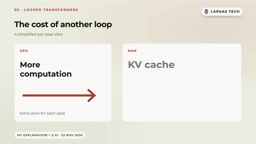
Looping isn't free. Each additional loop adds compute load on the GPU, and the KV cache (key-value cache) grows accordingly—each loop generates its own independent cache. This means model operating costs rise linearly with the number of loops.
The video author raises a very practical question: is the improvement in output quality sufficient to justify the infrastructure overhead behind it? There is currently no API pricing or third-party benchmark data to answer this question. Information released by Zhipu shows that the new model is at the 30-billion-parameter level, and with the new training pipeline, accuracy improved from 19% to over 30%. That's a substantial leap, but the cost side of the ledger hasn't been settled.
What is KV cache: During autoregressive decoding, to avoid recomputing the Key and Value matrices of already-generated tokens, the inference framework caches them—this is the KV cache. Its memory footprint is proportional to sequence length, number of layers, number of attention heads, and batch size, making it one of the main memory bottlenecks in long-context inference. In a standard Transformer, each layer maintains its own KV cache; in a loop architecture, the same set of layers is called multiple times, and if an independent cache is retained for each loop, memory usage and memory bandwidth pressure stack up with the number of loops. This is also why loop architectures are elegant in theory but expensive in engineering—they push the cost of "trading compute for quality" directly onto the inference infrastructure, unlike increasing parameter count, where the cost is a one-time training expense.
What Loop Architectures Look Like in Real Workflows
The video author shares his own experience using a similar approach. He doesn't loop at the model level but simulates it at the workflow level: have the model generate output, then critique the output, then generate again, then critique again, repeating three to four times until the result stabilizes. He uses this method to handle video titles, scripts, and thumbnail concepts, and has packaged the process into a reusable skill for his team.
This actually reveals a key point: the value of the Loop Transformer lies not only in the model architecture itself, but more in turning "self-reflection" into a system capability. Steps that previously required repeated manual revision can now be iterated by the model itself.
Several Developments Beyond Models
Google's AI Search Is Accelerating Its Penetration
The latter half of the video turns to other tech news. The author mentions that Google's AI search improvements are "very dangerous" in their speed, and argues that Google's real advantage isn't whether any single model is the strongest, but that it has embedded AI into an entire product suite—Gmail, Search, YouTube, and more. When users ask the AI a question, it can combine emails, itineraries, and watch history to give highly contextualized answers, something other companies find hard to replicate.
According to the video, YouTube is also testing an AI chat feature for creators—creators can discuss topic ideas with AI, analyze video performance, and generate title and thumbnail suggestions; regular viewers can directly ask AI to summarize video content and generate timestamps.

Coding Agents' Benchmarks Are Disconnected from the Real World
The video cites a new study pointing out that coding agents perform excellently in isolated benchmark environments but often fail to reach the same level on real tasks. The author corroborates with his own experience: when requirements are described clearly enough, the agent can deliver good results; but when requirements are vague and even he can't articulate what he wants, the agent struggles to produce anything usable.
His advice: before letting AI get to work, think the product through clearly—like writing a script and storyboarding before a film starts shooting—and put the requirements down on paper. The higher the clarity, the better the results.
The gap between benchmarks and real tasks: Benchmarks commonly used for coding agents (such as SWE-bench and its variants) typically provide complete, self-consistent issue descriptions and reproducible test environments, with clear task boundaries and explicit acceptance criteria. Real development scenarios are full of implicit constraints, legacy code debt, and verbal requirements; the agent must first clarify requirements and decompose the problem. Academia often explains this gap with "out-of-distribution generalization": benchmarks are a controlled distribution, while real tasks are an open distribution. This also explains why "write clear requirements first, then let the agent work" is so effective—it essentially artificially narrows the distribution gap, transforming vague tasks into structured inputs close to the benchmark form.
Google Compresses the Vulnerability Disclosure Window
Google's Project Zero team plans to gradually shorten the buffer period for vulnerability disclosure. According to the video, the previous policy was a 90-day fix period plus a 30-day observation period; the plan is to first compress it to 60 days, then further to 30 days. The author supports this, reasoning that in the AI era attackers' capabilities are rapidly improving—he mentions having received access to jailbroken Chinese models at extremely low prices, indicating that the barrier to abusing powerful models is falling.

The origin of the vulnerability disclosure window: Project Zero's "90+30" policy established in 2019 meant vendors had 90 days to fix vulnerabilities, after which details would be made public; a 30-day observation period was later added to give vendors a buffer. The logic behind this policy is "responsible disclosure"—giving vendors time to fix while using a public deadline to create pressure. Shortening the window means the security team believes attackers' exploitation speed has outpaced vendors' patching cadence, especially after the spread of AI-assisted vulnerability discovery and automated exploitation tools—the length of the disclosure window itself has become a variable in the offense-defense tempo.
Signals Worth Watching
The Loop Transformer is still at a very early stage. Public information is limited, API pricing and independent benchmarks are not yet available, and the balance between the cost increase from looping and the quality gain remains unanswered. But it raises a meaningful question: as the marginal returns from parameter scaling begin to diminish, will having models "think a few more times" become the next competitive focus?
For developers and product teams, the more practical takeaway may be this: no matter how model architectures change, thinking requirements through clearly and designing workflows well remain the key variables determining the quality of AI output.
One-line Summary
Zhipu's GLM becomes the first commercial model to publicly adopt a Loop Transformer, letting models iterate and think repeatedly.
Paragraph Summary
The article describes how Zhipu AI's newly released GLM series models adopt the Loop Transformer architecture, becoming the first commercial model to publicly confirm its use. The Loop Transformer has the model repeatedly call certain layers after output to judge and correct results, with the number of loops adjusting dynamically to task complexity—but the cost is that GPU load and KV cache grow linearly with loop count, and there is currently a lack of API pricing and third-party benchmark data to assess cost-effectiveness. The new model is at the 30-billion-parameter level, with accuracy improving from 19% to over 30%. The article also discusses Google's advantage in deeply integrating AI across its product suite, the gap between coding agents' benchmark performance and real tasks, and Google's move to shorten the vulnerability disclosure window, noting that clear requirement definition remains the key to AI output quality.
Related articles
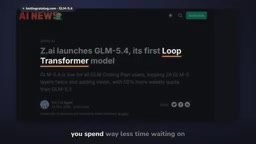
GLM 5.4 Looped Transformer Hands-On: One-Sixth the Cost of Claude
ZAI's GLM 5.4 looped Transformer: 75B base with 28 layers looped twice, fused CUDA kernels break the memory wall, 200 tokens/sec at 1M context. External tests show coding costs one-sixth of Claude. Plus Anthropic's enterprise PR suite, Amazon's $7.5B Decart acquisition, Nvidia's personnel reversal, and DeepMind's quantum verification.
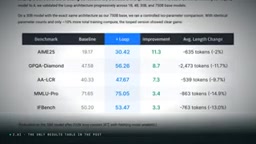
GLM-5.4 Is 5x Cheaper Than Claude — But at What Cost?
GLM-5.4 offers near-Claude coding ability at $18/month, about one-fifth the cost, but lacks flagship benchmarks and max effort can exhaust quotas on a single 7-hour task. This article combines the official paper and three independent reviews to explain the recurrent Transformer architecture and offer practical advice.
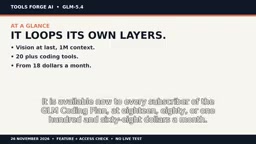
GLM-5.4 Open-Source Coding Model Tested: The Strongest, But It Takes 7 Hours
Z.AI releases GLM-5.4 coding model with Loop Transformer architecture, called the strongest open-source coding model by independent review, but it takes over 7 hours and ~15x tokens on the same benchmark. Here's the architecture, test scores, pricing, and competitive landscape.