GLM-5.4 Is 5x Cheaper Than Claude — But at What Cost?
GLM-5.4 takes #1 in open-source coding with a recurrent architecture at one-fifth the cost, but transparency and the quota black hole are real pain points.
GLM-5.4 has gone viral in the developer community thanks to its recurrent Transformer architecture and aggressive $18/month pricing, with official claims that 750 billion parameters achieve the intelligence level of 2-3 trillion parameter models. However, the official blog publishes no flagship benchmark scores, and the only ablation study is based on a test model 25 times smaller. Independent tests show it ranks #1 among open-source coding models in KingBench 4, but its total score of 33.2 trails Claude Fable 5.2's 42; cost is about one-fifth of the latter, but in max effort mode a single task can run over 7 hours and exhaust the five-hour quota. The article concludes that it is genuinely cheap, but transparency is questionable and the effort level mechanism requires fine-tuning, so it cannot yet replace Claude blindly.
Z.AI's release of GLM-5.4 quickly gained over 1,100 points on Hacker News, and Zixuan Li's X post racked up more than 9,000 likes. Officially, it claims intelligence on par with 2-3 trillion parameter models while the base model is only 750 billion parameters. But scouring the official blog, you won't find a single benchmark score for flagship models. The pricing page directly advises developers to abandon their other subscriptions and run Claude Code and Codex on GLM.
Is this $18/month model a real bargain or a trap? This article combines the official paper, four demos, three independent evaluations, and real usage logs from multiple developers to piece together a more complete picture.
Architectural Innovation: How the Recurrent Transformer Works
The core selling point of GLM-5.4 is its recurrent Transformer architecture. In a standard Transformer, each token passes through each layer only once. GLM-5.4 instead routes each token through the middle layers (layers 27 to 54) twice, using the exact same weights both times. The first pass generates a rough draft, and the second pass acts as an internal editor for refinement.
To prevent numerical explosion, Z.AI added per-token damped gating: cautious writes on the first pass, amplification on the second to optimize the answer. To control memory under ultra-long contexts, the second pass reuses the sparse global KV cache from the first pass, adding a tiny sliding window.
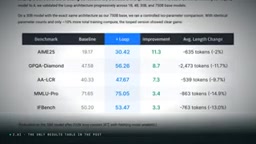
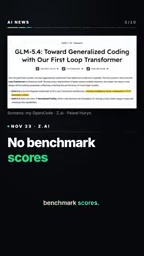
The only table disclosed in the official blog is an internal ablation study based on a test model 25 times smaller than the final release. At that scale, AIME 25 improved by 11.3 points and GPQA Diamond by 8.7 points. This proves the idea works at small scale, but it doesn't directly extrapolate to the flagship model.
More contradictory still: the blog touts a 10-14% reduction in thinking tokens in small tests in one breath, then admits in the fourth paragraph that the real 750-billion-parameter model gets stuck in overly long "marathon thinking loops." This contradiction was later confirmed in independent tests.
Recurrent Transformer is a class of architecture that lets a model iteratively compute over the same set of layers multiple times, first systematically proposed in the Universal Transformer work around 2019. Its core motivation is to replace "parameter stacking" with "depth reuse": rather than training a model with a huge number of layers and enormous parameters, let a small number of layers be called repeatedly, thereby increasing effective computational depth under a constrained parameter count.
Compared with a traditional Transformer, the key difference is: in a normal model, the output of layer N goes directly into layer N+1, whereas a recurrent architecture forms a "loop body" within some intermediate layer range, where tokens pass through multiple times and share weights. This brings two engineering challenges: first, multiple iterations tend to cause activation value explosion or gradient instability, requiring gating or normalization to control; second, the KV cache repeatedly inflates with each iteration round, requiring cross-round reuse or sparsification strategies. GLM-5.4's damped gating and sparse global KV cache reuse are precisely concrete solutions to these two points.
The Demos Are Beautiful, but Missing Key Information
Z.AI released four carefully crafted demos: a 2-minute-44-second animated music video, a FreeCAD six-axis robotic arm script, a 3D brick island game with physics and a minimap, and a snowy 3D bird scene built with pure math and custom GLSL shaders.
All four demos look stunning, but none disclose the prompt, runtime, token consumption, or number of retries. This makes them more like capability showcases than reproducible performance evidence.
Independent Testing: #1 in Open-Source Coding, but a Hidden "Effort Level" Trap
AI Code King's KingBench 4 is a 60-point multi-app coding test suite. In max effort mode, GLM-5.4 scores 33.2 / 60, ranking seventh among 19 frontier models and first among open-source coding models, beating GLM-5.3, DeepSeekAd V4.1 Flash, and Kimmy K3.1 Pro. But on the same leaderboard, Claude Fable 5.2 tops it with 42 points.
KingBench also exposes an "effort level" trap. In a tight 180-second probe, low effort scored 25, medium effort scored 24, and max effort timed out due to overthinking. On multi-hour giant apps, high and max effort only pull ahead. This means users need to dynamically adjust effort level based on task type, or they may get the opposite of what they want.

"Effort level" is a reasoning budget control mechanism that inference models have widely introduced over the past two years. It essentially controls the upper limit on the number of "thinking tokens" the model is allowed to generate before giving a final answer. Low effort corresponds to a shorter chain of thought, with fast responses and low cost; max effort allows the model to engage in long self-reflection, multi-path exploration, and verification.
This mechanism is not a free lunch. On simple or medium-difficulty tasks, an excessively high effort level causes the model to repeatedly second-guess itself and fall into redundant verification loops, which instead lengthens latency or even causes timeouts; on complex multi-step tasks, a low effort level may yield shallow answers due to insufficient reasoning. So "effort level" is really a matching problem between task difficulty and compute budget. GLM-5.4 performing better at low/medium effort than max effort in the 180-second probe is a typical manifestation of this mismatch, and it also explains why dynamic adjustment by task type is needed.
The Cost Advantage Is Real, but the Quota Black Hole Is More Real
Evan Berger compared the $18 GLM plan with Claude Opus 5.5 using the same four one-sentence prompts. Claude Opus 5.5 won on quality, but a single browser-based Photoshop clone alone consumed more than half of the five-hour limit of the $20 Pro plan. All four apps burned about $12 in API-equivalent compute. GLM-5.4 costs about one-fifth as much, and Evan's $18 quota still showed 100%.
However, B. John Bowen had the exact opposite experience when testing heavy 3D games and C++ with GLM-5.4 Max in Zcode. He praised its 3D skateboarding game as "crushing all other open-source models," but checking the logs revealed: the skateboarding game segment ran 1 hour 16 minutes, the shooter game 1 hour 36 minutes, and the C++ fighting game first ran 1 hour 48 minutes; after he manually typed "continue," it ran another 5 hours 21 minutes — over 7 hours for a single task. Worse, in max effort mode, his five-hour limit was exhausted before a single task completed. Even after upgrading to the Pro plan, he still said he "completely does not recommend the coding plan."
Subscription quotas and rolling access: Current mainstream coding subscription plans generally use "rolling window limits" rather than a fixed monthly total — that is, there is an upper limit on compute that can be consumed within any continuous period (such as 5 hours), and after it is used up, you must wait for the window to slide and recover rather than waiting until next month's reset. This design is friendly to interactive short tasks because per-use consumption is low and recovery is fast; but it is extremely unfriendly to long-running autonomous agent tasks.
Heavy agent tasks (such as generating a complete 3D game or iterating on a long C++ project) often consume large amounts of tokens continuously within a single task. Once the 5-hour window limit is hit, the task is forcibly interrupted midway, and the user can only wait or upgrade to a higher tier. This also explains why Evan Berger's lightweight four-prompt test still showed 100% of the $18 quota, while B. John Bowen's max-effort heavy task exhausted the limit before a single task was finished — the difference between the two is not model capability, but the product of token consumption rate per unit time and task duration.
The Truth About the Pricing Page and Current Limitations
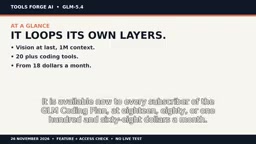
Z.AI's live pricing page shows: Lite at $18/month with rolling access; Pro at $80/month with priority access; the top tier at $168/month. Meanwhile, FreeChat still defaults to GLM-5.3, and neither the public API nor the open weights have been unlocked.
Putting all the runs on the same timeline, the contrast is very clear: ordinary apps take 3-19 minutes each, at about one-fifth the cost; max effort mode is a 7-hour marathon that directly shreds the quota.
Final Conclusion: Cheap Is Real, but Don't Jump on Blindly
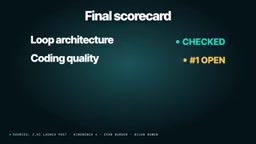
The architecture has been validated, coding quality is #1 among open-source models, and cost is about one-fifth. But transparency is questionable — zero flagship benchmarks; max effort speed and quota consumption are real pain points.
Can it beat Claude Fable 5.2? It wins easily on price, but not yet on quality. It should be noted that all the numbers above come from Z.AI's official releases, the live pricing page, and public independent tests, not from the author running them personally.
Three practical recommendations for developers:
- Need top-tier polish and predictable speed? Keep using Claude.
- Mid-sized project on a limited budget? The $18 GLM plan is quite attractive, but keep it at low or medium effort level.
- Need heavy agents or local weights? Wait for SWE bench scores, public API pricing, and actual open weights.
GLM-5.4 has torn open a gap with its recurrent architecture and aggressive pricing, but it is still some distance from being a "no-brainer replacement for Claude." Understanding its effort level mechanism and quota logic is more important than just looking at the price tag.
One-line Summary
GLM-5.4 takes #1 in open-source coding with a recurrent architecture at one-fifth the cost, but transparency and the quota black hole are real pain points.
Paragraph Summary
GLM-5.4 has gone viral in the developer community thanks to its recurrent Transformer architecture and aggressive $18/month pricing, with official claims that 750 billion parameters achieve the intelligence level of 2-3 trillion parameter models. However, the official blog publishes no flagship benchmark scores, and the only ablation study is based on a test model 25 times smaller. Independent tests show it ranks #1 among open-source coding models in KingBench 4, but its total score of 33.2 trails Claude Fable 5.2's 42; cost is about one-fifth of the latter, but in max effort mode a single task can run over 7 hours and exhaust the five-hour quota. The article concludes that it is genuinely cheap, but transparency is questionable and the effort level mechanism requires fine-tuning, so it cannot yet replace Claude blindly.
Related articles
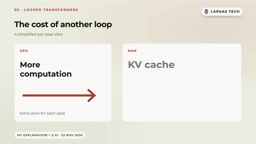
China's New GLM Model Adopts Loop Transformer: Will ChatGPT Follow Suit?
Zhipu's GLM adopts the Loop Transformer architecture, iterating multiple times to improve output quality as the first model to publicly confirm this design. This article explains the principles, KV cache cost, and surrounding developments in Google AI search and coding agent benchmarks.
GLM-5.4 Open-Source Coding Model Tested: The Strongest, But It Takes 7 Hours
Z.AI releases GLM-5.4 coding model with Loop Transformer architecture, called the strongest open-source coding model by independent review, but it takes over 7 hours and ~15x tokens on the same benchmark. Here's the architecture, test scores, pricing, and competitive landscape.
GLM-5.4 Hands-On: Loop Transformer Gives Coding a Big Boost, But It's Not Frontier Yet
GLM-5.4 hands-on: a loop transformer runs 28 layers twice, markedly improving code fixes over 5.3, but bug hunting still trails Gemini 4 Neon—solid iteration, not frontier.