GLM-5.4 Open-Source Coding Model Tested: The Strongest, But It Takes 7 Hours
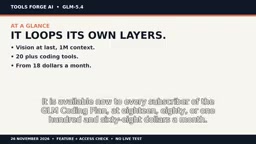
GLM-5.4 becomes the strongest open-source coding model at the cost of 7 hours 11 minutes — a quarter of its competitor's speed.
Z.AI's GLM-5.4 is the first flagship coding model built on the Loop Transformer architecture, running 28 layers twice per token to gain deeper reasoning without adding parameters. Independent reviewer AI CodeKing's KingBench 4 ranks it 7th at 33.2/60 — the highest-scoring open-source model, 5.7 points ahead of GLM-5.3 and above several closed-source models. But the full benchmark took 7 hours 11 minutes and about 1.04 million tokens, roughly 15x Gemini 4 Neon. The reviewer calls it the most cautious model, suited to reviewing and planning rather than sprinting. There is currently no per-token API, no free tier, and no released open-source weights; all hard data comes from a single independent review.
Z.AI's GLM-5.4 has been called "the strongest open-source coding model to date" in independent testing, but the same test also exposed its critical weakness: finishing the same benchmark suite took it 7 hours and 11 minutes, while competitor Gemini 4 Neon took only 109 minutes — and GLM-5.4 consumed roughly 15x the tokens. Strong and slow, both true at once.
Architecture: A Loop Transformer That Runs Layers Twice
GLM-5.4 is the first flagship model built on what Z.AI calls the Loop Transformer architecture. In an ordinary Transformer, each layer runs once per token; GLM-5.4 makes its 28 layers loop twice per token. Z.AI says this gives it the "thinking depth" of a 2–3 trillion parameter model without adding parameters (it self-reports a scale of 750 billion).
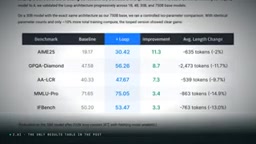
The division of labor between the two passes is clear: the first pass builds the global picture and outputs tend to be conservative; the second pass does fine-tuning with a fully updated state. Z.AI claims the extra loop costs almost nothing in memory, because the second pass reuses the first pass's attention computations. In its own tests, the looped version outperformed the non-looped version of the same size, with gains growing as reasoning chains get longer.
The cost is something Z.AI itself acknowledges: the model is prone to getting stuck in overly long "marathon-style" thinking loops. That line was later confirmed in independent testing.
On the relationship between "parameter scale" and "loop depth": In a standard Transformer, a model's "depth" is determined by the number of stacked layers, and each additional layer usually means a significant increase in parameter count. GLM-5.4 makes the same set of 28 layers compute twice per token, which is equivalent to lengthening the information flow path and increasing the number of reasoning steps without adding any new parameters. You can think of it as having the same expert read the same material twice: the first pass forms a preliminary judgment, and the second pass reviews and corrects it with the conclusions from the first. Z.AI claims this can simulate the thinking depth of a 2–3 trillion parameter model, but note that this "depth" comes from repeated computation rather than expanded knowledge capacity, so it is not fully equivalent to the knowledge base of a larger-parameter model.
Test Results: First Among Open-Source, Seventh Overall
Independent reviewer AI CodeKing tested GLM-5.4 with its KingBench 4 suite (building six complete applications from scratch). At the highest effort level, it scored 33.2/60 (55.3%), ranking 7th among 19 models. This is the highest-scoring open-source model the reviewer has tested, leading GLM-5.3 by 5.7 points, beating Kimi K3.1 Pro, DeepSeekAd V4.1 Flash, and Qwen 4 Max, and slightly outperforming GPT 6.1 Sol and Claude Haiku 5.5.
Performance varied enormously across the four effort levels. On quick tasks under three minutes, the low level was actually the strongest, passing all 25 items; on full builds taking hours, the Maximum level led by a wide margin, followed by High, with Low and Medium trailing. Its best works included a keyboard configurator (7.2 points), a 3D room designer (7.1 points), and a playable Pokémon Red (6.4 points). In the same test, prompt cache hit rate reached 98.4%, and all 31 parallel tool checks passed.

KingBench 4 and "effort levels": KingBench 4 is a coding benchmark built by independent reviewer AI CodeKing, whose core task is "building six complete applications from scratch," covering frontend, backend, games, 3D visualization, and other scenarios, with a maximum score of 60. The term "effort level" refers to the compute budget a model is allowed to spend on reasoning, similar to OpenAI's reasoning effort or Anthropic's thinking budget: low levels limit thinking steps and token consumption for fast responses; high levels remove limits and allow the model to repeatedly plan, check, and revise. Higher levels usually mean higher scores, but time and cost rise sharply, so the performance gap of the same model across different effort levels can be much larger than the gap between different models.
The "Caution" Bought by Seven-Plus Hours
Running the full benchmark, GLM-5.4 took a total of 431 minutes, or 7 hours and 11 minutes; Gemini 4 Neon took only 109 minutes on the same suite. It took 1,128 steps versus Neon's 244, and consumed about 1.04 million tokens, roughly 15x Neon's.
AI CodeKing's assessment was blunt: this is the most cautious model he has used, repeatedly checking and re-validating its own work. That caution did catch security vulnerabilities other models missed, but it is also exactly why it is slow. His recommendation is to use it as a reviewer and planner, not as a sprinter.
A note on evidence strength: all benchmark numbers above come from this single independent reviewer, not official results. Z.AI has not released any official benchmarks, technical papers, or API pricing, and scores are not yet available on Artificial Analysis or LM Arena.
What "prompt cache hit rate" means: Prompt caching refers to caching repeated prefix content in a conversation or task (such as system prompts, tool definitions, and code files already read) on the server side, so subsequent requests can reuse it without recomputing attention key-values, significantly reducing latency and token costs. A 98.4% hit rate means GLM-5.4 almost fully reused existing context during long tasks, which explains how it could maintain acceptable per-step overhead across a 7-hour run with over a thousand steps. But caching only saves the cost of "re-reading"; it cannot offset the extra steps and token consumption caused by "re-thinking," which is the main reason its total time far exceeds competitors.
Capability Boundaries: Vision, Demos, and Security
GLM-5.4 is Z.AI's first flagship model that can see both images and code (earlier lightweight versions already supported vision), with a 1 million token context window. Z.AI says it can reach 200 tokens per second during off-peak hours.
Official demos show where it is headed: writing code for a self-narrated music video called "Hello World"; designing a six-axis robotic arm in FreeCAD at engineering-grade CAD modeling quality; building a complete game from scratch with movement, physics, maps, combat, and art assets; and generating an interactive 3D birdwatching scene using pure math and custom shaders. These are vendor demos rather than independent tests, but the direction is clear — treating code as a general-purpose tool for video, games, engineering, and 3D.
On the security sandbox front, it capped out at 3.0 points in the SimLink isolation test, hitting the same ceiling as closed-source models.
Who Can Use It and How to Buy It
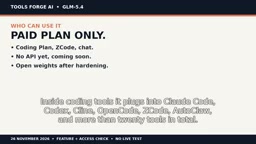
GLM-5.4 became available to all GLM Coding Plan subscribers on November 23 and can integrate with more than 20 coding tools including ClaudeCode, Codex, Cline, OpenCode, Zcode, and Autoclaw. There is currently no pay-per-token API (officially marked "coming soon"), and open-source weights are promised after security hardening is complete, but no timeline has been given.
There is no free tier. The minimum entry is the $18/month Light plan (2,000 credits per 5 hours, 10,000 per week), Pro is $80 (12,000 credits per 5 hours, 60,000 per week), and Max is $168 (28,000 credits per 5 hours, 140,000 per week). Annual billing reduces each tier by 30%, to roughly $12.60, $56, and $117.60 per month respectively.
Two caveats in the fine print: plans are non-refundable, and unused credits are not refunded either; cancel at least three days before renewal. Credits are a hard cap — when they run out, you stop and wait for the window to reset, with no overage billing. Z.AI says GLM-5.4 consumes credits one-third slower than GLM-5.3, and it raised members' weekly quotas by 50% at launch.
Competitive Landscape: Closed-Source Still Leads, It's First Among Open-Source
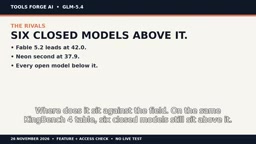
On the same KingBench 4 leaderboard, six closed-source models still rank ahead of it: Claude Fable 5.2 leads with 42.0 points, Gemini 4 Neon has 37.9, GPT 6.2 Sol has 37.0, and Claude Opus 5.5, GPT 6 Astra, and GPT 6.2 Astra are also above it. But everything above it is closed-source, and every open-source model below it scores lower, including Qwen 4 Max at 30.6.
The real comparison is speed traded for quality. Neon finishes the same suite in under two hours; GLM-5.4 takes over seven hours and 15x the tokens. The question is not whether it is good, but whether that extra caution is worth the extra time.
Conclusion
If you need to review code, plan large builds, or want a "second pair of eyes" that catches problems others miss, the High effort level is the balance point recommended by the reviewer. If you just want to get everyday coding done quickly, the low level performs better on short tasks, and Neon can do the same work in a quarter of the time. Until the API and open-source weights land, don't rush to call it a revolution; it is also worth watching whether the next independent test reaches the same conclusion. At this stage, it is a specialist, not a sprinter — and the strongest open-source coding model you can actually buy right now.
Related articles
China's New GLM Model Adopts Loop Transformer: Will ChatGPT Follow Suit?
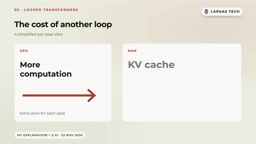
Zhipu's GLM adopts the Loop Transformer architecture, iterating multiple times to improve output quality as the first model to publicly confirm this design. This article explains the principles, KV cache cost, and surrounding developments in Google AI search and coding agent benchmarks.
GLM-5.4 Is 5x Cheaper Than Claude — But at What Cost?
GLM-5.4 offers near-Claude coding ability at $18/month, about one-fifth the cost, but lacks flagship benchmarks and max effort can exhaust quotas on a single 7-hour task. This article combines the official paper and three independent reviews to explain the recurrent Transformer architecture and offer practical advice.
GLM-5.4 Hands-On: Loop Transformer Gives Coding a Big Boost, But It's Not Frontier Yet
GLM-5.4 hands-on: a loop transformer runs 28 layers twice, markedly improving code fixes over 5.3, but bug hunting still trails Gemini 4 Neon—solid iteration, not frontier.