Choosing an AI Inference Provider: What Do Developers Care About Most?
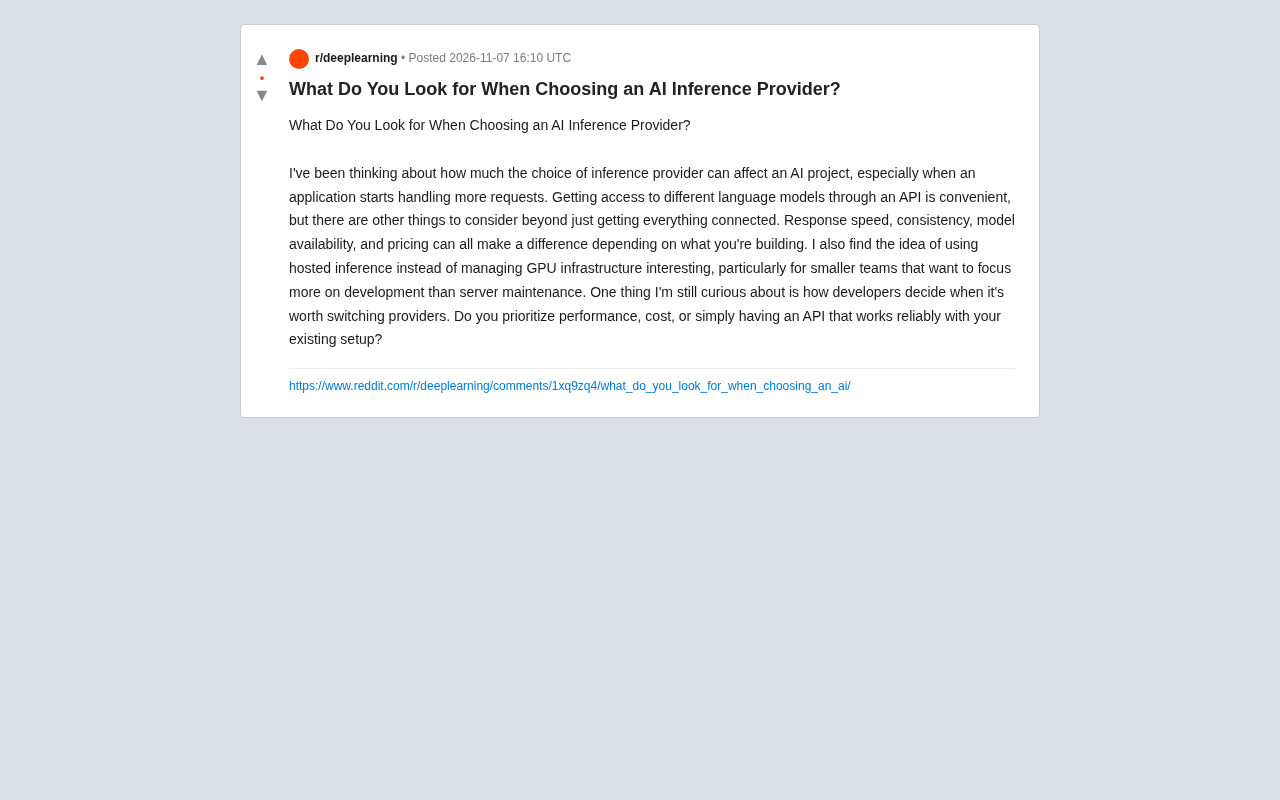
A Reddit discussion highlights the multi-dimensional trade-offs in choosing an AI inference provider: performance, cost, integration, and operations.
Starting from a Reddit question, the article explores the core considerations developers weigh when choosing an AI inference provider. The author points out that performance is not just response speed but also involves time to first token, throughput, long-term stability, and output consistency; pricing cannot be judged by price per token alone, since integration friction and engineering time are hidden costs; managed inference frees small teams from GPU operations, but self-building still has advantages when request volume is high or data residency requirements exist. Practical signals for switching providers include excessive latency, rising error rates, an unbalanced cost structure, and vendor lock-in risk. The article concludes that this field has no universal best practices yet, and developers need to figure out their priorities based on their own scenarios.
Starting from a Reddit Question
Recently there was an interesting discussion on Reddit: a developer posted asking what factors people actually care about when choosing an AI inference provider. He noted that as an application starts handling more requests, the choice of inference provider significantly affects project performance. Accessing different language models via API is convenient, but response speed, stability, model availability, and pricing all vary depending on the project type. He also specifically mentioned that for small teams, using managed inference instead of building their own GPU infrastructure is very appealing, since it lets them focus more on development rather than server maintenance.
This question touches on a very practical issue when putting AI applications into production: beyond model capability, infrastructure decisions at the inference layer are equally critical.
Performance Is More Than Just "Fast"
The poster put response speed first, but in practice "performance" is a multi-dimensional concept. Time to first token affects interactive experience, throughput determines concurrency capacity, and stability under long-running workloads relates to service availability. Different providers may vary widely on these metrics, and developers often need to make trade-offs based on their own scenarios. For example, chat applications are sensitive to time to first token, while batch processing tasks care more about throughput and cost.
Another easily overlooked point is consistency. The same model at different providers may show fluctuations in output quality due to quantization strategies, inference optimizations, or version updates. For products that depend on stable model output, this variation needs to be part of the evaluation.
Time to first token (TTFT) and throughput (TPS) are two key but often confused metrics for measuring inference service performance. Time to first token refers to the time from sending a request to receiving the first output token, and it directly determines the "response speed" perceived by users—crucial for interactive scenarios like chat and real-time assistants. Throughput refers to the number of requests a service can handle or the total number of tokens it can generate per unit of time, affecting concurrency capacity and unit cost. The two often involve trade-offs: aggressive batching can improve throughput but may increase queueing time for individual requests, thereby raising time to first token. In addition, quantization (compressing model weights from FP16 to lower precision such as INT8/INT4) can significantly reduce memory footprint and inference cost, but may introduce fluctuations in output quality; different providers vary in their quantization strategies and the degree of inference engine optimization, which is exactly an important reason why the same model performs inconsistently across platforms.
Cost Structure and Hidden Overhead
Pricing is an unavoidable factor, but simply comparing price per token is not enough. The poster mentioned that "pricing has an impact," but in actual decision-making you also need to look at billing granularity, free quotas, tiered pricing, and cost elasticity during traffic spikes. Managed inference eliminates GPU procurement and operations staffing, which is a real cost transfer for small teams.
However, hidden overhead is also worth noting: if a provider's API is expensive to integrate with the existing tech stack, or requires an additional adaptation layer, engineering time turns into hidden cost. The poster specifically mentioned "whether the API can reliably work with existing setups," which is really asking how much integration friction there is.
Managed Inference vs. Self-Built GPUs: The Trade-Off for Small Teams
The poster's interest in managed inference centered on "letting the team focus on development rather than server maintenance." This is indeed the core selling point of managed solutions: no need to manage GPU clusters, drivers, autoscaling, and failure recovery. For small teams without dedicated infrastructure staff, this can significantly lower the barrier to entry.
But self-building is not without its reasons. When request volume is large enough, or when there are hard requirements for data residency and customization, self-built GPUs may have advantages in long-term cost and controllability. The poster did not give a specific threshold, but pointed out a key judgment: when is it worth switching providers? There is no standard answer to this question; it depends on team size, growth expectations, and tolerance for operational complexity.
Managed inference means the provider handles GPU resource scheduling, model deployment, autoscaling, and failure recovery, and developers only call it through an API; self-built GPUs require the team to purchase or rent GPU instances itself and manage inference frameworks (such as vLLM, TGI), drivers, monitoring, and disaster recovery. Managed solutions turn fixed capital expenditure and operations staffing into variable costs billed by usage, making them suitable for teams with highly variable request volume or lacking infrastructure specialists. The advantage of self-building lies in full control over data residency, model customization, and low-level optimization, and when request volume remains consistently high, the marginal cost per token may be lower. Data residency requires data to be stored in a specific geographic region, and industries such as finance and healthcare often exclude some managed providers for this reason. The key to the decision is evaluating the balance point between "operational complexity" and "cost controllability."
Decision Signals for Switching Providers
The poster's final curiosity was: how do developers decide when to switch providers? From the context of the discussion, priorities vary from person to person. Some put performance and reliability ahead of cost, while others take "the API can reliably work with existing systems" as the bottom line. A more pragmatic approach is to set several observable trigger conditions: latency consistently exceeding acceptable ranges, rising error rates affecting user experience, cost structure becoming unreasonable as usage grows, or model availability failing to meet the product roadmap.
Another signal is vendor lock-in risk. If the API abstraction layer is thin enough, switching cost is low, and teams can adjust more flexibly based on cost-effectiveness; conversely, deep coupling to a specific provider's features makes migration expensive. The poster did not go deeper into this point, but the phrasing "reliably work with existing setups" suggests that integration depth affects willingness to switch.
Vendor lock-in means that after an application becomes deeply dependent on a provider's proprietary API, SDK, or features, migrating to another platform requires costly rework. A common way to reduce lock-in risk is to add a thin abstraction layer between the application and the inference service (such as a gateway that uniformly wraps multiple APIs), so that switching only requires changing configuration rather than rewriting business code. When assessing lock-in risk, consider: whether the API follows common standards such as OpenAI compatibility, whether it depends on provider-specific fine-tuning or caching mechanisms, and how convenient data export and migration are. The thinner the abstraction layer, the more flexibly the team can adjust based on cost-effectiveness, but excessive abstraction may also sacrifice performance optimization features offered by the provider.
A Multiple-Choice Question with No Single Answer
This Reddit question did not provide a conclusion, but it laid out several core dimensions of choosing an inference provider: performance, consistency, model availability, pricing, integration cost, and operational burden. For small teams, managed inference lowers the infrastructure barrier, but choosing which provider still requires weighing trade-offs against their own scenarios. The poster's question itself also shows that this field has not yet formed universal best practices, and developers are mostly figuring out their own priorities through real projects.
Related articles
 Tech Frontiers
Stylome Bot Slammed as Useless Junk: Why Do AI Detection Tools Keep Failing?
Reddit users test the Stylome AI detection bot: Gemini-rewritten text judged human-written, consistently low confidence. An analysis of AI text detection's technical dilemmas, privacy concerns, and credibility crisis in community governance.
 Tech Frontiers
When AI Becomes a Productivity Divide: Clarity or "AI Psychosis"?
A civil engineer's deep use of agentic AI boosted efficiency but bred contempt for peers who refuse to learn. Is this clarity or AI psychosis? An analysis of the cognitive and psychological challenges behind the AI productivity divide.
 Tech Frontiers
Opus 5.5 Benchmark Scores Climb, Community Says Its "Weights Are Blessed"
Reddit community discusses Opus 5.5's rising scores on the Benchmaxxing Bench, with users describing its performance as "weights are blessed." This article interprets the community reaction and cautions against conflating benchmark scores with real capability.