Chrome Launches Modern Web Guidance: Helping AI Coding Assistants Move Past 2019-Era JavaScript

Chrome, Edge, Firefox, and MDN jointly launch a tool to guide AI coding agents toward native Web features.
Chrome, Edge, Firefox, and MDN have jointly released Modern Web Guidance 1.0, using agent skill and CLI forms to guide coding agents toward prioritizing native Web platform capabilities. The article notes that AI coding assistants, affected by the time inertia of training corpora, often produce code stuck at 2019 levels, tending to introduce polyfills and unnecessary dependencies. The tool's value lies in constraining agents' default behavior, but its public evaluations are vendor-reported — before accepting them, you should independently verify target features' browser support rates, CI compatibility, and code style impact. The multi-vendor collaboration itself reflects that code generation lag has become a shared pain point across vendors, and signals that Web platform competition is shifting from feature count to the usability of native features.
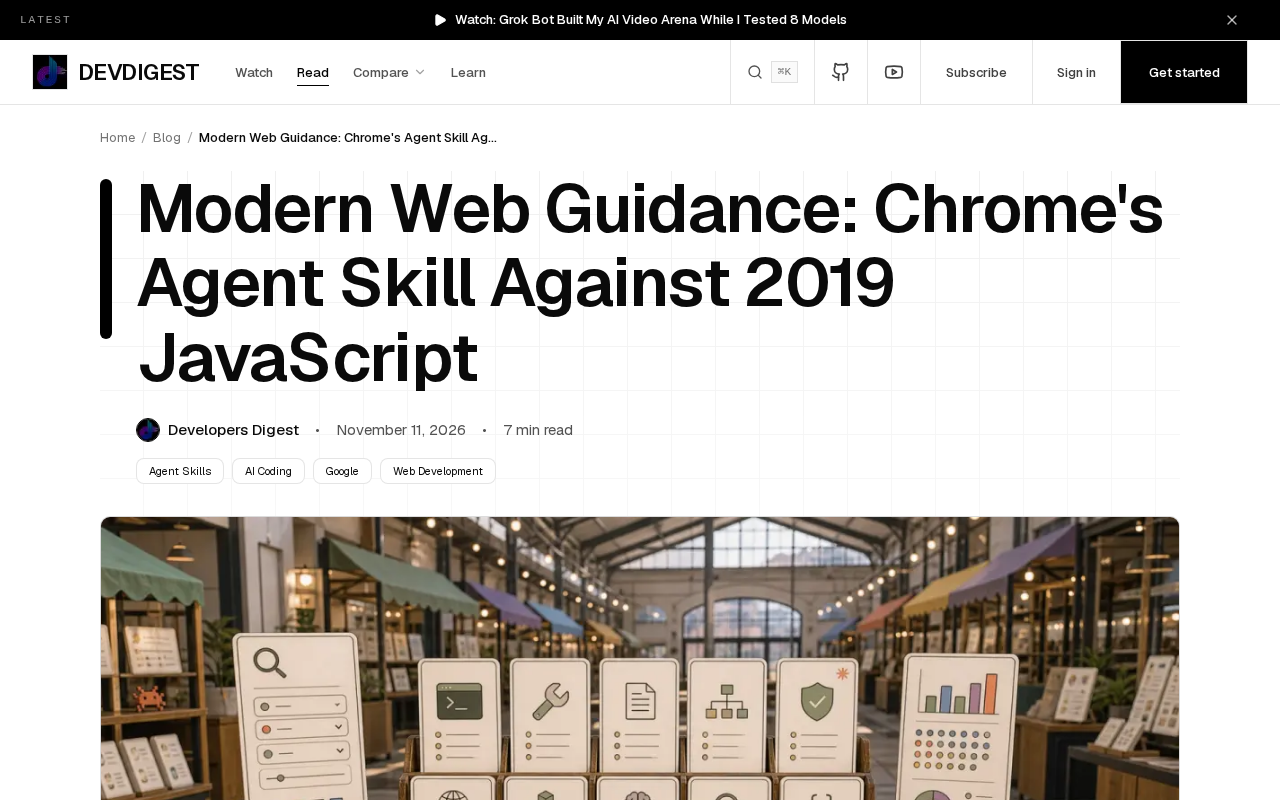
Chrome, Edge, Firefox, and MDN have jointly released Modern Web Guidance 1.0 — an agent skill and CLI tool for AI coding assistants designed to steer coding agents toward native Web platform features. According to RSS feed reports, the tool addresses a rather ironic problem: much of the code produced by AI coding assistants is still stuck at the level of 2019-era JavaScript.
Why AI-Written Code Looks Like It's From 2019
The Time Inertia of Training Data
Coding agents' code generation capabilities are built on training corpora, and the mainstream patterns, highly upvoted Stack Overflow answers, and open-source project templates in those corpora often lag behind what the Web platform can actually do. The result: even when browsers have long natively supported a feature, the agent still pulls in polyfills, utility libraries, or hand-writes verbose compatibility logic.
This is exactly where Modern Web Guidance steps in — rather than letting agents spin their wheels in old paradigms, it constrains them with a structured set of "skills" so they prioritize capabilities already built into modern browsers when writing code.
Dual Form: Agent Skill and CLI
The tool comes in two forms: the agent skill can be mounted directly into a coding agent's workflow, while the CLI makes it easy for developers to invoke locally or in CI pipelines. With four browser vendors plus MDN participating, the specification content isn't any single browser's dialect but a standard capability set covering the entire platform.
Agent Skill is a type of convention that has recently emerged in the AI coding tool ecosystem: it mounts into a coding agent's context as structured files (typically containing skill names, trigger conditions, operational instructions, and examples), so the agent automatically follows established specifications in specific task scenarios without the user having to prompt it manually each time. Typical implementations include Claude Code's Skills and Cursor's Rules. Compared with traditional system prompts, agent skills emphasize reusability, versioning, and distributability. CLI (command-line interface) provides the same set of rules to developers and CI pipelines as an executable tool, making it easy to automatically check whether code uses outdated patterns before committing or during the build phase. Together, the two cover both "constraint during agent generation" and "validation after generation."
The time inertia of training data has a more technical explanation behind it: large models' pretraining corpora have a clear knowledge cutoff, and the highest proportion of that corpora tends to be historically accumulated Q&A, tutorials, and open-source code. New features need several years to build sufficient density in the corpora. In addition, reinforcement learning and human feedback tend to reward conservative patterns that "work and are widely recognized," further amplifying this lag. By contrast, the Web platform itself releases annually (e.g., one ECMAScript version per year), and new APIs typically take 2-4 years from specification finalization to widespread browser support to developer adoption — meaning the gap between model output and platform capabilities may persist.
Beyond Vendor Self-Assessment: Check Browser Support First
Evaluation Data Comes from the Vendors Themselves
The original report explicitly notes that currently public evaluation results are vendor-reported, i.e., reported by the vendors themselves. This isn't unusual, but it does mean caution is warranted before taking them at face value: the vendors' evaluation scenarios, test set selections, and scoring criteria may not represent your real projects.
What's truly worth developers verifying hands-on is the support status of each recommended "modern feature" on target browsers. The tool's value lies in guidance, but the final code has to run in users' actual environments.
Vendor-reported is a common label in the evaluation space, referring to performance or effectiveness data tested and published by the product provider itself rather than reproduced by a neutral third party under uniform conditions. The problem with such data: test sets tend to favor scenarios advantageous to the vendor, and baseline choices, scoring criteria, and hardware/browser environments may not be disclosed. In the browser and Web platform space, similar controversies have long existed — for example, results from various JavaScript benchmarks (such as JetStream and Speedometer) are often selectively cited by vendors. Hence the industry convention: vendor-reported data can serve as directional reference, but key decisions involving compatibility and performance should be based on independent sources like MDN's Browser Compatibility Data (BCD) and Can I Use, as well as the project's own real traffic distribution.
Pre-Installation Checklist
Before integrating Modern Web Guidance into your team's workflow, you should confirm at least three things: whether the browser coverage of target features meets your project baseline; the CLI's compatibility with existing build and CI processes; and whether the agent skill will alter existing code style conventions. The original material doesn't provide a specific support matrix — such information should be based on official documentation.
The Signal Value of Multi-Vendor Collaboration
Chrome, Edge, Firefox, and MDN all appearing behind a single tool is itself a noteworthy signal. Browser vendors usually each have their own agendas when it comes to AI coding, and this time choosing to collaborate on the goal of "guiding agents to write modern code" shows that the lag in code generation has become a shared pain point across vendors.
From an industry perspective, this also means the competitive focus of the Web platform is shifting from "who supports more features" to "who can make both humans and AI more willing to use native features." Modern Web Guidance is the first clear move in this direction, but its actual effectiveness ultimately depends on whether the evaluations can be independently reproduced and whether developers are genuinely willing to hand their agent's code style over to an external set of rules.
Should You Install It?
If your team already uses coding agents and suffers from "old patterns," this tool is worth a pilot. If your project has a strict browser compatibility baseline, verify feature support first before deciding — don't let vendor evaluation conclusions sweep you away. The tool is guidance, not enforcement — it changes agents' default behavior, not the final quality guarantee of your code.
One-line Summary
Chrome, Edge, Firefox, and MDN jointly launch a tool to guide AI coding agents toward native Web features.
Paragraph Summary
Chrome, Edge, Firefox, and MDN have jointly released Modern Web Guidance 1.0, using agent skill and CLI forms to guide coding agents toward prioritizing native Web platform capabilities. The article notes that AI coding assistants, affected by the time inertia of training corpora, often produce code stuck at 2019 levels, tending to introduce polyfills and unnecessary dependencies. The tool's value lies in constraining agents' default behavior, but its public evaluations are vendor-reported — before accepting them, you should independently verify target features' browser support rates, CI compatibility, and code style impact. The multi-vendor collaboration itself reflects that code generation lag has become a shared pain point across vendors, and signals that Web platform competition is shifting from feature count to the usability of native features.
Related articles

AI Teams Up with Mathematicians to Attack the Riemann Hypothesis: 17 Million Lines of Code Tear Open a 167-Year Gap
In November 2026, Anthropic mathematicians and Claude claimed to have discovered a proof of the Riemann Hypothesis, publishing 17 million lines of Lean formalized code that passed machine verification. This article analyzes the event's impact on mathematics and cryptography, and the deeper questions raised by the separation of discovery and understanding.

AI Claims Formal Proof of the Riemann Hypothesis — But Machine Verification Isn't a Mathematical Proof
In Nov 2026, Anthropic's Levent Alpöğe released a Riemann Hypothesis proof of 175,000 code files that passed machine formal verification. But machine verification isn't a mathematical proof: the kernel can't confirm the proposition is the Riemann Hypothesis humans understand, and there's no human-readable paper. This article breaks down how ζ function zeros determine prime-count deviation, and the core of the controversy.

Anthropic Raises Over $80 Billion in IPO, DeepSeek Secures $100 Billion in Funding: AI Weekly Roundup
This week in AI: Anthropic's Nasdaq IPO raises $93.5B in the largest ever, DeepSeek closes ~100B yuan round, AI claims formal Riemann proof, MiniMax breaks crypto candidates in seconds.