Chrome Privacy Loophole: Google Once Again Exempts Its Own Domains from Site Data Rules
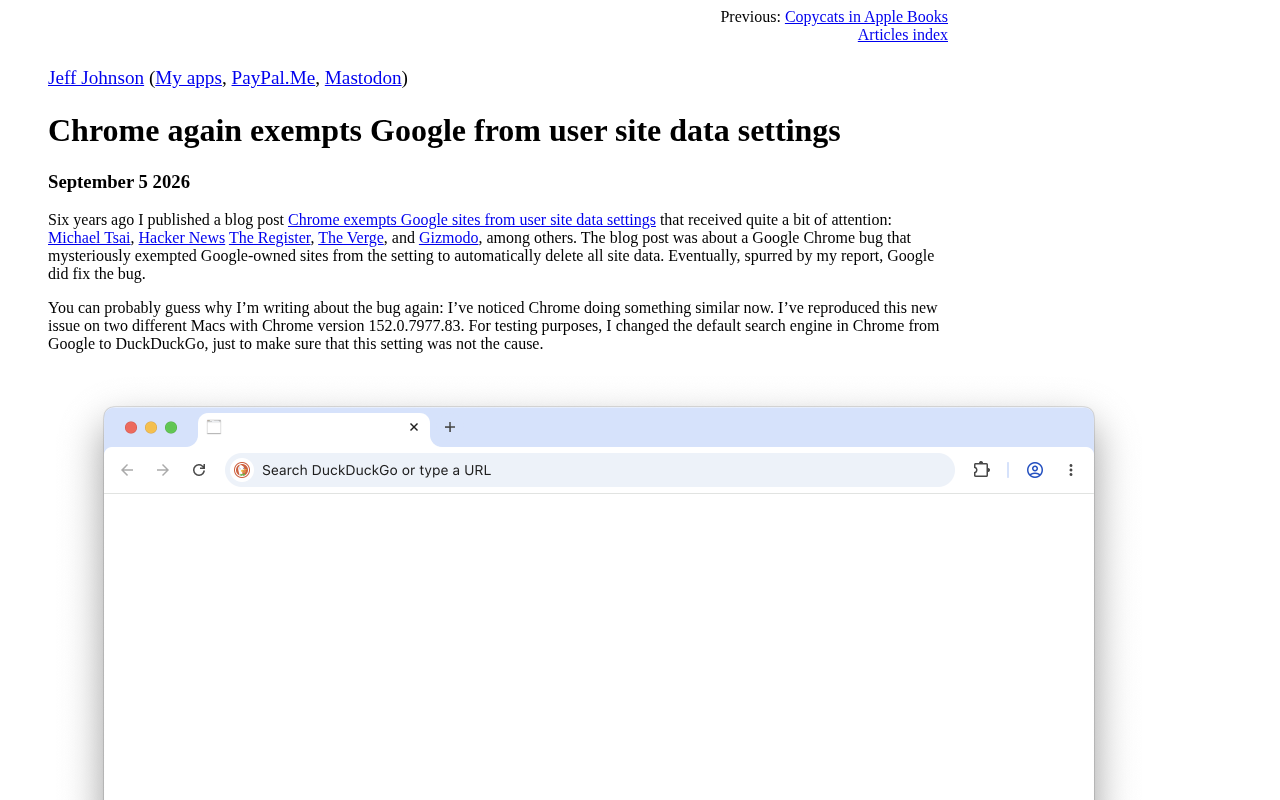
Chrome secretly exempts Google-owned domains from user privacy rules, bypassing site data deletion settings.
Google Chrome has been found to silently exempt Google's own domains — such as google.com — from user-configured privacy settings like "clear site data on exit," allowing cookies and local storage to persist despite user restrictions. This exemption is not disclosed in any visible interface, creating a serious information asymmetry. The deeper conflict lies in Google's dual role as both the author of browser privacy rules and the largest beneficiary of user data. Combined with ongoing controversies around Privacy Sandbox and repeated delays to third-party cookie deprecation, doubts about whether Google can truly prioritize user interests continue to grow. The article recommends privacy-conscious users switch to Brave or Firefox and proactively manage their data through extensions and source-level scrutiny.
Overview: Chrome's Privacy Exemption for Google Domains
A privacy controversy surrounding Google Chrome has been generating heated discussion in technical communities like Hacker News. Developers and security researchers have discovered that Chrome once again grants "special exemptions" to Google's own domains when processing user site data settings — even when users have explicitly disabled or restricted third-party site data storage in their browser settings, domains owned by Google (such as google.com and its associated services) can still retain and access the relevant data.
The word "again" in the original headline is telling, implying this is not the first time Google has been caught doing something similar. For a product that commands over 60% of the global desktop and mobile browser market, this kind of "selective enforcement of user privacy preferences" naturally invites serious scrutiny over fairness and transparency.

What Is a Site Data Exemption? A Technical Breakdown
What Site Data Does in Your Browser
"Site data" refers to the various types of local information websites store in your browser, including Cookies, LocalStorage, IndexedDB, and cache. This data serves legitimate functional purposes — like keeping you logged in or remembering your preferences — but it is also frequently used for cross-site tracking and targeted advertising, both of which carry significant privacy risks.
Modern browsers generally offer users options to manage site data, such as "clear cookies on exit," "block third-party cookies," or "wipe all site data when the browser closes." When users enable these settings, the intent is clear: they want to reduce the chances of being persistently tracked.
What This Exemption Means for User Privacy
When Chrome exempts Google's own domains from these rules, it means the privacy boundaries a user has actively set are being silently bypassed when it comes to Google's own services. A user might believe they've cleared all site data, when in reality data from google.com and related domains may have been preserved in full. This "outwardly compliant, secretly excepted" mechanism directly undermines the trust users place in their browser's privacy controls.
From a technical implementation standpoint, these exemptions are typically hardcoded into the browser's internal Content Settings Exception List, or implemented by attaching specific flags (such as chrome_content_settings_pattern) to Google domains to skip the standard clearing process. Because this logic lives deep within the browser's source code rather than in any user-visible settings interface, third-party auditors generally need to perform in-depth comparisons of the Chromium source code to detect any anomalies. Historically, researchers have found similar hardcoded whitelist entries in the Chromium codebase — including domains like accounts.google.com and youtube.com — which enjoy unrestricted Cookie access under certain privacy policies. This stands in stark contrast to the "uniform and equal enforcement of privacy rules" that the browser presents to users.
The Core Contradiction Behind Chrome's Privacy Controversy
Google's Dual Role: Both Referee and Player
What makes this incident particularly sensitive is that Google simultaneously occupies two roles: it is both the developer of Chrome (a user privacy tool) and the operator of advertising and search businesses that are heavily reliant on user data. When the entity writing the browser's rules happens to be the biggest beneficiary of those rules, any self-serving "exceptions" will face amplified scrutiny.
Critics argue that a browser, as the "gatekeeper" between users and the internet, should neutrally enforce user privacy preferences without creating backdoors for any specific company — including its own developer. This practice essentially constitutes a serious conflict of interest.
A Serious Lack of Transparency
Even more concerning is that these exemption mechanisms are often not disclosed to users in any prominent way. Ordinary users adjusting their privacy settings have almost no way of knowing that certain domains are excluded from the rules. This information asymmetry prevents users from making truly informed choices, and it is a key reason privacy advocates have consistently criticized Google.
Broader Industry Context: A Pattern of Chrome Privacy Issues
In recent years, privacy controversies surrounding Chrome have come one after another. From the repeatedly delayed "third-party cookie deprecation plan" to the antitrust concerns raised by Privacy Sandbox, to this latest site data exemption issue, Google's balancing act between "protecting user privacy" and "sustaining advertising revenue" has been a constant source of doubt.
This also explains why a growing number of privacy-conscious users are migrating to alternative browsers like Firefox and Brave, or opting for open-source Chromium forks with Google's service integrations stripped out, such as Ungoogled Chromium. For the developer community, events like this serve as an important reminder: default settings and underlying implementations reveal a product's true priorities far more honestly than surface-level options do.
Privacy Sandbox is a set of privacy technology standards proposed by Google in 2019 as a replacement for third-party cookies. Key proposals include the Topics API (interest-based ad targeting) and the FLEDGE/Protected Audience API (remarketing ad auctions). The design philosophy is to move user interest classification from ad servers into the browser itself, reducing data leakage. However, the initiative has drawn criticism from multiple directions: browser competitors argue it further consolidates Google's control over the advertising ecosystem, since Google both defines the API specifications and operates as the largest buyer and seller in the ad market. The UK's Competition and Markets Authority (CMA) launched a formal investigation into Google over the matter, and in 2022 signed a binding commitment with Google requiring that its Privacy Sandbox rollout not confer unfair competitive advantages on its own advertising business. The final timeline for deprecating third-party cookies has been pushed back multiple times and has yet to materialize.
User Strategies: How to Truly Protect Your Browser Privacy
Don't Rely Entirely on Chrome's Default Privacy Settings
This incident demonstrates that the privacy toggles a browser provides may not execute exactly as users expect. Users with higher privacy requirements may want to consider the following measures:
- Switch to a privacy-first browser: Such as Brave, or Firefox with a hardened privacy configuration
- Install privacy-enhancing extensions: Tools like uBlock Origin and Cookie AutoDelete for stronger control
- Regularly audit site data manually: Review and clear cookies and local storage on a per-domain basis
- Use containerized browsing: Firefox's Multi-Account Containers feature can effectively isolate data between different sites
Focus on Underlying Implementation, Not Marketing Claims
For technical practitioners, evaluating a product's privacy capabilities should involve looking closely at its source code, network request behavior, and actual data flows — not the vendor's public promises. This is precisely why open-source software and auditability are becoming increasingly important.
Conclusion
The "Chrome exempts Google again" incident may currently be limited in scope of discussion, but it touches on a long-standing, deeper question: when a single company controls both the user's privacy tools and the user's data itself, does it have sufficient incentive to truly stand on the user's side? The answer may not be encouraging.
For both ordinary users and developers, staying vigilant, actively taking control of your own data, and supporting transparent and auditable open-source solutions remain the most pragmatic paths to navigating browser privacy risks of this kind.
Related articles

Open-Source Python SDK: Measuring AI Agent Reliability with SRE Principles
Agent Reliability is an open-source Python SDK that applies SRE's SLO and error budget concepts to AI Agent evaluation, with PASS/FAIL/UNKNOWN states, CI assertions, and zero forced dependencies.
MiniMax RefMod: A Complete Guide to Training-Free Reusable Identity Workflows
MiniMax RefMod offers training-free reusable identity workflows for image, video, and audio generation. Includes Runpod template and tutorial for quick setup.

Invalid Source Material Notice
The source material provided lacks substantive information and is unrelated to AI/tech topics, making it impossible to produce a complete professional article.