Chrome Updates Every Two Weeks: How AI is Reshaping Browser Security Strategy
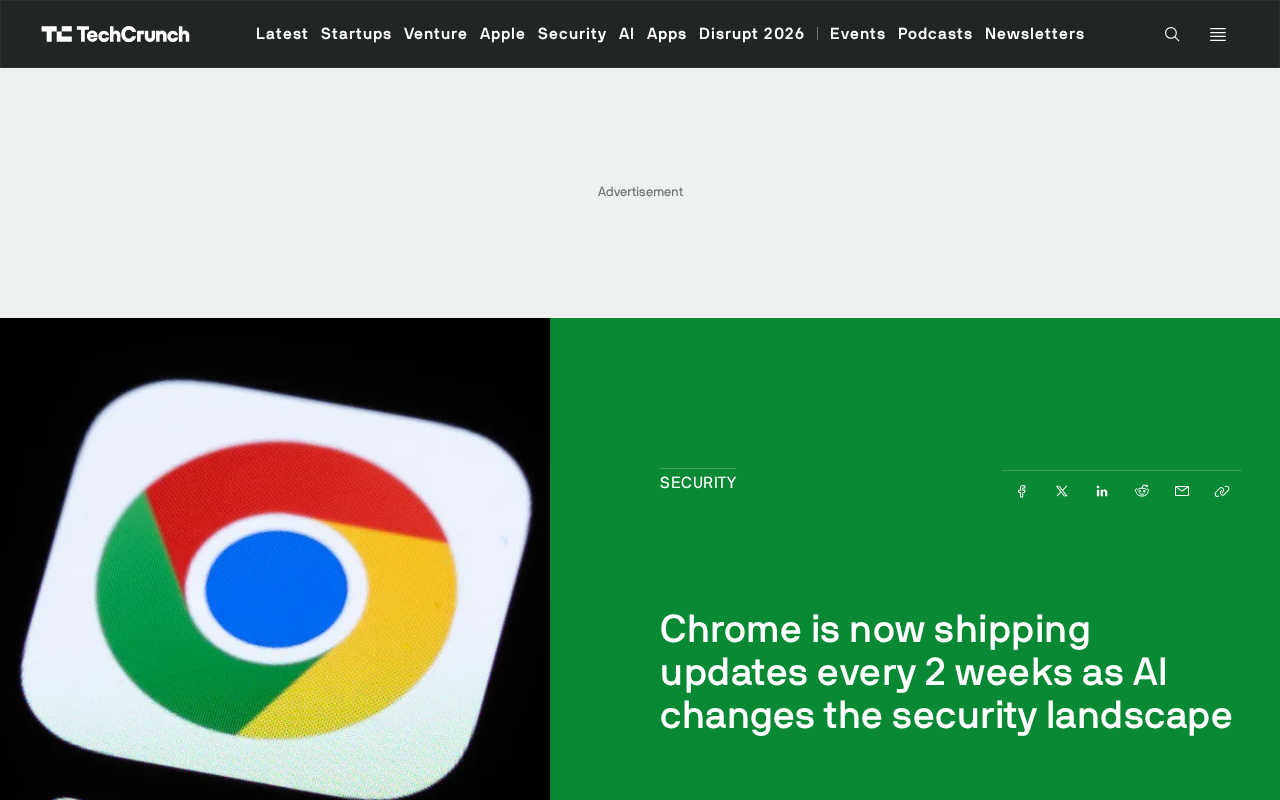
Chrome moves to biweekly updates as AI accelerates both cyberattacks and security responses
Google is accelerating Chrome to biweekly stable releases, driven by AI's dramatic impact on cybersecurity. As AI tools enable attackers to develop exploits in hours rather than days, the window between vulnerability disclosure and exploitation has shrunk from 60 days to under 5 days. Google responds by shortening patch delivery times, leveraging AI-enhanced fuzzing, and building robust CI/CD pipelines to maintain quality at higher release velocity.
Google Accelerates Chrome Update Cadence
Google is speeding up the release cycle for its Chrome browser to deliver security patches and new features more quickly. Chrome will transition from its previous update cycle to biweekly stable releases, marking a significant shift in the release strategy for the world's most popular browser.
Since its launch in 2008, Chrome has dominated the global browser market with approximately 65% market share and over 3 billion active users, thanks to the performance advantages of its V8 JavaScript engine and deep integration with the Google ecosystem. Chrome's release strategy has evolved multiple times: early on it used irregular releases, shifted to a 6-week stable release cycle starting in 2010, and compressed further to 4 weeks in 2021. This adjustment to biweekly releases is a natural continuation of that trend. Chrome employs a multi-channel release system including Canary (daily builds), Dev (weekly updates), Beta (monthly updates), and Stable, with code changes undergoing multiple rounds of validation before reaching end users.
For a product serving billions of users, any adjustment to release cadence is significant. More frequent updates mean security vulnerabilities can be patched faster, but also place higher demands on Google's testing, quality assurance, and automation pipelines. The core driving force behind this is the profound changes AI technology has brought to the cybersecurity landscape.
How AI is Changing the Security Landscape
Accelerated Evolution on the Attack Side
The proliferation of generative AI is significantly lowering the barrier to entry for cyberattacks. Exploit code that once required days of work by seasoned hackers can now potentially be completed in hours using AI tools. Attackers can leverage large language models to rapidly analyze open-source code, discover potential vulnerabilities, generate phishing content, and even automate entire attack chains.
Specifically, large language models (LLMs) can understand and generate code, allowing attackers to analyze technical details in CVE (Common Vulnerabilities and Exposures) bulletins, quickly locate affected code paths, and generate proof-of-concept (PoC) exploits. AI can also automate variant analysis—deriving similar vulnerabilities that might exist in code patterns based on a known vulnerability. Additionally, AI-driven social engineering attacks have become more precise, capable of generating highly personalized phishing emails that significantly increase attack success rates. Data from security research firm Mandiant shows that the average time for zero-day vulnerabilities to be exploited dropped from about 60 days in 2020 to less than 5 days in 2023, a trend that closely aligns with the proliferation timeline of AI tools.
This "attack acceleration" means the time window between vulnerability disclosure and widespread exploitation is shrinking dramatically. For software like browsers that are directly exposed on the internet frontline, traditional monthly update cycles can no longer match the pace of threat evolution.
Defense Strategy Responses
Facing faster attack cycles, defenders must speed up as well. Google's decision to compress Chrome's update cycle to two weeks is essentially a defensive strategy to shorten exposure windows—getting vulnerability fixes to end users faster and reducing exploitation opportunities.
At the same time, Google is heavily applying AI technology to strengthen its security defenses. One important direction is AI-assisted fuzzing. Fuzzing is an automated software testing technique that feeds large amounts of random or semi-random data into programs, observing whether they crash, leak memory, or exhibit abnormal behavior to discover potential security vulnerabilities. Google's open-source project OSS-Fuzz has helped discover over 10,000 vulnerabilities in open-source software since its launch in 2016. Traditional fuzzing relies on predefined mutation strategies, while AI-enhanced fuzzing can use machine learning models to understand the semantic structure of input data, generate more targeted test cases, and significantly improve code coverage and vulnerability discovery efficiency.
Beyond upgraded testing methods, Google is also pushing to rewrite critical components in memory-safe languages like Rust, fundamentally eliminating an entire class of memory safety vulnerabilities—forming a defense-in-depth strategy complementary to AI-assisted testing. Meanwhile, machine learning technology is widely applied to improve real-time detection of malware and phishing websites. Both attackers and defenders are arming themselves with AI, and this "arms race" is driving the entire security ecosystem to accelerate.
Significance and Challenges of More Frequent Updates
Real Impact on Users
For ordinary users, the most direct benefit of more frequent updates is improved security. Faster patching of critical vulnerabilities means users face a smaller risk window. Thanks to Chrome's mature silent background update mechanism, most users are barely aware of the update process and their experience won't be noticeably disrupted.
Chrome's silent updates rely on a background service called Google Update (GoogleUpdate.exe on Windows, Google Software Update on macOS). This service periodically checks update servers (typically every 5 hours), downloads incremental update packages, and automatically applies them the next time users restart their browser. Incremental update technology (using binary diff algorithms like Courgette) keeps each update package to just a few MB, avoiding noticeable burden even on limited-bandwidth networks. However, it's worth noting that Chrome updates in enterprise environments are often centrally controlled by IT administrators through Group Policy, and the update cadence may lag behind consumer versions—an aspect that requires special attention in enterprise security management.
New feature rollouts will also be smoother. Compared to pushing out large batches of changes at once, small iterative steps allow feature updates to integrate more gradually into users' daily routines, reducing abruptness.
Test of Google's Engineering System
Compressing the release cycle from several weeks to two weeks is a real stress test for Google's engineering system. It requires:
- Highly automated testing pipelines to ensure update quality doesn't decline due to speed
- Robust canary deployment and rollback mechanisms to quickly mitigate damage if issues are discovered
- Stable feature flag systems to decouple feature releases from code merges
CI/CD (Continuous Integration/Continuous Delivery) is the core engineering practice supporting all of this. Continuous integration requires developers to frequently merge code into the main branch, with each merge triggering automated builds and tests; continuous delivery ensures code is always in a releasable state. Chrome's codebase (Chromium) is one of the world's largest monolithic codebases, containing over 35 million lines of code with hundreds of daily commits. Supporting such high-frequency releases at this scale requires tens of thousands of build servers and millions of automated test cases.
Feature flags are the key technology for decoupling code merges from feature releases: code for new features can be merged into the main branch early, but configuration switches control whether they're visible to users. This allows Google to conduct canary testing (A/B testing) with specific user groups and remotely disable features without releasing a new version if problems are discovered. Chrome's chrome://flags page displays some experimental feature flags, but the actual server-side feature flag system is far larger and more sophisticated than what users can see.
Google's ability to make this adjustment also reflects that its CI/CD capabilities are mature enough to dramatically increase release frequency while maintaining stability.
Industry Trend: Security Response Enters Real-Time Era
Chrome's adjustment can be seen as a microcosm of the "real-time" trend in software security response. In a context where AI is deeply involved in offensive and defensive operations, "patching speed" is becoming one of the core competitive advantages in software security.
In the browser space, Mozilla Firefox shifted to a 4-week release cycle in 2020, and Microsoft Edge closely follows Chrome's release cadence based on the Chromium core. At the operating system level, Microsoft Windows maintains the traditional "Patch Tuesday" (second Tuesday of each month), but issues out-of-band emergency patches for actively exploited zero-day vulnerabilities. Apple has introduced Rapid Security Response mechanisms, allowing critical security fixes to be pushed without full system updates. CISA (Cybersecurity and Infrastructure Security Agency) has repeatedly emphasized "Secure by Design" principles in recent years, requiring software vendors to treat security update timeliness as a core product quality metric.
Predictably, other major software vendors will face similar pressures. When attackers use AI to compress vulnerability exploit development and deployment to extremely short timeframes, defenders who maintain traditional update cadences essentially leave users exposed to known risks for extended periods. In the future, more critical software will likely shift toward higher-frequency, more automated security update models. As "continuous security updates" gradually replace "periodic patches" as the industry standard, software supply chain security (such as SBOM—Software Bill of Materials) and automated vulnerability response platforms will also receive greater industry investment.
For the entire industry, this is both a challenge and an opportunity. It compels companies to invest in automated testing, AI-assisted security audits, and rapid response mechanisms, thereby improving the robustness of the entire software ecosystem in the long term.
Conclusion
Chrome's shift to biweekly updates may seem like a simple release cadence adjustment, but it actually reflects deeper transformations in cybersecurity in the AI era. When AI arms both attackers and defenders simultaneously, speed becomes the key variable determining success or failure. Google's response with faster update cycles demonstrates both confidence in its engineering capabilities and forward-looking strategic positioning for the future security landscape.
For users and the entire industry, this is a welcome direction—because in the race against cyber threats, being one step slow could mean far greater consequences.
Related articles
Complete Guide to Deploying Large Models Locally with Ollama: From Installation to Code Integration
Complete guide to deploying large models locally with Ollama, including custom installation paths to avoid C drive issues, practical commands, and LangChain integration code examples for building offline private AI development environments.

Canada Declares Trade War with the United States: Impact Analysis and Outlook
Canada's PM declares the country is in a trade war with the U.S. — a historic escalation. We analyze impacts on supply chains, tech, AI talent, and more.

AI Won't Replace Senior Developers — It Will Push Their Value Upstream
Will AI replace programmers? From radiologists to coachmen, learn how AI pushes developer value upstream. Master architecture, judgment, and skills AI can't replace.