Cities Put the Brakes on Robotaxis: Self-Driving Cabs Face a Regulatory Siege
Robotaxi deployment faces tightening city regulation, with permits, data, and right-of-way as three key tools for constraining operators—and regulatory fragmentation as the real challenge.
Autonomous taxis are moving from tech demos into real operations, but city officials are tightening rules. The article highlights a disconnect between permissive state legislation and municipal management needs: as Robotaxis scale up, incidents of stalled vehicles and blocked bus lanes erode public patience, and cities find themselves lacking direct means of constraint. Cities apply pressure mainly through operating permits and fees, data disclosure obligations, and right-of-way and infrastructure management. For operators, the early 'deploy first, communicate later' strategy is failing, bringing longer deployment cycles and higher compliance costs. The more fundamental challenge is regulatory fragmentation: varying rules across states and cities drive up cross-city expansion costs and hinder unified safety standards. The core battle is balancing cities' public responsibility with the pace of technological innovation.
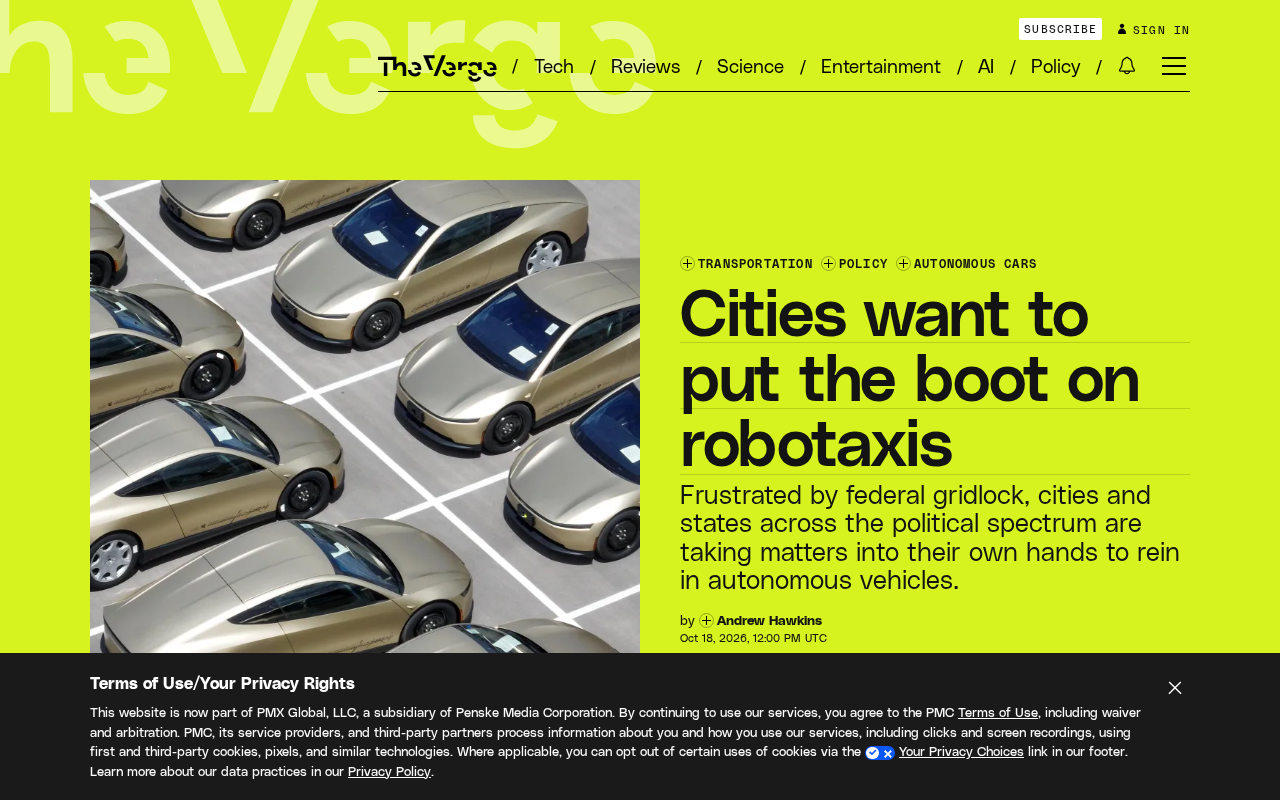
Autonomous taxis (Robotaxis) are driving out of tech demos and onto real streets—but what greets them isn't just curious passengers, but an increasingly tight regulatory grip from city officials. In the latest edition of The Stepback newsletter, The Verge senior reporter Andrew J. Hawkins dissects this battle over right-of-way, safety, and local autonomy.
From "Launch First" to "Regulate First"
For the past few years, the Robotaxi narrative has centered on technological breakthroughs and expansion speed. Waymo gradually rolled out service in Phoenix and San Francisco, while Cruise once tried to replicate that pace in San Francisco. Cities' initial attitudes were mostly wait-and-see, or even welcoming—after all, autonomous driving was packaged as a solution to reduce human error and ease congestion.
The turning point came after operational scale expanded. Incidents of vehicles stalling at intersections, blocking bus lanes, and interacting poorly with emergency vehicles were documented one by one, and public patience began to wear thin. According to Hawkins' observations, a clear disconnect emerged between permissive state-level legislation and the practical management needs of cities: the first state to pass autonomous driving legislation did so to seize an industrial advantage, not to provide cities with fine-grained management tools.
This disconnect means that when Robotaxis actually enter a city, local officials often find themselves lacking the means to directly halt or constrain operations. Thus, "putting the boot on"—using local authority like licenses, permits, fines, and even vehicle impoundment to apply pressure—became the way cities reclaimed the initiative.
State Preemption is a key legal concept in U.S. autonomous driving regulation. It refers to state legislatures passing laws that explicitly centralize regulatory authority over a certain domain at the state level, prohibiting lower-level local governments (cities, counties) from making their own rules. In the autonomous driving field, several states (such as Arizona and Texas) have passed such laws, originally to avoid fragmented municipal rules hindering technological innovation and industrial deployment—but this has also left cities without direct jurisdiction when facing Robotaxi operational issues. Cities can only apply indirect pressure through existing general authorities like traffic management and business licensing, which is the legal root of the "disconnect" described in the article.
The Cards Cities Hold: Permits, Data, and Right-of-Way
Cities have more than one weapon against Robotaxis. From the threads Hawkins lays out, there are at least three paths:
Operating permits and fees. Some cities have tried requiring autonomous driving operators to apply for local permits and pay corresponding fees, binding market access to compliance.
Data disclosure obligations. Requiring companies to report operational data, accident records, and disengagement situations is a prerequisite for cities to gain regulatory leverage. Without data, rules have no foundation.
Right-of-way and infrastructure. Access rights to bus-only lanes, loading zones, and emergency corridors directly determine whether Robotaxis can operate efficiently. Cities can use traffic management measures to indirectly compress their operational space.
The common thread among these tools is that none require waiting for federal or state legislation—they're based on cities' existing authority over public space management. This also explains why conflicts often erupt at city hall rather than Capitol Hill.
Operating permits and fees are a common way cities manage market access for emerging transportation services. Take San Francisco as an example: the city tried requiring Robotaxi operators to apply for local business permits and pay fees, binding operating rights to compliance obligations. Such permits typically come with conditions, such as requiring companies to submit safety plans, proof of insurance, and emergency response protocols. Unlike state-level operating permits (such as those issued by the California DMV and CPUC), municipal permits focus more on local traffic impacts and community interests, providing cities with direct regulatory leverage.
Data disclosure obligations refer to cities requiring autonomous driving companies to regularly report operational data, including mileage driven, accident records, vehicle disengagement counts, and passenger complaints. This data is the foundation for cities to assess safety and formulate rules. For example, the San Francisco Transportation Authority has required Waymo and Cruise to provide detailed operational data to analyze their impact on traffic flow and public safety. Without mandatory data disclosure, city regulation lacks factual basis, and rulemaking has no starting point.
Right-of-way management is a means by which cities indirectly constrain Robotaxi operations by controlling access permissions for public road space. Cities can designate bus-only lanes, loading zones, and emergency vehicle corridors, and stipulate usage restrictions for autonomous vehicles. For example, prohibiting Robotaxis from stopping to pick up passengers in bus-only lanes, or restricting their entry into certain busy road segments. These measures are based on cities' existing traffic management authority, require no waiting for higher-level legislation, and can quickly affect Robotaxi operational efficiency and coverage.
The Companies' Dilemma: Expansion Urge vs. Local Relations
For Robotaxi operators, tighter city regulation brings dual pressure on expansion pace and public relations. On one hand, scaled operations are a prerequisite for spreading costs and validating business models; on the other hand, every public operational incident becomes grounds for tighter regulation.
Hawkins' article suggests that the industry's early strategy of "deploy first, communicate later" is failing. Cities are no longer satisfied with passively accepting test fleets—they demand verifiable commitments on safety records, emergency response, and community impact before companies enter. For operators, this means longer deployment cycles and higher compliance costs.
Regulatory Fragmentation Is the Real Challenge
More noteworthy than any single city's tough stance is the lack of uniform rules. State legislative standards differ, municipal permit requirements vary, and operators must navigate dozens of rule sets. This fragmentation not only drives up operating costs but also greatly reduces the certainty of cross-city expansion.
From a public policy perspective, fragmentation is equally detrimental to the accumulation of safety standards. If each city defines accident reporting criteria and testing thresholds differently, the industry cannot form a comparable data foundation, and regulators and the public cannot judge whether technological progress is genuinely occurring.
Regulatory Fragmentation refers to different levels and regions of government creating mutually incompatible rule systems for the same emerging technology, leading to higher compliance costs for companies and difficulty in cross-regional expansion. In the autonomous driving field, the U.S. lacks unified federal legislation, state rules vary in strictness, and cities add their own requirements through permits, data, and right-of-way—creating a situation of "fifty states, fifty rule sets; hundreds of cities, hundreds of requirements." This fragmentation not only undermines economies of scale but also hinders the unified accumulation of safety standards, making it difficult for regulators and the public to compare the true performance of different operators side by side.
What to Watch in This Battle
The city regulation fight over Robotaxis is essentially a磨合—a running-in process—between new technology and local governance capacity. The tech side tends to view rules as obstacles, while the city side views rules as the baseline of public responsibility. Hawkins' reporting reminds us that the pace of autonomous driving deployment depends not only on algorithms and sensors but also on permitting processes and community hearings at city hall.
What's worth watching next: whether cities can establish effective accountability mechanisms while remaining open, and whether operators are willing to trade transparency for operational space. Whoever finds this balance first will gain the upper hand in the next phase of the Robotaxi race.
One-line Summary
Robotaxi deployment faces tightening city regulation, with permits, data, and right-of-way becoming cities' three main tools for constraining operators—and regulatory fragmentation emerging as the real challenge.
Paragraph Summary
Autonomous taxis are moving from tech demos into real operations, but city officials are starting to tighten the rules. The article points out a disconnect between permissive state legislation and municipal management needs: as Robotaxis scale up, incidents of stalled vehicles and blocked bus lanes wear down public patience, and cities find themselves lacking direct means of constraint. Cities apply pressure mainly through three paths: operating permits and fees, data disclosure obligations, and right-of-way and infrastructure management. For operators, the early "deploy first, communicate later" strategy is failing, bringing longer deployment cycles and higher compliance costs. The more fundamental challenge is regulatory fragmentation: varying rules across states and cities drive up cross-city expansion costs and hinder unified safety standards. The core of the battle is the balance between cities' public responsibility and the pace of technological innovation.
Related articles

Dutch Government Allegedly Hacked Kushner's Phone: The Hidden Tech-Geopolitical Battle
Dutch government allegedly hacked Kushner's phone, sparking nearly 200 comments on Hacker News. This article analyzes the rumor from three angles: technical attack paths, allied intelligence games, and information credibility, exploring why mobile device security has become the frontline of geopolitical games.

New Alzheimer's Finding: Restoring Sleep Without Clearing Brain Plaques
New Alzheimer's research suggests restoring two hours of sleep can improve function without clearing amyloid plaques, raising questions for sleep intervention and drug R&D.

Which Paid AI Is Best for Writing and Research? Reddit Users Debate ChatGPT vs. Gemini
Reddit users debate paid AI chatbots for writing and research: a veteran writer finds free Gemini outperforms paid ChatGPT, with community discussion focusing on writing quality, research scenario preferences, and prompt workflows, revealing tool selection strategies as the boundary between free and paid blurs.