Claude 5.1 Complete Breakdown: Cost, Scientific Capabilities, and Safety Guardrails Explained

Claude 5.1 delivers lab-validated science, 75% cheaper caching, and cleaner safety guardrails in two versions.
Anthropic's Claude 5.1 release pairs a general-audience model with a trusted-user safety version built on the same foundation. Key highlights include a 75% cache read price cut driving 25-45% workload savings, protein binders with ~50% lab hit rates, Venus terrain resolution improved to 2-3 km, 2.5x scientific inference speedup, and 60% fewer cybersecurity false positives — all while maintaining strict safety boundaries.
Anthropic has officially released Claude 5.1, alongside a Claude Opus-tier safety version designed for trusted professional users. What's most striking about this release isn't yet another benchmark record — it's a concrete scientific fact: protein binders designed by the model were successfully validated in real laboratory experiments.
This article covers the full scope of this update, from the release overview, performance and cost, scientific research breakthroughs, and safety guardrails to usage boundaries.
How Do the Two Versions of Claude 5.1 Differ?
The key takeaway for understanding this release is: The general-audience Claude 5.1 and the version for trusted users are fundamentally the same underlying model. The difference lies not in intelligence, but in the "risk boundaries the model is allowed to handle."
The general version covers coding, knowledge work, and long-horizon tasks, while the trusted version is only available to vetted cybersecurity and life sciences professionals. Additionally, the default reasoning tiers differ: the coding terminal (Claude Code) uses the High tier, while the web interface and collaborative scenarios default to Medium. A reasoning tier refers to the amount of computation the model dedicates to internal chain-of-thought reasoning before generating a response — the High tier allows the model to spend more computational resources on deep reasoning, suited for complex coding and scientific tasks, while the Medium tier strikes a balance between response speed and reasoning depth, appropriate for everyday knowledge work.
The four numbers most worth remembering from the release page are:
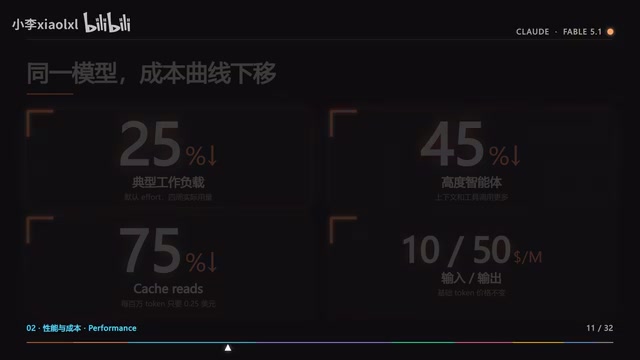
- Typical workload costs reduced by 25%
- High-agentic workloads reduced by up to ~45%
- Cache Reads pricing reduced by 75%
- Cybersecurity guardrail false positives reduced by ~60%
These four numbers essentially outline the core value of this update — not a single-point capability breakthrough, but capability, cost, and safety curves all shifting downward simultaneously.
Claude 5.1 Performance and Cost Optimization
Let's start with coding and computer operation capabilities. On Terminal-Bench Science, Claude 5.1 scored 52.6%, more than doubling the previous generation's 24.7%. On Terminal-Bench 4.0, the standard version scored 55.8%, while the trusted version scored even higher at 60.9%; the partial completion rate on OS World 2.0 was 77.9%. Terminal-Bench is a class of benchmarks that evaluates a model's ability to complete complex tasks in real terminal environments — the model must write code, debug programs, manage files, and configure environments like a human developer in a command line, rather than simply generating code snippets. OS World goes even further, requiring the model to complete complex cross-application tasks in a full operating system environment.
For reasoning and business work, Humanities Last Exam scored 60.9% without tools and rose to 65% with tool access; Automation Bench scored 31.4%, and Cursor Bench scored 73.4%. It's important to note that these scores come from different benchmarks and cannot be simply added or compared against each other. Humanities Last Exam is a crowdsourced, extremely difficult humanities exam created by academics, with questions spanning philosophy, history, linguistics, and other fields that even PhD-level experts might find challenging — a score of 60.9% means the model already demonstrates considerable academic reasoning ability on these top-tier difficulty questions.
For knowledge work specifically, on GDPVal AAV2, Claude 5.1 scored 1853, surpassing the previous generation's 1723 and slightly edging out Opus 5 — this is the benchmark's own composite score, not a percentage.
What Does a 75% Cache Read Price Cut Mean?
On the cost side, the biggest change is that cache reads are 75% cheaper, which is the primary reason behind the "25% savings on typical workloads." Cache Reads are an important cost optimization mechanism in LLM APIs. When developers repeatedly send the same system prompts, tool definitions, or lengthy reference documents across multi-turn conversations or batch tasks, the API provider caches the already-processed context in GPU memory, allowing subsequent requests to directly reuse computed results instead of reprocessing them. In agentic workflows, the model often needs to re-read tool descriptions, codebase context, and historical action logs at each decision step, and this content is highly repetitive across steps. So when tasks heavily depend on context and tool calls, the savings can approach 45%. Base input and output prices remain unchanged at $10 and $50 per million tokens, respectively.
What early partners repeatedly emphasized wasn't some impressive leaderboard score, but the stability of long-horizon tasks: the model will first study unfamiliar code and documentation, then break down plans, run verification loops, and ultimately deliver results. It prefers to "fix root causes" rather than bypass tests, and can sustain autonomous operation for extended periods. This explains why its value lies not in a single Q&A exchange, but across an entire workflow.
Claude 5.1's Breakthrough Applications in Scientific Research
The most significant part of this release is the model's participation in real scientific research, with verifiable results.
Protein Design: Hit Rate Approaching 50%
Protein binders designed by the trusted version were sent to external institutions for experimental validation by research teams. A protein binder is an artificially designed protein molecule that can specifically bind to a target protein — this is crucial in drug development, as antibody drugs are essentially a type of protein binder. Traditional protein design relies on computational physics methods (such as the Rosetta suite) or directed evolution experiments, which are time-consuming and expensive. In recent years, deep learning methods like AlphaFold and RFdiffusion have dramatically accelerated this process, but the hit rate of designed candidate molecules in wet-lab experiments is typically only 10-15%.
Across 12 targets, Claude 5.1's designed protein binders achieved a hit rate approaching 50% — roughly one out of every two designed molecules actually worked in experiments. Even more remarkable, on 3 targets, the binding affinity reached approximately 10x that of the competition's best designs. Binding affinity measures the strength of interaction between a binder and its target, typically expressed as the dissociation constant Kd, where lower values indicate tighter binding. A 10x improvement in affinity means these AI-designed molecules have significantly surpassed human experts' manual optimization results in terms of function, which will dramatically shorten the iteration cycle from computational design to clinical drug candidates.
Venus Terrain Reconstruction: Resolution Improved to 2-3 Kilometers
The model read NASA Magellan mission radar images from over 30 years ago and organized data from different sources and resolutions into trainable samples. Magellan was a NASA Venus probe launched in 1989 that used Synthetic Aperture Radar (SAR) to penetrate Venus's thick sulfuric acid cloud layer, systematically imaging the planet's surface from 1990 to 1994. SAR technology constructs images by emitting microwave pulses and receiving surface echoes, enabling terrain information acquisition without any reliance on visible light. Magellan covered approximately 98% of Venus's surface, but the spatial resolution of its elevation data was far lower than its image resolution.
The previous Venus elevation maps had spatial detail of roughly 10-20 kilometers per grid cell, while the newly generated Digital Elevation Model (DEM) pushed detail to 2-3 kilometers across one-third of Venus's surface, with altitude accuracy improved by approximately 25%. A Digital Elevation Model is a standard geographic information product that interpolates discrete elevation samples into a continuous terrain surface — it has direct engineering value for planning future Venus landing missions (such as NASA's VERITAS and ESA's EnVision). Anthropic plans to release this map under a Creative Commons license to serve as a reference for future exploration missions.
Scientific Inference Accelerated by 2.5x
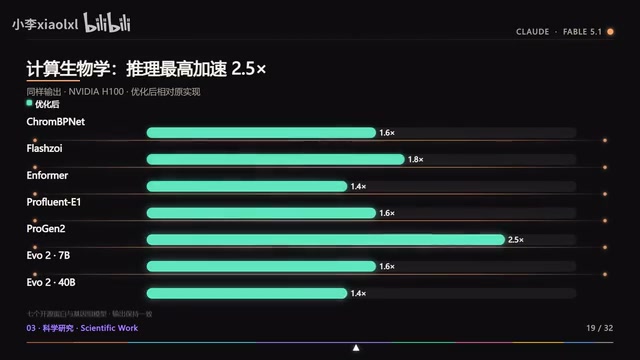
Another bottleneck in computational biology is inference speed. The model wrote custom GPU Kernels for 7 open-source protein and genomics models and cached intermediate results, achieving up to 2.5x speedup on individual inference runs while maintaining consistent outputs. A GPU Kernel is the smallest unit of computational function executed on a graphics processor. Deep learning frameworks (like PyTorch) provide general-purpose Kernel implementations, but generality often comes at the cost of performance — for example, failing to fully exploit a specific GPU architecture's shared memory hierarchy, Tensor Cores, or memory bandwidth. Custom GPU Kernels are optimized computational functions hand-written or auto-generated for specific model structures and hardware characteristics, typically using low-level programming languages like CUDA or Triton. In protein and genomics models, attention mechanism sequence lengths can be extremely long (a single protein sequence can span thousands of amino acids, and genomic fragments can reach tens of thousands of base pairs), making memory usage and computation in standard implementations a bottleneck. Through operator fusion, intermediate result caching, and memory access pattern optimization, the custom Kernels written by Claude 5.1 dramatically reduced computational overhead while maintaining numerically consistent outputs. Estimated GPU costs for genomic analysis dropped 30-60% as a result.
Putting it all together: protein hit rate approaching 50%, Venus terrain detail at 2-3 kilometers, inference up to 2.5x faster, GPU costs down 30-60% — this is the concrete meaning of "moving from answering scientific questions to advancing experiments."
Safety Guardrail Upgrades: Fewer False Positives, No Looser Defenses
The stronger the capabilities, the less safety guardrails can rely on a crude master switch. The most easily misread part of this update concerns the cybersecurity domain.
The new version can now help identify software vulnerabilities in source code — this is defensive work. However, it still blocks exploit code generation, and binary vulnerability scanning and penetration testing requests are also redirected. Exploit code refers to executable code that can actually trigger a software vulnerability and achieve attack objectives (such as gaining system privileges or stealing data), which is fundamentally different from defensive analysis that merely identifies the existence of vulnerabilities. Official data shows that false positive interventions decreased by approximately 60%, meaning security researchers are significantly less frequently blocked incorrectly when legitimately using the model for code auditing.
Life Sciences and Agentic Safety
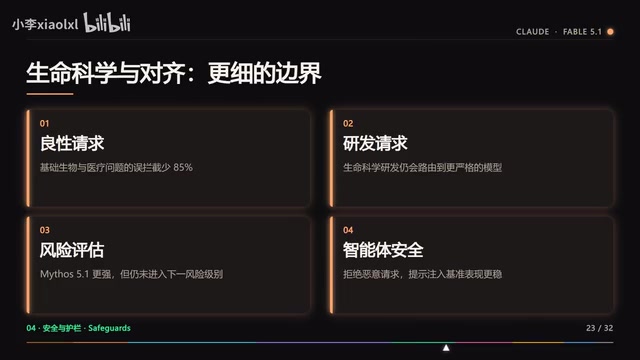
For basic biology and medical questions, "benign false blocks" decreased by 85% compared to the previous generation's guardrails, while genuinely sensitive research-related requests are still routed to stricter models. Evaluation results show that while the trusted version is more capable than the previous generation, it has not entered the next tier of chemical and biological risk levels. The "risk level" here refers to Anthropic's internal safety evaluation framework's grading standards, which assess whether a model could provide substantive guidance on dangerous substance synthesis to someone lacking professional expertise — "not entering the next tier" means the trusted version's capability improvements remain within safety thresholds.
For agentic safety, the model's rejection rate for malicious requests and prompt injections is on par with peer models, and it ranks at the most robust tier on external prompt injection benchmarks. Prompt Injection is one of the core security threats facing LLMs, where attackers embed malicious instructions in external content that the model might read (such as web pages, documents, emails), attempting to hijack the model's behavior. This threat is especially severe in agentic scenarios because the model not only reads external content but also has real capabilities to execute code, send requests, and manipulate files. Claude 5.1 reaching the most robust tier on these benchmarks means it can more reliably distinguish between the user's genuine intent and malicious instructions embedded in external content.
AI Watermarking and Data Compliance
To comply with the EU AI Act, model outputs carry invisible text watermarks, used solely to detect whether content may have been generated by the model. They contain no user or conversation information and do not affect content quality. The EU AI Act, which officially took effect in 2024, is the world's first comprehensive AI regulatory law, requiring providers of general-purpose AI systems to mark AI-generated content so it can be detected by machines, in order to address risks such as deepfakes and misinformation. The principle behind invisible text watermarks typically involves subtly adjusting the token sampling probability distribution during text generation to embed statistical signals — for example, introducing patterns in synonym selection and sentence structure that are imperceptible to the human eye but detectable by algorithms. Unlike image watermarks, text watermarks face challenges due to the discrete nature and ease of editing text, where minor modifications can potentially destroy the watermark signal. Anthropic has explicitly stated that this watermark is solely for detecting content origin and does not contain user identity or conversation content, striking a balance between compliance requirements and privacy protection. Enterprises can apply for a detection API for compliance verification.
On data security, Anthropic introduced Enterprise Frontier Safeguards (EFS), which keeps data within the customer's own controlled cloud infrastructure, with a privacy posture equivalent to zero data retention. This architecture means that enterprise sensitive data — including prompts and model outputs — never leaves the enterprise's own cloud environment; Anthropic provides only model inference capabilities without touching actual data. EFS will roll out in phases across Claude Code, the enterprise edition, and AWS, Google Cloud, Azure, and other access points.
Claude 5.1 API Pricing and Selection Guidance
The most tangible price change is in cache reads: now $0.25 per million tokens, a 75% reduction. Standard input remains at $10 per million, and output at $50. How much you save depends on how much context gets repeatedly read in your workflow. For typical agentic applications — for example, a code review Agent that needs to reload project architecture documentation and coding standards each time it analyzes a new file — cache reads can account for over 50% of total token consumption, at which point the 75% price cut translates directly into significant billing reductions.
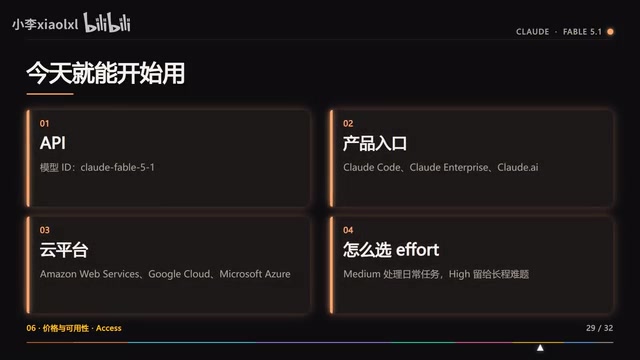
Claude 5.1 is now available across platforms with the API model ID "claude-5.1", accessible from Claude Code, the enterprise edition, and the web interface, as well as through AWS, Google Cloud, and Azure. For less complex tasks, the Medium tier is often sufficient; switch to the High tier when long-horizon reasoning is needed. A simple principle for choosing tiers: if the task involves multi-step planning, complex code debugging, or analysis that synthesizes multiple information sources, the High tier's additional reasoning depth is usually worth the cost; for single-turn Q&A, text summarization, simple code generation, and similar tasks, the Medium tier delivers near-equivalent quality while saving on inference compute costs.
The trusted version is another door to the same foundation, aimed at professional users: cybersecurity access goes through a dedicated application channel, and the Claude Security capability for scanning codebases and suggesting patches is now powered by it.
Conclusion: How to Determine Whether Claude 5.1 Is Right for You
The focus of Claude 5.1 isn't just higher benchmarks. It pushes long-horizon workflows, real scientific research, and cost structure forward together, while cleanly separating different risk boundaries into two versions. When actually making a selection, the first step isn't evaluating capabilities — it's confirming which guardrail your task falls under, and then checking whether model capabilities and billing align with your needs.
Related articles
Getting Started with Machine Learning at 16: A Complete Learning Path from Zero to Hands-On Practice
How can a 16-year-old UK A-Level student get started with machine learning from scratch? A clear learning path covering Python basics, math connections, resources, and hands-on project ideas.
Building a GitHub Action Text Replacement Tool with JavaScript: From Principles to Practice
Learn how to build a GitHub Action for text replacement with JavaScript, covering implementation principles, use cases, and key technical details for CI/CD automation.
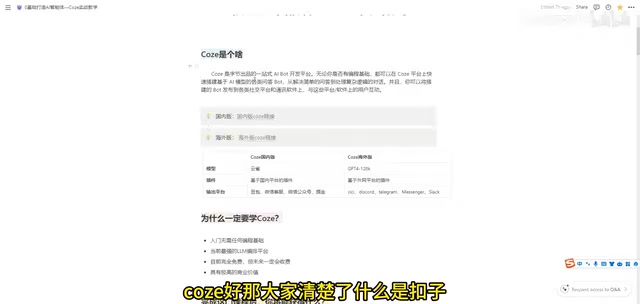
Coze Beginner's Guide: A Complete Cognitive Guide to Building AI Agents from Scratch
Learn what ByteDance's Coze platform is, key differences between domestic and international versions, how to use GPT-4 for free, and how to build AI Bots with zero coding experience.