Claude Adds Personal Finance Analysis Tool: Privacy vs. Convenience

Claude's Personal Finance launch sparks Reddit debate on financial data privacy vs. cloud convenience.
Claude released Personal Finance, a tool that analyzes users' spending records, sparking lively Reddit discussion. Users value the need but worry about sending bank statements to cloud models. Commenters debated implementation: a DIY local PDF analyzer claims data never leaves the device, but others note cloud inference still sends data out. The article argues vendors must clearly explain data flows and offer verifiable local options for broad adoption.
Claude recently launched a new tool called Personal Finance, which allows users to directly analyze their spending data. The news sparked discussion in the Reddit community, and the core tension is clear: people want AI to help them look at their books, but handing bank statements over to a cloud model makes many of them uneasy.
The Tool Itself: Putting Spending Analysis in the Chat Box
Based on community feedback, Personal Finance is positioned to let Claude directly process users' spending records and output analyses such as spending structure and trend judgments. For ordinary users, this eliminates the steps of organizing spreadsheets and writing formulas themselves, compressing "bookkeeping—categorization—analysis" into a single conversation.
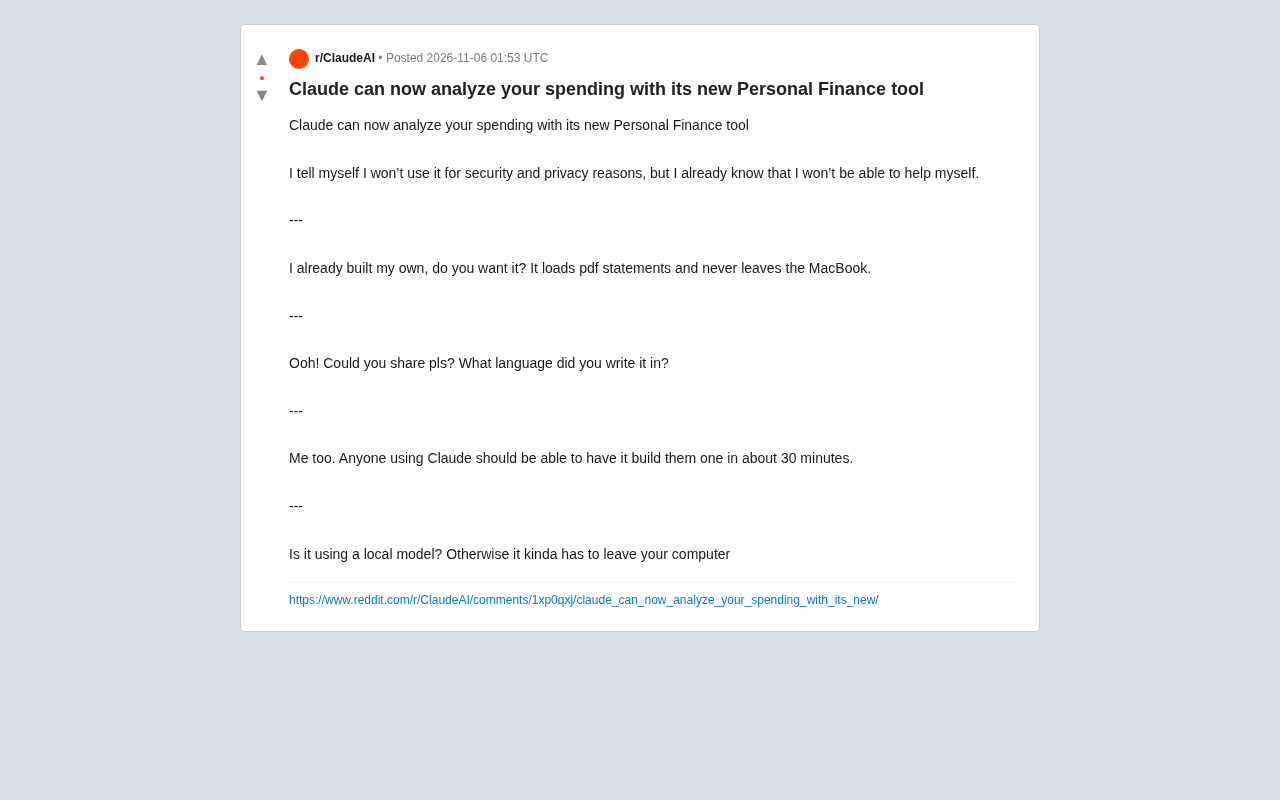
The top highly upvoted comment under the original Reddit post is very representative: the poster said that for security and privacy reasons they "told themselves they wouldn't use it," but immediately admitted "I already know I won't be able to resist." This mindset is almost the common starting point for every AI feature involving financial data—the need is real, and so are the concerns.
Privacy Anxiety: Does the Data Have to Leave Your Computer?
The most informative disagreement in the comments appeared around a technical detail. One user said they had already built a local version that can read PDF statements and that "data never leaves this MacBook." Someone else asked what language it was written in, and another added that anyone using Claude should be able to get it to help them build a similar tool in about half an hour.
But someone immediately raised the key question: "Does it use a local model? Otherwise the data still has to leave your computer to some extent." This remark exposes the core premise of the DIY approach—if the local tool still calls a cloud LLM for analysis after parsing the PDF, then the promise of "never leaving the local machine" only holds halfway. The community did not reach a consensus on this point: some assumed local processing meant the entire pipeline was offline, while others clearly distinguished "file parsing happens locally" from "inference happens in the cloud."
The distinction between "local models" and "cloud inference" is crucial here. A local model refers to an LLM running entirely on the user's device (such as open-source models deployed via Ollama or llama.cpp), where the inference process does not depend on the network and data does not leave the device; cloud inference, by contrast, sends data to the provider's servers, where remote GPU clusters perform the computation. The privacy implications of the two are completely different: with the former, as long as the device is trusted, the data flow is closed; with the latter, users must trust the provider's data handling policies, encryption measures, and compliance audits. For local PDF parsing tools, file parsing can be done locally, but if the subsequent analysis step calls a cloud API such as Claude or GPT, the statement content will still leave the device in text form. The community's argument about "building a tool in half an hour" usually refers to a hybrid approach of local parsing plus cloud analysis, not a fully offline pipeline.
The Pull Between Convenience and Control
What this discussion reflects is not really the quality of any single feature, but the structural tension that AI products inevitably face once they enter the personal finance domain.
The advantages of cloud solutions are straightforward: strong model capabilities, ready to use out of the box, and no need for users to know programming. The cost is that users must trust how the service provider handles financial data. Local solutions are the reverse: control stays with the user, but users must build and maintain them themselves, and analysis capability is limited by the models that can run locally. Some Reddit users believe that getting Claude to help write a small local tool takes only half an hour; that claim may hold for people with some technical background, but not necessarily for most ordinary users.
As a detail, no one in the community denied the value of such tools; the debate focused entirely on the implementation path. That in itself shows that, as an AI application scenario, personal finance analysis already has a fairly clear demand side, and the remaining question is how products can find a balance between privacy promises and model capability. For vendors, whether they can clearly explain data flows and offer verifiable localization options may become the key to whether such features are widely accepted.
The structural tension can be summed up as the "privacy—capability—convenience" impossible triangle: in personal finance analysis scenarios, users can usually satisfy only two of the three at once. Cloud LLMs offer strong capability and are ready to use out of the box, but provide weak privacy control; local small models offer strong privacy and high control, but their analysis capability is limited by device compute and model size; and wanting both strong capability and high privacy often requires users to have the technical ability to build a hybrid solution themselves, which greatly reduces convenience. This framework also explains why the community discussion did not reach a consensus—different users prioritize different corners of this triangle, with technically savvy users leaning toward local solutions and ordinary users relying more on the out-of-the-box nature of cloud products. The vendor's challenge is to broaden the feasible region as much as possible through product design (such as on-device preprocessing, differential privacy, and verifiable data flow explanations).
A Direction Worth Watching
The emergence of features like Personal Finance means that general assistants are extending into highly sensitive personal data domains. The Reddit discussion provides an early sample: users will not completely avoid it just because of concerns, but they will not completely let down their guard just because it is convenient. What really determines adoption may be whether the product can explain "where the data goes" clearly enough.
One-line Summary
Claude's launch of Personal Finance sparked heated discussion on Reddit, centered on the trade-off between financial data privacy and cloud convenience.
Paragraph Summary
Claude launched the Personal Finance tool, which can directly analyze users' spending records, and the Reddit community discussed it enthusiastically. Users generally recognize the value of the need, but have obvious privacy concerns about handing bank statements to a cloud model. Technical disagreements emerged in the comments: one user built a local PDF statement analysis tool and claimed data never leaves the device, but was questioned that if inference still calls a cloud model, the privacy promise only holds halfway. The core of the debate is not whether the feature is good, but the implementation path—cloud solutions are capable and ready to use but require trusting the provider, while local solutions offer high control but require self-building and maintenance and are limited by local model capability. The article points out that whether vendors can clearly explain data flows and provide verifiable localization options will determine whether such features can be widely accepted.
Related articles
 Tech Frontiers
Stylome Bot Slammed as Useless Junk: Why Do AI Detection Tools Keep Failing?
Reddit users test the Stylome AI detection bot: Gemini-rewritten text judged human-written, consistently low confidence. An analysis of AI text detection's technical dilemmas, privacy concerns, and credibility crisis in community governance.
 Tech Frontiers
When AI Becomes a Productivity Divide: Clarity or "AI Psychosis"?
A civil engineer's deep use of agentic AI boosted efficiency but bred contempt for peers who refuse to learn. Is this clarity or AI psychosis? An analysis of the cognitive and psychological challenges behind the AI productivity divide.
 Tech Frontiers
Opus 5.5 Benchmark Scores Climb, Community Says Its "Weights Are Blessed"
Reddit community discusses Opus 5.5's rising scores on the Benchmaxxing Bench, with users describing its performance as "weights are blessed." This article interprets the community reaction and cautions against conflating benchmark scores with real capability.