Claude API Inline Tools: Dynamically Adding Tools Mid-Conversation

Claude API beta supports dynamically adding or modifying tool definitions mid-conversation while preserving prompt cache.
Claude API's beta inline tool definitions let developers dynamically add, adjust, or upgrade tools mid-conversation via a single system message while preserving prompt cache hits. This breaks the traditional constraint that tool sets must be fixed before a session starts. The article covers three typical use cases—adding, reshaping, and upgrading—and highlights the capability's benefits for agent architecture, including finer-grained context budget management and staged permission control. It also cautions that the feature is still in beta and that call stability after definition changes and cache reuse behavior must be verified before production use, offering practical recommendations.
Claude API's beta inline tool definitions allow developers to dynamically add, adjust, or upgrade tools mid-conversation via a single system message, while preserving prompt cache hits. This capability breaks the traditional constraint that "the tool set must be fixed before the session begins," offering more flexible orchestration for agent applications that require multi-turn capability expansion.
Core Mechanism: Declaring New Tools with a Single System Message
In the traditional approach, tool JSON schemas must be placed in the tools field at the beginning of the request. Once a session starts, the only way to add a new tool mid-way is to reset the session, which invalidates the cached prefix and increases token costs. Inline tools turn this action into part of the conversation: insert a system message into the message stream that declares a new tool or overrides an existing tool definition, and the model can call it in subsequent turns.
According to the original source, the key advantage of this approach is to "keep the prompt cache"—new tool declarations enter the context incrementally rather than rewriting the entire request prefix, so existing cached segments remain reusable. For long sessions and multi-stage tasks (e.g., retrieve first, then compute, then write), this can significantly reduce duplicate billing and shorten time-to-first-token.
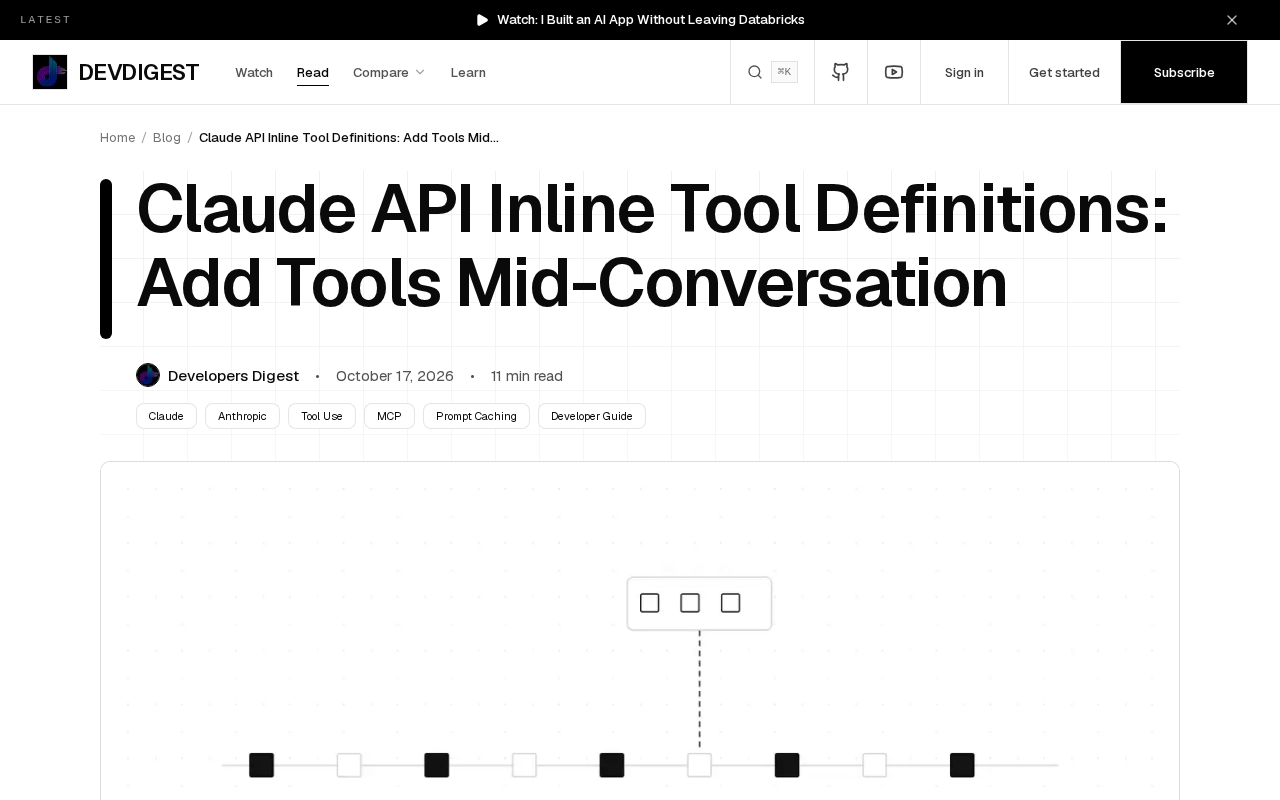
Prompt cache is a cost-optimization mechanism provided by the Anthropic API: when a request prefix (such as the system prompt, tool definitions, or message history) is exactly identical to a previous request, the server reuses the already-cached computation, thereby reducing token billing and time-to-first-token. Caching typically depends on contiguous matching of the request prefix; once any part of the prefix changes (for example, inserting a new tool definition at the beginning), subsequent content can no longer hit the cache. Inline tool definitions can "preserve the cache" because they insert new tool declarations as a newly added system message within the conversation flow, rather than modifying the tools field at the start of the request. As a result, the original prefix remains intact and cached segments stay reusable. Understanding this point is essential for evaluating the cost model.
Three Typical Use Cases: Adding, Reshaping, and Upgrading
The original article distills the value of inline tools into three actions, each corresponding to different engineering needs:
- Define (add): Early in the session, only basic tools are needed; specialized tools are mounted when a specific subtask is reached, avoiding stuffing a huge tool set into the context from the start.
- Reshape: When the parameter structure of the same tool needs to change with context (e.g., a query switching from a lenient mode to a strict mode), the definition can be rewritten mid-way rather than creating a new tool with duplicate semantics.
- Upgrade: When iterating tool versions, smoothly switch to a new schema within the session, letting the model continue to complete tasks under the same tool name and reducing branch logic in the orchestration layer.
What these three use cases share is that the evolution of the tool set is explicitly written into the conversation trace rather than hidden in an external state machine. This means that during debugging, the set of tools available to the model at that time can be reconstructed directly from the message record—a practical benefit for observability.
Tool definition in the Claude API is typically described in JSON Schema form, including the tool name, functional description, and the fields and types of input parameters. The model uses this information to decide whether to call a tool and how to construct parameters. Inline tool definitions allow tools to be re-declared mid-conversation via a system message, with the effect of overriding or extending the model's currently available tool set. Note that tool definitions themselves also consume context tokens, and the model's understanding of tools depends on the clarity of the descriptions. When changing dynamically, ensure that the new and old definitions transition smoothly in semantics to avoid confusing the model.
Impact on Agent Architecture
Inline tools demote "tool registration" from request-level configuration to a conversation-level event, which has several practical implications for agent design. First, context budget management becomes more granular: tool schemas themselves consume tokens, and on-demand mounting leaves limited context for the actual content. Second, tool permissions can be tightened or relaxed as the session stage changes—for example, sensitive-operation tools can be injected only after user confirmation, reducing the surface for erroneous calls.
It is worth noting that this is still a beta feature, and the original article provides example code in a "code included" manner. Before adopting it in production, two things should be verified: whether the model's understanding of tool names and parameters remains stable after dynamically changing tool definitions, and whether cache reuse still behaves as expected after multiple system message insertions. These two points directly determine whether the cost model holds.
Practical Recommendations
When mixing inline tools with traditional static tool sets, it is advisable to define clear trigger conditions for each tool change and to spell out the tool's applicable boundaries in the system message, so the model does not keep trying to call a tool that is no longer valid. Also keep a session-level log of tool changes for replay and billing reconciliation. For cost-sensitive teams, start with an A/B test on non-critical paths, comparing changes in cache hit rate and tool-call accuracy, before deciding whether to expand usage.
Overall, inline tools are a pragmatic addition to the Claude API's direction toward "evolvable conversations": they do not change the basic principles of tool calling, but return lifecycle management of the tool set to the conversation itself, giving multi-stage agents a finer-grained means of control.
One-line Summary
Claude API beta supports dynamically adding or modifying tool definitions mid-conversation while preserving prompt cache.
Paragraph Summary
Claude API's beta inline tool definitions allow developers to dynamically add, adjust, or upgrade tools mid-conversation via a single system message while preserving prompt cache hits. This breaks the traditional constraint that the tool set must be fixed before the session begins. The article introduces three typical use cases—adding, reshaping, and upgrading—and notes the capability's positive impact on agent architecture, including more granular context budget management and staged permission control. It also cautions that the feature is still in beta, and that call stability after definition changes and cache reuse behavior must be verified before production use, along with practical recommendations.
Related articles

Pi Durable: A Persistence Solution That Lets AI Agents Auto-Resume After Crashes
Pi Durable is a TypeScript library that checkpoints every task and tool call to SQLite or JSONL, letting AI agents auto-resume after crashes—no manual continue needed.

How Thomson Reuters Built Trustworthy Legal AI with GPT Enterprise
Thomson Reuters partners with OpenAI to unify lawyers' entry point with GPT Enterprise and combine CoCounsel Legal and HighQ's professional data and compliance systems to make legal AI judgments verifiable.

Anthropic Proposes AI Model Ban Threshold: $1 Billion in Damages or 50 Casualties
Anthropic proposes banning AI models only if they cause over $1 billion in losses or 50 casualties. Reddit debates whether this is pragmatic regulation or a straw man strategy, exploring the reasonableness and controversy of quantitative AI safety standards.