Claude-BugHunter: 82 Skills Powering AI-Assisted Vulnerability Discovery and Red Team Operations
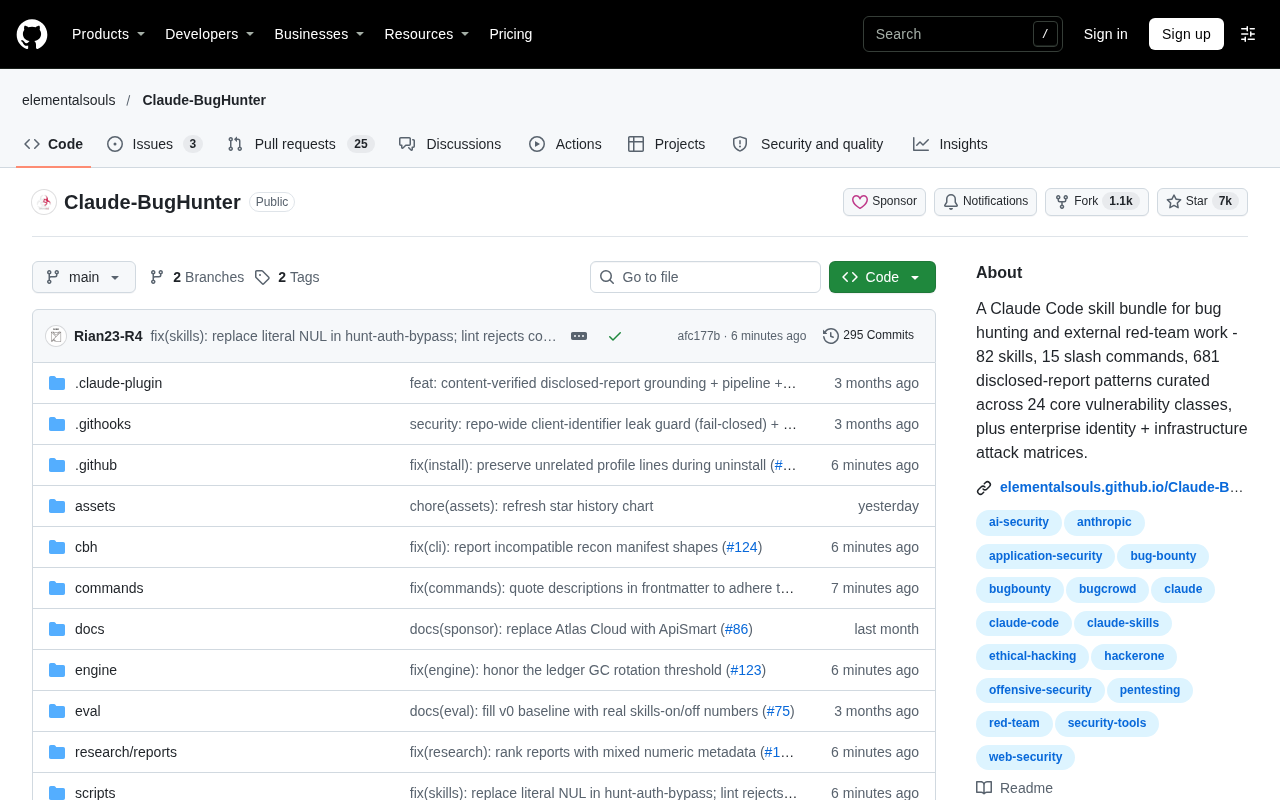
Claude-BugHunter gives Claude Code 82 security skills and real vulnerability patterns for bug hunting and red teaming.
Claude-BugHunter is an open-source project for security research that provides Claude Code with 82 skills, 15 slash commands, and patterns from 681 disclosed reports covering 24 core vulnerability categories, plus enterprise identity and infrastructure attack matrices. Built in Python, it has about 7,000 stars and over 1,000 forks on GitHub, with 98 new stars in a day, showing strong community interest.
Introduction
In the security research field, vulnerability hunting and red team work often rely on expert experience and a great deal of repetitive effort. Recently, an open-source project called Claude-BugHunter has drawn attention on GitHub. The project provides a skill package for Claude Code, designed to assist security professionals in vulnerability discovery and external red team operations. According to the project description, it includes 82 skills, 15 slash commands, and catalogs patterns from 681 disclosed reports, covering 24 core vulnerability categories, while also integrating enterprise identity and infrastructure attack matrices. The project is developed in Python and has already gained 6,995 stars and 1,074 forks, with 98 new stars in a single day, indicating strong community interest.
Core Feature Breakdown
A Rich Skill Library
The core of Claude-BugHunter is its 82 skills. These skills are likely predefined operations or knowledge modules targeting different vulnerability types and attack scenarios, enabling Claude Code to provide more precise assistance in security tasks. For example, for common web vulnerabilities (such as SQL injection or XSS) or network attack techniques, the skill library may include corresponding detection, exploitation, or analysis workflows. This design allows security professionals to quickly invoke expert knowledge and reduce repetitive trial and error.
Claude Code is an AI programming assistant for developers launched by Anthropic. Unlike the web version of Claude, it runs as a command-line tool or IDE plugin and can directly read and write files and execute commands. Skills are an extension mechanism in Claude Code that allows developers to package domain-specific instructions, tool calls, and knowledge in a modular way, with the model automatically loading them when needed. Therefore, the 82 skills in Claude-BugHunter are essentially 82 "security expert behavior packs" that Claude Code can activate on demand, rather than standalone programs.
Slash Commands are shortcut instructions in Claude Code that begin with /; when entered by the user, they trigger preset prompt templates or action sequences. In Claude-BugHunter, the 15 slash commands essentially wrap common red team operations (such as generating reports or starting scans) into one-click entry points, reducing the burden of manually writing prompts while also ensuring consistency of operations. This is similar to the "playbook" concept in traditional security tools, but implemented in a way that AI can understand.
Slash Commands Improve Efficiency
The project also provides 15 slash commands, further simplifying interaction with Claude Code. Slash commands are typically used to quickly trigger specific functions; in security scenarios, they may correspond to operations such as scanning, report generation, and vulnerability verification. Through command-based invocation, security professionals can execute tasks more efficiently without needing to remember complex prompts.
Vulnerability Patterns Based on Real Reports
Most notably, the project catalogs patterns from 681 disclosed reports, covering 24 core vulnerability categories. This means the skill package was not designed in a vacuum but distilled from a large number of real vulnerability reports. These patterns may include common manifestations of vulnerabilities, exploitation techniques, and remediation recommendations, helping Claude Code more accurately identify potential risks when analyzing code or network environments. For security researchers, this is equivalent to a continuously updated knowledge base that helps improve the coverage and depth of vulnerability discovery.
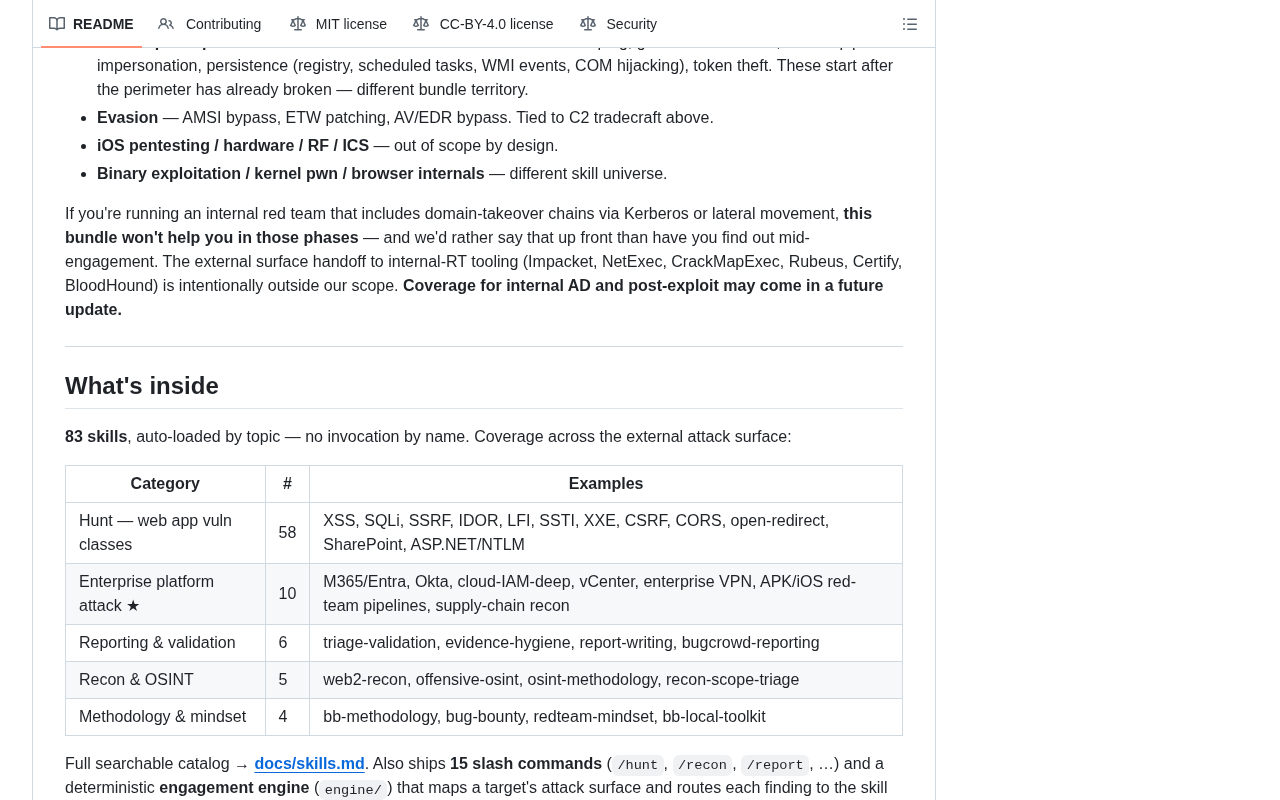
"Patterns from disclosed reports" refers to reusable features extracted from public bug bounty reports (such as HackerOne and Bugcrowd), CVE details, or analyses from security vendors, including vulnerability trigger conditions, common code forms, exploitation chains, and impact scope. Such patterns are essentially a form of knowledge distillation: unstructured report text is converted, manually or automatically, into structured rules or examples and then provided to large models as context. "Core vulnerability categories" usually refer to typical risks in the OWASP Top 10 (such as injection, broken access control, and SSRF). The project claims coverage of 24 categories, meaning its pattern library has been hierarchically classified in terms of breadth. This approach allows the model to "recall" historical cases when analyzing a target rather than relying solely on general reasoning, thereby improving the accuracy and interpretability of vulnerability identification.
Enterprise Identity and Infrastructure Attack Matrix
In addition to vulnerability discovery, the project also includes enterprise identity and infrastructure attack matrices. This part may organize common attack paths in enterprise environments such as Active Directory, cloud identity, and network devices, helping red teamers simulate more complex attack scenarios. Combined with Claude Code's reasoning capabilities, security teams can more systematically assess the security posture of enterprise environments.
Attack Matrix draws on the framework concept of MITRE ATT&CK, organizing an attacker's tactics, techniques, and procedures (TTPs) into tables by phase and platform to facilitate systematic evaluation of the attack surface. In terms of enterprise identity, common targets include Active Directory's Kerberos authentication, Group Policy, and ACL configuration, as well as IAM roles and OAuth authorization in cloud environments; infrastructure covers network devices, VPNs, mail servers, and more. Claude-BugHunter organizes these attack paths into matrices, enabling Claude Code in red team scenarios to suggest possible attack techniques by phase, essentially internalizing a senior penetration tester's "checklist" into the model's workflow.
Project Background and Community Response
Claude-BugHunter was created by developer elementalsouls and is written in Python, making it easy to extend and integrate. Judging from the data, the project is active on GitHub: 6,995 stars and 1,074 forks indicate that it has attracted attention from many security practitioners and AI enthusiasts, and the growth of 98 stars in a single day also shows that its popularity is rising. This attention may stem from the potential of AI in security—using large models to assist vulnerability discovery can lower the barrier to security research and improve efficiency.
Potential Use Cases
For security teams, Claude-BugHunter can be used in the following scenarios:
- Vulnerability discovery assistance: Use the skill library to quickly analyze code or network traffic and identify potential vulnerabilities.
- Red team exercises: Use the attack matrix to plan attack paths and simulate penetration testing in enterprise environments.
- Security knowledge management: Use patterns from disclosed reports as reference material to help security professionals learn about or verify vulnerabilities.
- Task automation: Trigger common operations through slash commands to reduce manual repetitive work.
Conclusion
Claude-BugHunter is an interesting attempt to combine large model capabilities with security practice. Through structured skills and real report patterns, it provides security professionals with a practical assistance tool. Although the project details still require further exploration, its community popularity and design approach are worth noting. As AI is applied more deeply in security, tools like this may become an important part of red team and vulnerability discovery workflows.
One-line Summary
Claude-BugHunter provides Claude Code with 82 security skills and real vulnerability patterns to assist vulnerability discovery and red team work.
Paragraph Summary
Claude-BugHunter is an open-source project for security research that provides a skill package for Claude Code, including 82 skills and 15 slash commands, and catalogs patterns from 681 disclosed reports covering 24 core vulnerability categories, while also integrating enterprise identity and infrastructure attack matrices. Developed in Python, the project has gained about 7,000 stars and more than 1,000 forks on GitHub, with 98 new stars in a single day, indicating strong community interest. The article analyzes its core features such as the skill library, command-based interaction, a pattern library based on real reports, and the attack matrix, and lists application scenarios including vulnerability discovery assistance, red team exercises, security knowledge management, and task automation. Overall, the project is an attempt to combine large model capabilities with security practice and is expected to become an auxiliary tool in red team and vulnerability discovery workflows.
Related articles
Two Cursors: A Hopeful Song About Writing Software with AI
YouTube music video *Two Cursors* uses lyrics to portray AI-assisted programming: from a single cursor to two-cursor collaboration to a three-party debugging scene, offering a hopeful view of conversational collaboration between developers and AI.

No API Key Needed: Manage Your WordPress Site Directly With Your AI
Anti-Manual releases MCP Connector, letting Claude, ChatGPT, Cursor and 14 AI tools manage WordPress without an API Key—draft writing, internal links, SEO audits, broken link checks, reusing existing subscriptions with no extra bills.
Cursor vs Claude Code: Terminal Agents Face Off Against Editor Completion
Cursor vs Claude Code compared: Cursor excels at editor tab completion; Claude Code is a full-repo autonomous terminal agent. Context windows, costs, and use cases.