Claude Can Now Autonomously Review and Fix PRs: Anthropic Launches Claude Ship

Anthropic launches Claude Ship, enabling Claude to review, fix, and approve PRs—AI moves from advisor to executor.
Anthropic has released Claude Ship, enabling Claude to review code changes, locate issues, submit fixes, and ultimately approve pull requests. This marks AI coding tools extending from "giving advice" to "making changes," forming a closed loop for PR handling. The article notes that approval involves responsibility transfer and engineering governance; if mature, it could boost review throughput and shorten feedback cycles, but teams must define which changes AI may handle autonomously. Pricing, supported platforms, CI/CD integration, and liability remain unclear, so validation in low-risk scenarios is advised before relaxing permissions.
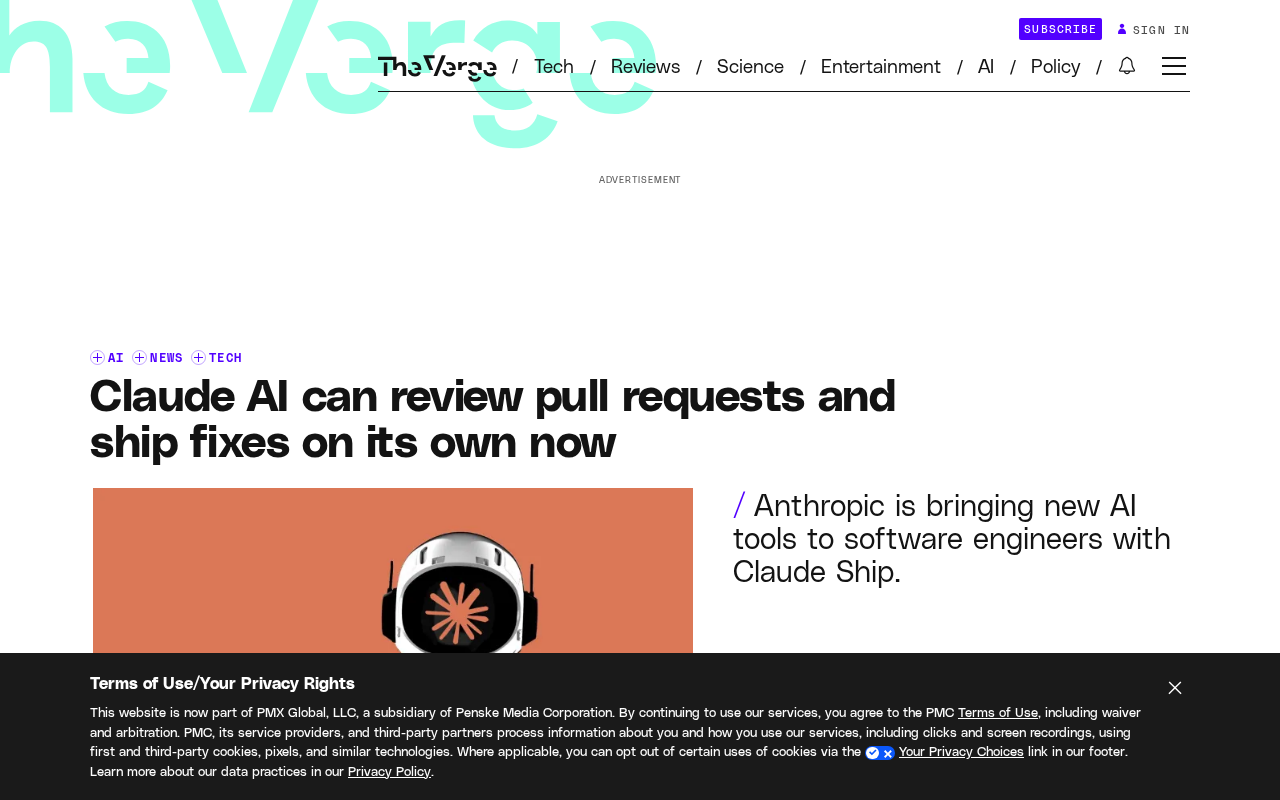
Anthropic is pushing Claude from "an assistant that can write code" toward "a collaborator that can independently carry a code delivery process through to completion." According to an RSS source, Anthropic has released a new product called Claude Ship, which enables Claude to review, fix, and approve pull requests (PRs). This means code review—a step long dependent on humans—is beginning to fall within the scope of autonomous AI execution.
What Claude Ship Actually Does
Based on the available information, Claude Ship's core capabilities revolve around the PR lifecycle: reviewing code changes, locating issues, submitting fixes, and ultimately completing the approval action. The report notes that engineers could previously get help with code review through Claude's Code Review feature, and Claude Ship builds on this by linking "finding problems" and "solving problems" into a single chain.
The significance of this change lies not in any single capability, but in the closed-loop process. Most AI coding tools in the past remained at the "suggestion" level—offering comments, flagging risks, and pointing out refactoring directions, while the final judgment and modification authority stayed with engineers. Claude Ship incorporates the fixing action as well, turning AI from a reviewer into an executor.
Pull Request (PR) is the standard mechanism in distributed version control systems (such as Git) for proposing code changes and requesting merges. After completing modifications on a separate branch, a developer submits the changes to the main branch via a PR, along with descriptions, linked issues, and test results. The PR process typically includes automated CI checks, peer review, discussion and revision iterations, and finally approval and merge by a reviewer with the appropriate permissions. On platforms like GitHub and GitLab, PRs are the core unit of team collaboration and a key gate for code quality and knowledge sharing.
The Leap from "Giving Advice" to "Making Changes"
Code review is widely recognized in software engineering as a high-value, time-consuming activity. It requires reviewers to understand context, assess the impact of changes, identify boundary conditions, and express opinions in a way the team can accept. Having AI take on this work is essentially a test of how deeply models understand code semantics and engineering constraints.
More noteworthy is the "approval" action. In most teams' processes, PR approval means a transfer of responsibility—the approver is accountable for the merge. Giving approval authority to AI touches not only technical issues but also engineering governance and trust boundaries. The report does not disclose the specific design of Claude Ship's permission model or human review mechanisms, which is precisely the part most likely to be questioned during real-world deployment.
CI/CD (Continuous Integration/Continuous Delivery) is a set of automated software delivery practices. Continuous integration requires developers to merge code into the mainline frequently, with each merge triggering automated builds and tests to catch integration errors early; continuous delivery further automates deployment of validated code to production-like environments. CI/CD pipelines are typically deeply integrated with the PR process: after a PR is created, tests, static analysis, and security checks run automatically, and the results serve as the basis for whether merging is allowed. If AI participates in PR review and fixes, it needs to work in concert with these automated checks and avoid bypassing quality gates.
What This Means for Engineering Teams
If this kind of capability matures, the most direct impact will be higher review throughput. Low-risk PRs such as small changes, dependency upgrades, and formatting fixes can move through the process faster, freeing up human reviewers' attention for architectural changes and security-sensitive modifications.
Another layer of impact concerns collaboration cadence. When AI can quickly provide review comments along with fixes after a commit, the cycle in which developers wait for feedback is compressed, and the cost of context switching declines accordingly. But this also brings new requirements: teams need to clarify which changes AI may handle autonomously and which must involve humans—otherwise "automatic approval" could become an exposure to risk.
Questions to Watch
The currently public information is quite limited. Claude Ship's pricing model, the code hosting platforms it supports, how it integrates with existing CI/CD processes, and who is liable when AI fixes introduce new defects have all not been clearly stated. The report itself is merely a product launch announcement, lacking hands-on testing data and user feedback.
For teams planning to try it, a pragmatic approach is to first validate it on low-risk repositories or non-critical paths, observe the quality of Claude's fixes and its false-positive rate, and then decide whether to relax its operating permissions. AI's ability to autonomously handle PRs is worth watching, but before connecting it to real production processes, defining boundaries matters more than the capability itself.
One-line Summary
Anthropic launches Claude Ship, enabling Claude to review, fix, and approve PRs—AI moves from advisor to executor.
Paragraph Summary
Anthropic has released a new product, Claude Ship, which enables Claude to review code changes, locate issues, submit fixes, and ultimately complete the approval action for pull requests. This marks the extension of AI coding tools from "giving advice" to "making changes," forming a closed loop for PR handling. The article notes that the approval action involves a transfer of responsibility and engineering governance, and giving approval authority to AI touches trust boundaries; if the capability matures, it could boost review throughput and shorten feedback cycles, but teams need to clarify which changes AI may handle autonomously. Currently, pricing, supported platforms, CI/CD integration, and liability attribution all remain unclear, so it is advisable to validate in low-risk scenarios before relaxing permissions.
Related articles

ChatGPT Plus Subscription Pitfall Guide: Go/Plus/Pro Tier Comparison and Quick Activation
A complete ChatGPT Plus subscription guide based on a Bilibili tutorial: from registering an account, comparing Go/Plus/Pro tiers, to the practical steps for quickly completing your subscription.

GPT-6.2 Sol/Astra Released! A Step-by-Step ChatGPT Plus Subscription Guide and Tier Comparison
GPT-6.2 Sol/Astra is out—here's a ChatGPT Plus subscription guide: register an account, compare Go/Plus/Pro tiers, and subscribe in a minute.

Comparing Three Channels for Subscribing to GPT Plus in China: Is Website Top-Up the Easiest?
How to subscribe to GPT Plus in China? This article compares website top-up, credit card, and mobile top-up channels—process, cost, and risk—with steps and tips to help you choose wisely.