Claude Code Adds Agent View: A Research Preview for Unified Session Management
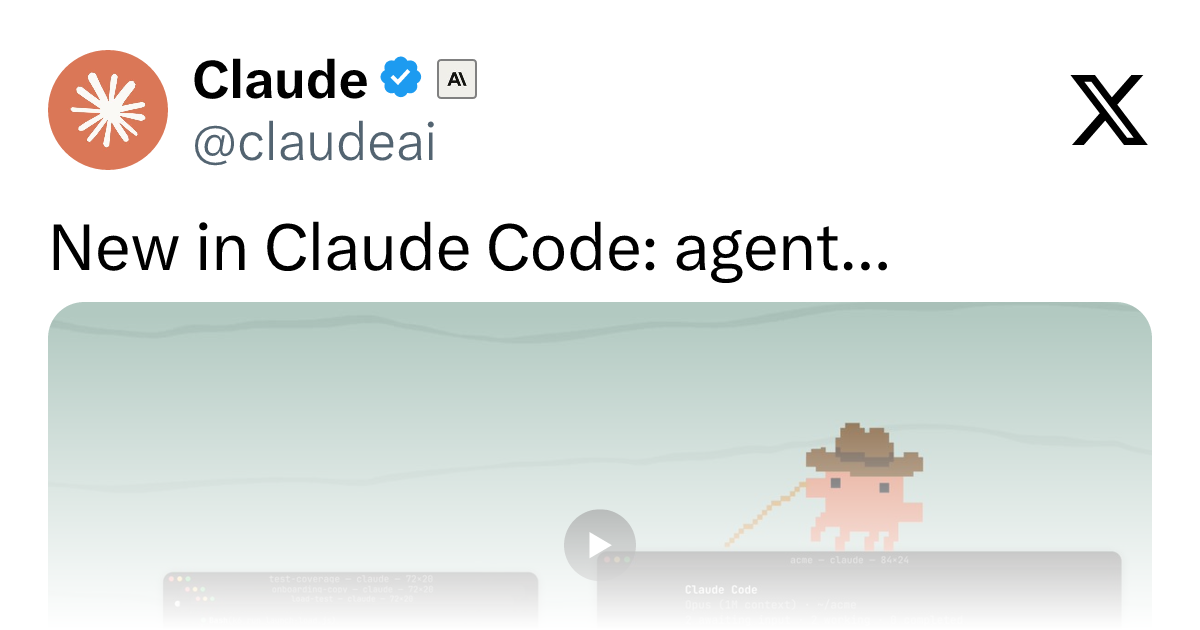
Claude Code's Agent View unifies all sessions in one list, pushing AI coding tools toward multi-task agent orchestration.
Anthropic's AI coding assistant Claude Code has introduced "Agent View," now available as a research preview. The feature consolidates all user sessions into a unified list, enabling developers to manage multiple parallel coding tasks from a single interface — addressing the fragmented workflow caused by constant context-switching. This design reflects the broader shift from single-turn Q&A toward multi-agent orchestration, and signals Claude Code's evolution into a professional developer workbench. As a research preview, the feature is still in early iteration, with interaction details and capability boundaries yet to be fully disclosed.
Claude Code Launches Agent View
Anthropic's coding assistant Claude Code has introduced a new feature called "Agent View," now available to users as a research preview. The core value of this feature lies in consolidating all of a user's sessions into a single unified list, allowing developers to view and manage multiple parallel coding tasks within one interface.
For developers who frequently switch between projects or tasks, session management has long been a pain point. Previously, starting a new coding session often meant jumping between different windows or contexts. Agent View is designed to address exactly this kind of fragmented workflow.
Why a Unified Session View Matters
The way AI coding assistants are used is evolving — shifting from "one-off Q&A" toward "multi-task parallelism." When a developer might simultaneously have AI agents handling code refactoring, bug fixes, documentation generation, and more, the ability to quickly grasp the status of each task becomes critical to productivity.
Agent View aggregates all sessions into a single list, essentially visualizing and centralizing what would otherwise be a scattered set of agent workflows. This design philosophy aligns with the broader "Agent Orchestration" trend that has become central to AI tooling in recent years — as AI transitions from an assistive tool to an autonomous agent capable of executing multi-step tasks, users need something like a "control panel" to oversee the bigger picture.
From a product logic standpoint, this also reflects Claude Code's evolution toward a more mature developer workbench. Purely conversational interaction can no longer meet the demands of complex engineering scenarios, and session-level management capability is a hallmark of professional development tools.
What is Agent Orchestration? "Agent Orchestration" is one of the core concepts in the AI tooling space in recent years. The fundamental idea is that individual AI agents handle specific subtasks, while a higher-level coordination mechanism manages the launching, monitoring, and result aggregation of multiple agents. In a software development scenario, for example, one agent might focus on running tests, another on modifying code, and a third on updating documentation — all running in parallel but interdependent. This multi-agent concurrency model boosts efficiency but also introduces the complexity of state tracking: developers need to know what stage each agent is at, whether it's blocked, and what output it has produced. Agent View attempts to address this through a visual list — essentially providing a lightweight scheduling dashboard for multi-agent workflows.
What "Research Preview" Means
Notably, Anthropic has positioned Agent View as a "research preview" rather than a formal release. This typically signals that the feature is still in early iteration, and that Anthropic is looking to refine the product experience through real-world user feedback.
The research preview strategy is a reasonable one: it lets core users get early access and provide input, while also leaving room to adjust stability and interaction design. For developer tools in particular, workflow-related features need to be validated through actual use, since they directly impact day-to-day productivity.
This gradual release approach is consistent with Anthropic's characteristically measured and pragmatic product cadence. Users should understand that the current version is likely to undergo significant changes.
What is a "Research Preview"? A "Research Preview" is a release strategy commonly used by tech companies — especially in the AI space — and differs from a "Public Beta" or "GA (General Availability)" release. A research preview typically means that the core mechanics of a feature are still being explored, and the product team wants to collect real-world usage data and user feedback to inform future design decisions, rather than simply fixing known bugs. Anthropic used a similar approach when launching Claude itself, gathering user insights through a Limited Access phase. For developers, the experience of a research preview may differ significantly from the final product — API interfaces, data structures, and even core interaction paradigms could undergo fundamental changes before the official release. For this reason, it is not recommended to integrate research preview features into critical production workflows.
Potential Impact on Developer Workflows
If Agent View matures and reaches a full release, it could meaningfully change how developers interact with AI coding tools. Sessions would no longer be fleeting, disposable interactions — they would become traceable, manageable units of work. Developers could return to any past session at any time to review code changes and the AI's reasoning process.
This capability also has implications for team collaboration and knowledge retention — session records serve as a kind of work log, helping developers reconstruct the full chain of task execution for retrospectives.
Since official disclosures are limited at this stage, specifics around interaction details, supported session types, and whether cross-device sync is supported remain unclear. Developers who are interested can try the research preview directly in Claude Code and form their own assessments.
Summary
The Agent View feature in Claude Code marks another step in AI coding assistants' exploration of session management and agent orchestration. While it remains a research preview with limited information available, the underlying product vision — unified management of multiple sessions — is worth watching closely for any developer following the evolution of AI coding tools.
Related articles
No Valid Source Material: A Dad Joke Tweet Cannot Support a Technical Article
The source material provided is an unrelated dad joke tweet with no informational value. A valid technical article cannot be generated. Please provide relevant tech content.
Building a Character Consistency Workflow with Hailuo H3: A T2VA Character Sheet Tutorial
A Reddit creator shares how to build a character consistency workflow using MiniMax Hailuo H3's T2VA/R2VA — from still harvesting to reusable .chars files, with a structured four-view character sheet Prompt.
25 Fields Medalists Issue Joint Statement: AI Is Causing Severe Misalignment in Mathematics
25 Fields Medalists issue a joint statement warning that AI is causing "severe misalignment" in mathematics — and what this means for the broader research community.