Claude Code Best Practices: From Vibe Coding to Agentic Engineering
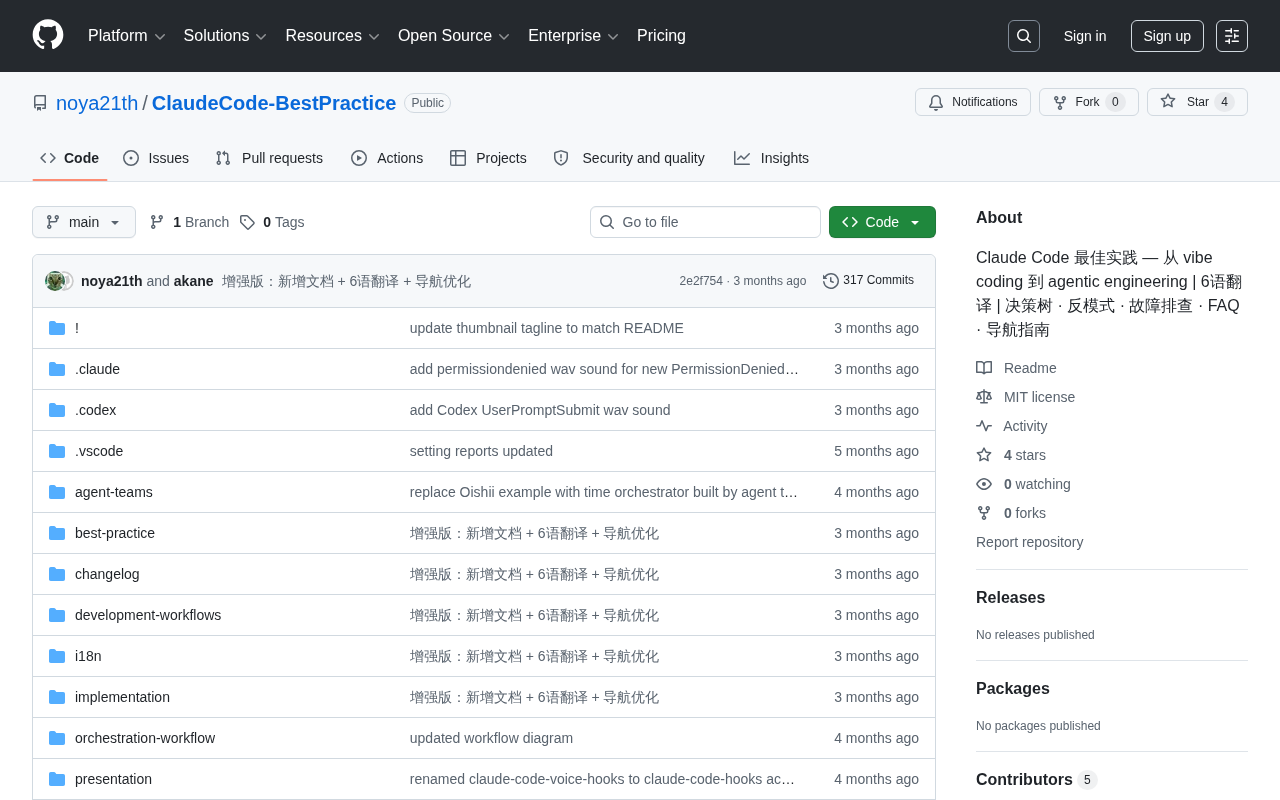
Open-source guide ClaudeCode-BestPractice helps developers move from vibe coding to structured agentic engineering with Claude Code.
The GitHub project `ClaudeCode-BestPractice` is an open-source usage guide for Anthropic's command-line AI tool Claude Code. Its core goal is to help developers graduate from intuition-driven "vibe coding" to structured "agentic engineering." The project covers decision trees, anti-patterns, troubleshooting, and FAQs, presented as an HTML knowledge site with translations in six languages. Still in its early stages with a small community, it's best used as a supplement to official docs — its real value lies in promoting a more disciplined, process-oriented approach to AI-assisted programming.
From Intuition-Driven Coding to Engineered Agent Development
Claude Code, Anthropic's command-line AI programming tool, is reshaping how developers interact with code. The open-source project noya21th/ClaudeCode-BestPractice on GitHub aims to systematically document the methodology behind using this tool. Its core proposition is clear: how to move from "vibe coding" — relying on intuition and improvising as you go — to "agentic engineering," a structured and reproducible approach to AI-assisted development.
Vibe coding refers to the practice of tossing vague requirements at an AI and iterating on the fly, driven more by feel than by plan. This approach works well for rapid prototyping, but tends to fall apart in complex projects — context gets lost, code style becomes inconsistent, and the AI keeps undoing work that's already been done. Agentic engineering, by contrast, treats AI as an engineering collaborator that requires explicit instructions, clear boundaries, and validation mechanisms. Structured processes keep the AI's output stable and predictable.
Claude Code is Anthropic's terminal-native AI programming assistant, launched in 2024. Unlike IDE plugins such as Copilot, it runs directly in the command line, capable of reading and writing files, executing shell commands, calling external tools, and autonomously completing multi-step programming tasks with user authorization. This "agentic" architecture means it doesn't just answer coding questions — it can actively operate on a codebase. That's precisely why it's both powerful and in need of engineering guardrails. Without clear instructions and defined boundaries, its autonomous execution capabilities can produce unexpected side effects: accidentally deleting files, looping through repeated modifications, or drifting far from the original requirements.
What the Project Covers
The repository positions itself as a "navigation guide" covering several key aspects of working with Claude Code. Based on the available information, it consolidates several types of practical resources:
Decision Trees and Anti-Patterns
Decision trees help developers quickly determine the right strategy for a given situation — for example, when to let the AI generate something in one shot versus when to break a task into smaller steps. The anti-patterns section takes the opposite approach, cataloging common mistakes. These "pitfall guides" are often more valuable than prescriptive tutorials, because they map directly to real mistakes developers have encountered in practice.
The concept of anti-patterns originated in software engineering, first introduced by Andrew Koenig in 1995 and later systematized in the book AntiPatterns. It describes solution templates that appear reasonable in context but are actually harmful. In AI-assisted programming, typical anti-patterns include: submitting overly broad requirements to the AI all at once (making output difficult to review), repeatedly appending new requirements without locking down context (resulting in inconsistent code style across the codebase), and over-relying on the AI to self-correct while skipping human validation (causing errors to compound rather than get resolved). Naming and recognizing these patterns helps developers build an early-warning instinct before falling into the traps.
Troubleshooting and FAQ
The troubleshooting and FAQ sections address common issues encountered during day-to-day use. Claude Code, as a command-line tool, involves numerous details around permission configuration, context management, and tool invocation. A systematic troubleshooting reference can significantly lower the barrier to entry for new users.
Localization Across Six Languages
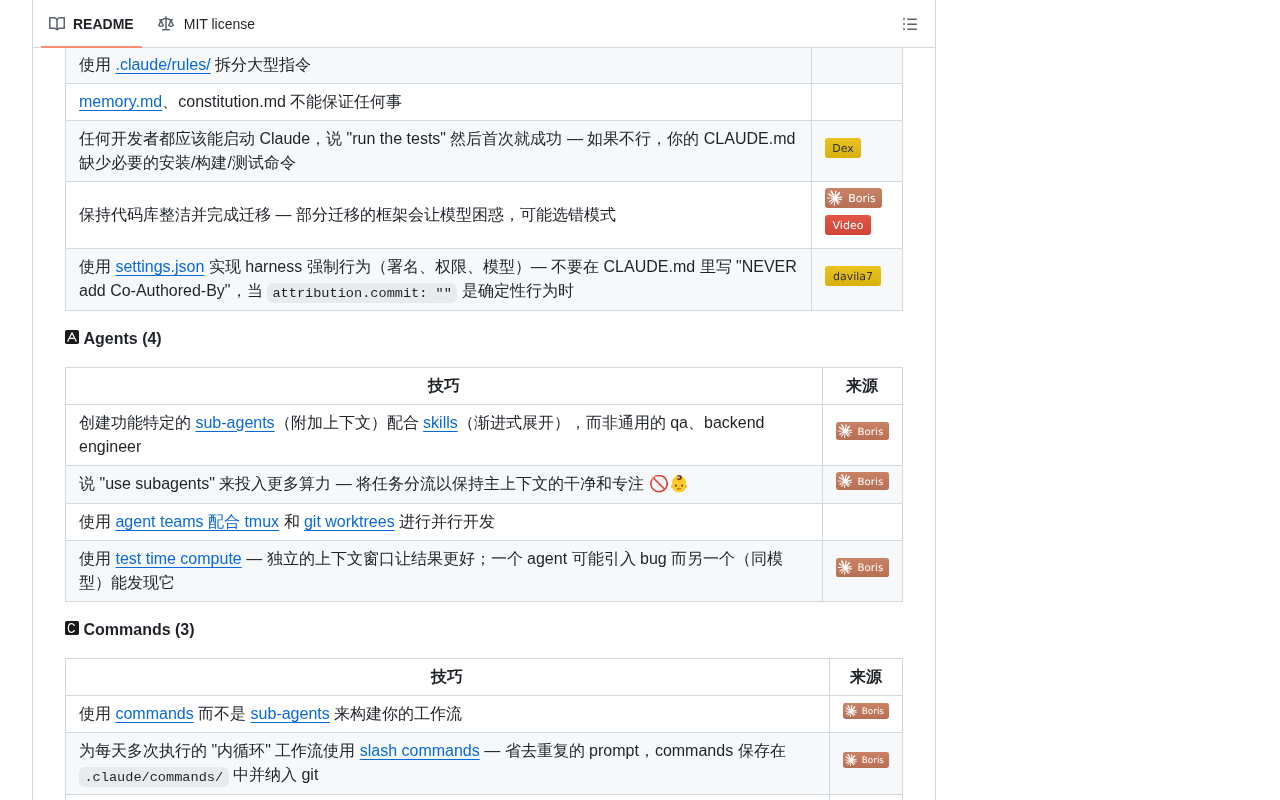
One notable feature is that the project offers translations in six languages. Best-practice documentation for AI programming tools is predominantly written in English, with localization quality varying widely. Multi-language support means non-native English speakers can absorb these insights with much less friction — a meaningful step toward making Claude Code more accessible globally.
The project uses HTML as its primary format, suggesting an intent to build a browsable, navigable knowledge site rather than a simple collection of Markdown documents. This approach delivers a more comfortable reading experience and makes it easier to jump between sections.
How to Think About Community Practice Guides
Looking at the project's metrics, the repository currently has relatively few stars and forks — it's an early-stage community effort. The value of this kind of individually maintained best-practices collection lies in the fact that it often draws from real, frontline experience, capturing edge cases that official documentation never covers.
That said, it's worth keeping perspective: community guides can't match the authority or update cadence of official sources. Claude Code itself iterates quickly, and some practices may become outdated as new versions are released. It's best treated as a supplementary reference alongside official documentation, with developers applying their own judgment based on their specific project needs.
For teams currently using or considering Claude Code, the most valuable takeaway from this guide may not be any specific tip, but the methodological shift it represents — elevating AI programming from a luck-dependent improvisation to an engineered practice with defined processes, validation steps, and reusable patterns. That's arguably the most important step toward maturity in AI-assisted development today.
Summary
ClaudeCode-BestPractice is an open-source navigation guide focused on Claude Code usage methodology. Through modules covering decision trees, anti-patterns, troubleshooting, and FAQs, it helps developers make the conceptual leap from vibe coding to agentic engineering. While the project is still in its early stages with a small community, its systematic approach to organizing real-world experience — paired with multi-language support — offers genuine reference value for developers looking to use AI programming tools in a more disciplined and structured way.
Related articles
Recurrent Looped Transformers: A New Architecture That Teaches Models to "Think Again"
Recurrent Looped Transformers repeatedly apply the same Transformer block to decouple compute from parameters, enabling variable reasoning depth without scaling model size.
"Everyone Else Should Slow Down AI — Except Me": The Double Standard Trap in Big Tech
A viral Hacker News quip — "Everyone should slow down AI, except me" — exposes the double-standard at the heart of the AI race. We unpack why it's a Prisoner's Dilemma, not mere hypocrisy, and why institutions matter more than moral self-discipline.
OWL: An Open-Source Multi-Agent Framework for Real-World Task Automation
OWL (Optimized Workforce Learning) is an open-source multi-agent framework by camel-ai for real-world task automation, with 19K+ GitHub Stars. Learn how it works.