Claude Code Bills Too High? Anthropic's Official Guide Reveals 4 Money-Saving Tips

Four Claude Code cost leaks and fixes based on the official guide
The article summarizes four common reasons Claude Code bills grow faster than expected and their fixes, all from Anthropic's official cost optimization guide. The four leaks: using the expensive Opus model for all tasks; enabling many unused MCP servers; fully loading a large Claude.md every session; and verbose test/log output entering the main conversation. The fixes: switch to Sonnet via /model, disable idle servers in /mcp, migrate workflows to on-demand skills, and delegate verbose tasks to sub-agents that return only summaries. The common logic is reducing unnecessary context consumption; effectiveness varies by project, so review your actual usage patterns first.
Claude Code is Anthropic's coding assistant tool, but many developers are finding their bills growing faster than expected. A short video from YouTube summarized four common cost leak points and offered corresponding fixes. These methods aren't made up—they come directly from Anthropic's official cost optimization guide.
Leak 1: Using Opus for Every Task
Opus is the most capable and most expensive model in the Claude family. Many developers habitually use Opus for all tasks, but this isn't necessary. The video points out that Sonnet is more than enough for most coding tasks, and costs less.
Switching to Sonnet is simple: just use the /model command in Claude Code. For everyday tasks like code completion, refactoring, and debugging, Sonnet's performance is already reliable enough. Opus is only needed for genuinely complex reasoning or architecture design problems.
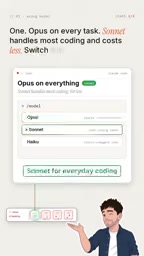
The core logic behind this advice: reserve the most expensive resource for the scenarios that need it most. Tiering model usage by task complexity is the most direct way to control costs.
Leak 2: Enabling MCP Servers You Never Use
MCP (Model Context Protocol) servers extend Claude Code with external tools and capabilities, but every enabled server incurs additional context overhead. If you've enabled many servers but rarely use some of them, those idle servers are continuously draining your budget.
The solution is to disable servers you never use via the /mcp command. The video also mentions a further idea: for some functions, using command-line tools directly is cheaper than going through MCP servers. Command-line tools don't involve additional context loading, so overhead is lower.
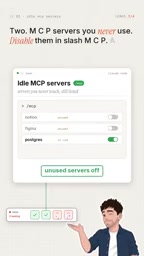
Before configuring an MCP server, ask yourself: does this function really need to be always on? Is there a lighter-weight alternative?
MCP (Model Context Protocol) is an open protocol launched by Anthropic in late 2024, designed to provide AI assistants with a standardized way to connect to external data sources and tools. Before MCP, different AI tools connected to external services in different ways, and developers often had to write separate integration code for each application. MCP unified this interface, allowing file systems, databases, APIs, and other resources to be called on demand by AI clients in the form of "servers." Claude Code extends its capabilities through MCP servers, but every enabled server's tool definitions and descriptions get injected into the model context—even if you never call it, those tokens are still billed. So the number of MCP servers is positively correlated with context overhead, which explains why disabling idle servers directly saves money.
Leak 3: Loading a Massive Claude.md Every Session
The Claude.md file provides project-level context and instructions to Claude Code—coding standards, project structure descriptions, workflows, etc. The problem is that this file is fully loaded at the start of every session, so if the file is large, you're paying for that content in every round of conversation.
The video's advice is to migrate workflows into skills. The key characteristic of skills is that they only load when needed, rather than being fully injected every session. This way, the always-on Claude.md can stay lean, with detailed procedural content handed off to skills triggered on demand.
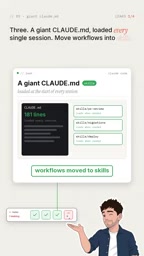
The essence of this approach is distinguishing between "context always needed" and "context needed only in specific scenarios." Keep the former in Claude.md, put the latter in skills, and avoid paying for irrelevant information every session.
Skills are an on-demand capability package mechanism in Claude Code. Unlike Claude.md, which is fully injected at session start, a skill's description is always present but extremely small in size—only when the model determines the current task requires a skill does it load that skill's full content. This "lazy loading" design means that putting lengthy workflows and framework-specific operating steps into skills avoids paying for irrelevant content every session. The criteria are simple: if an instruction isn't used in most sessions, it doesn't belong in Claude.md. Trimming Claude.md down to the core information a project always needs and migrating scenario-specific workflows to skills is a common practice for controlling always-on context.
Leak 4: Test Runs and Logs Flooding the Conversation
Running tests and checking logs are high-frequency operations during development, but their output is often very verbose. If executed directly in the main conversation, the large volume of output enters the context and significantly drives up token consumption.
The solution is to delegate such tasks to a sub-agent. A sub-agent executes tasks in an independent context and returns only a summary result to the main conversation. This way, verbose intermediate output doesn't pollute the main conversation's context, and costs naturally come down.
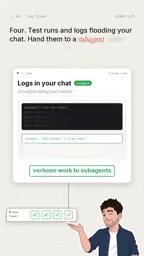
The sub-agent pattern is especially suited for tasks that are "lengthy in process but brief in conclusion"—test runs and log analysis are typical examples.
A sub-agent is a mechanism in Claude Code that executes tasks in an independent context window. The main conversation can delegate a task to a sub-agent, which has its own context. All intermediate output produced during execution—command echoes, test logs, stack traces—exists only in the sub-agent's context and doesn't flow back to the main conversation. Once the sub-agent finishes, only the final summary is returned to the main conversation. Since token billing is based on the actual context length processed, this isolation means verbose intermediate processes don't continuously accumulate in the main conversation and therefore aren't repeatedly billed in subsequent interactions. This is exactly why "lengthy process but brief conclusion" tasks are well-suited to sub-agents.
The Common Logic Behind All Four Leaks
Looking back at these four tips, they all point to the same principle: reduce unnecessary context consumption. Whether it's switching to a cheaper model, disabling idle MCP servers, trimming Claude.md, or isolating verbose output with sub-agents, the essence is controlling the volume and cost of content entering the model's context.
The video emphasizes that these methods all come from Anthropic's own cost guide, not third-party speculation. For developers using Claude Code, spending a few minutes reviewing your configuration could significantly lower your bill while maintaining the same work output.
Note that the effectiveness of these tips varies by project. Model choice depends on the distribution of task complexity, and the optimization potential for MCP and skills depends on how redundant your current configuration is. It's recommended to first examine your actual usage patterns, then apply these methods in a targeted way.
Related articles

A 19-Year-Old's Rental Horror Story: Ceiling Collapse, Bug Infestation, and the Lessons It Taught Me
At 19, my first off-campus rental brought bug infestations, no heat, a collapsed ceiling, and a ruined laptop with no renter's insurance. Here are the hard-won lessons for first-time student renters.

Veda Nurse's Cranial Nerve Exam: Why ASMR Role-Play Is Going Viral
Bilibili creator Veda's cranial nerve exam ASMR video goes viral, blending humor and sensory triggers through nurse role-play. This article analyzes its unique appeal and the audience psychology behind ASMR role-play.

LG Cinebeam AI Review: 120-Inch Giant Screen + 3000 Lumens, a New Choice for the Living Room Theater
LG Cinebeam AI projector review: 3000 ANSI lumens, 4K, 100 inches from about 8 cm and 120 inches from about 18 cm. Built-in webOS, AI Concierge voice recommendations, AI Sound Pro 11.1.2 virtual surround, and Game Optimizer—positioned for fixed living room installation, complementing the portable Cinebeam S.