Claude Code Health Mod: Do a 5-Minute Stretch While Waiting for AI
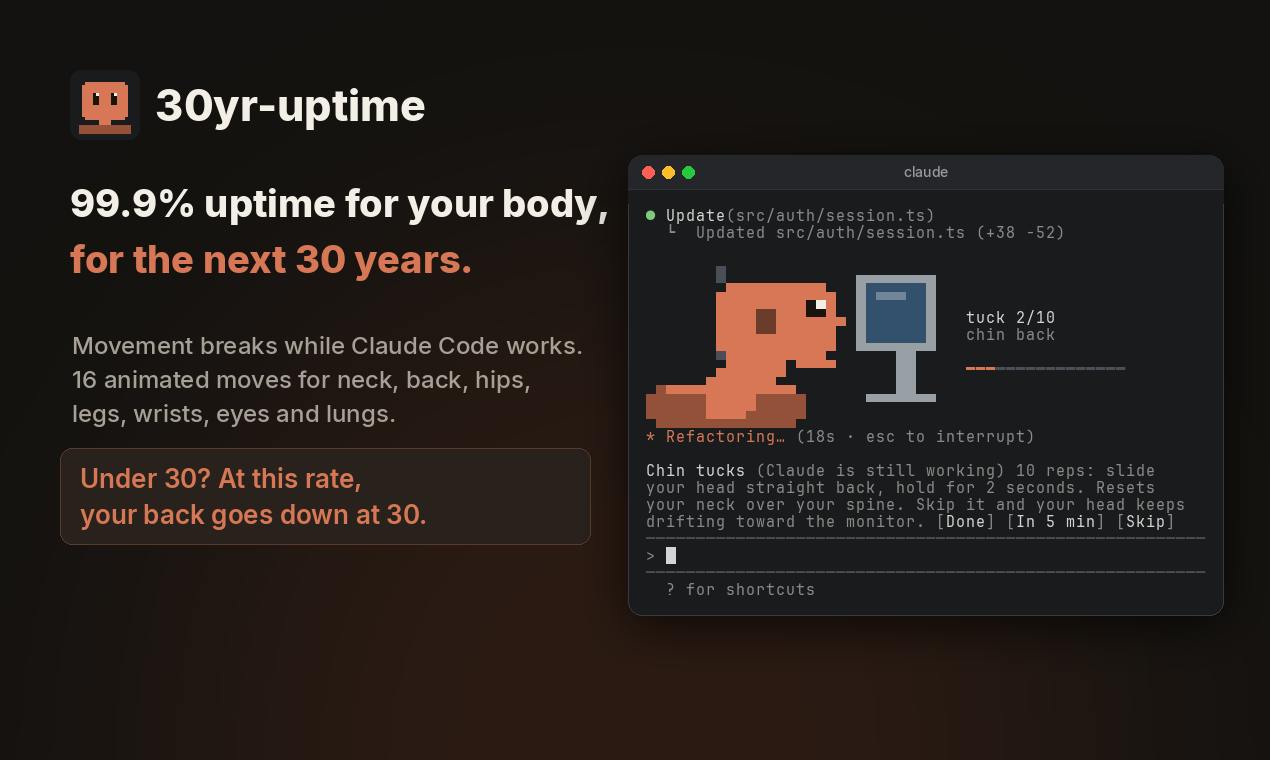
A Claude Code mod turns gaps spent waiting for AI into stretch reminders every 45 minutes.
30yr-uptime is a health reminder mod for Claude Code developers, targeting the fragments of time spent waiting for a turn to complete after submitting an AI request. Every 45 minutes, when a Claude Code turn runs for more than 15 seconds, a pixel-art character pops up to demonstrate a stretch from a library of 16 movements covering the neck, back, hips, legs, wrists, eyes, and lungs. Users can choose Done, In 5 min, or Skip. The mod runs locally with zero token consumption, doesn't call AI interfaces, adds no cost, and doesn't transmit data externally. It received 61 votes on Product Hunt and ranked 20th for the day, suited to developers who use Claude Code for long periods—though its effectiveness depends on whether users actually perform the movements.
Developers spend long hours sitting in front of screens waiting for AI responses, often for tens of minutes at a time. A Claude Code mod called 30yr-uptime has appeared on Product Hunt, turning that waiting time into an opportunity to move your body. The project's tagline is blunt: "Claude Code mod for taking care of your body."
What problem it solves: wasted fragments of time spent waiting for AI
Anyone using Claude Code has had the same experience: after submitting a complex request, you wait for the model to think, generate, and execute. This can take anywhere from a few seconds to dozens of seconds, while you remain glued to the screen. 30yr-uptime's logic is that rather than waiting idly, you might as well use these fragments of time to stretch your neck, lower back, and wrists.
The mod received 61 votes on Product Hunt, ranking 20th for the day and listed under three categories: health & fitness, productivity, and developer tools. Its design approach isn't complicated, but it captures a real yet often overlooked detail of the AI programming workflow.
Claude Code is Anthropic's command-line AI programming assistant, and it works in "turns": after a user submits an instruction, the model thinks, calls tools, reads and writes files, and generates a response, and this complete process constitutes one turn. A single turn on a complex task (such as refactoring a module or making cross-file changes) can last dozens of seconds or longer, during which the developer can typically only wait, because subsequent instructions depend on the result of the current turn. This state of "human in the loop but temporarily with nothing to do" is exactly the time window 30yr-uptime targets.
Trigger mechanism: 45-minute interval and 15-second timeout
30yr-uptime's operating rules are clear: every 45 minutes, when a Claude Code turn runs for more than 15 seconds, the mod pops up a pixel-art character demonstrating a set of stretches. The movement library contains 16 exercises covering the neck, back, hips, legs, wrists, eyes, and lungs.
Users have three options: mark as done (Done), remind again in 5 minutes (In 5 min), or skip (Skip). This interaction design leaves the decision to the user and doesn't forcibly interrupt the workflow.
The 45-minute interval is worth noting. It's close to the "stand up and move every hour" advice commonly cited in sedentary-behavior research, but it isn't a rigid timer—it only triggers when an AI turn actually exceeds 15 seconds, avoiding frequent interruptions during quick interactions.
Sedentary behavior research (such as WHO guidelines on physical activity and sedentary behavior) generally recommends that adults reduce continuous sitting time and stand up and move for a few minutes every 30 to 60 minutes to relieve neck and lower-back strain and improve blood circulation. Programmers, who face screens for long periods, are at particularly high risk of forward head posture, lumbar disc pressure, and carpal tunnel syndrome. The 45-minute reminder interval falls within this recommended range, while the 15-second trigger threshold ensures intervention only when the user is genuinely in a "waiting state," avoiding frequent disruptions.
Technical highlights: local execution, zero token consumption
The official description emphasizes two points in particular: local execution and zero token consumption. This means the mod itself doesn't call any AI interface, doesn't add usage costs, and doesn't send health data or usage habits to external servers.
For developers who care about privacy and cost, these two features lower the barrier to trying it. A health reminder tool that consumes tokens or makes network requests every time it triggers would be hard to use long-term. 30yr-uptime chooses to handle all judgment and display entirely locally, which is a reasonable engineering choice.
In the context of AI programming tools, a token is the basic unit of measurement for text processed by a model, and API calls are billed by the number of input and output tokens. "Zero token consumption" means the mod's trigger logic and animation display are handled entirely by local code, sending no additional requests to the model, so it incurs no cost and doesn't occupy the model's context window. By contrast, if the reminder logic depended on calling an AI interface, it would not only increase costs but could also interfere with an ongoing programming turn. Local execution also means health data and usage habits never leave your machine, lowering privacy risk.
Pixel-art style and low-friction design
As the screenshot shows, reminders appear as pixel-character animations in a relaxed style. The 16 movements cover the areas programmers most commonly strain: forward head posture, lower-back stiffness, repetitive wrist strain, and eye fatigue. Including lung stretches shows the designers considered not just musculoskeletal issues but also breathing and relaxation.
The core of this design is reducing friction. If the reminder were a serious health pop-up, users would be more likely to resist it; the pixel-character format makes the intervention feel lightweight, and the three buttons—Done / In 5 min / Skip—are simple enough that no learning curve is required.
"Friction" in product design refers to the cognitive and operational cost a user must pay to complete an action. A common failure mode for health reminder tools is excessive friction: serious pop-ups, cumbersome operations, no way to postpone—and users quickly choose to close or uninstall them. 30yr-uptime minimizes the cost of a single interaction through the light visual style of pixel animations and the short-path options of Done / In 5 min / Skip, thereby increasing the likelihood of long-term retention.
Who should use this mod
30yr-uptime is aimed at developers who use Claude Code for long stretches. If you spend a lot of time each day waiting for AI turns, this mod essentially turns passive waiting into active rest. If you don't use Claude Code frequently, or each request completes quickly, there will be far fewer trigger opportunities.
Interestingly, the effectiveness of such tools depends on whether users actually perform the stretches. The mod itself is only responsible for reminding, not for tracking the quality of the movements. It's more reasonable to treat it as a low-cost health nudge rather than a complete health management solution.
The project was published by MamRez Manesh, with the official link pointing to its Product Hunt page. Developers who want to try it can find the relevant code on GitHub and install it locally.
Conclusion
30yr-uptime is a small, specific tool that provides health interventions during the waiting gaps in AI programming scenarios. Its value lies not in technical complexity but in turning an easily overlooked behavioral context—waiting for an AI response—into a trigger for physical activity. Its 61 votes and 20th-place ranking for the day show that at least some developers endorse this approach.
One-line Summary
A Claude Code mod turns gaps spent waiting for AI into stretch reminders every 45 minutes.
Paragraph Summary
30yr-uptime is a health reminder mod for Claude Code developers, targeting the fragments of time spent waiting for a turn to complete after submitting an AI request. Its trigger rule: every 45 minutes, when a Claude Code turn runs for more than 15 seconds, a pixel-art character pops up to demonstrate a stretch, with a library of 16 movements covering the neck, back, hips, legs, wrists, eyes, and lungs. Users can choose Done, In 5 min, or Skip, keeping the decision in their own hands. The mod runs locally with zero token consumption, doesn't call AI interfaces, adds no cost, and doesn't transmit data externally. The product received 61 votes on Product Hunt and ranked 20th for the day. It's suited to developers who use Claude Code for long periods, but its effectiveness depends on whether users actually perform the movements.
Related articles

The Gemini 4 Trio and 3.8 Flash: A Full Comparison of Positioning, Pricing, and Benchmarks
A comparison of Gemini 4 Neon, Carbon, Argon, and Gemini 3.8 Flash: positioning, context, API pricing, Artificial Analysis and Arena benchmark scores, and available entry points.

AI Coding Model Leaderboard: Opus 5.5 Crowned, Gemini Neon Stages a Comeback
Tech blogger Matthew Berman releases an AI coding model tier list: Claude Opus 5.5 holds S-tier, Gemini Neon surprises with A-tier, OpenAI Astra lands B-tier. How do open-source models like DeepSeek fare? We break down the scoring logic and practical takeaways.

New Jersey Joe Sandwich: Meat and Coleslaw on Triple-Decker Rye
New Jersey Sloppy Joe isn't a ground beef burger—it's triple-decker rye bread with meat, Swiss cheese, and coleslaw, plus Russian dressing. Learn the authentic Essex County method and family recipe.